Living well with osteoporosis means building a rhythm you can keep for years, not a burst of effort you abandon by spring. The core is a weekly loading session strong enough to make bone adapt, protein and calcium at the recommended levels, a daily walk, short balance practice, sleep, and a medication routine that never lapses. Around that core: a fall-proofed home, a few travel habits, a yearly check-in with your physician, and a follow-up DEXA every 12 to 24 months so you can see the plan working. At OsteoStrong Austin and Georgetown, the weekly session is the anchor the rest of the rhythm hangs on.
The long game starts after the first month
The first weeks after a diagnosis are loud: appointments, searches, a prescription decision. We wrote the day-after roadmap for exactly that stretch.
This article is for what comes next: the quiet years after the urgency fades, when the plan either becomes part of your life or falls off the calendar. Living well with osteoporosis is not a sprint. It is a rhythm, and rhythms are won or lost on how easy they are to keep.
What does living well with osteoporosis actually look like?
It looks ordinary, which is the point. A woman living well with osteoporosis still travels, gardens, and picks up the grandchild who runs at her in the driveway. The difference is underneath: a plan running in the background that keeps her bone, muscle, and balance ahead of the fall that would otherwise change everything.
Four things have to be true:
- Her skeleton gets a real signal. Bone adapts to load above roughly 4.2 times body weight (Deere et al., 2012). Walking, swimming, and most weight-room routines never get there, which is why so many diligent women watch their DEXA slide. Osteogenic loading reaches that threshold safely; the four-pillar non-drug osteoporosis plan explains where it sits alongside nutrition, balance, and physician care.
- Her skeleton gets the raw materials. Protein at every meal, calcium 1,200 mg per day from food first (women 51 and older), vitamin D 600 to 800 IU depending on age, per the NIH Office of Dietary Supplements.
- Her balance stays ahead of her bones. The CDC reports about 1 in 3 adults over 65 falls each year. Most fractures start with a fall, so reaction time and single-leg balance are half the plan.
- She can see it working. A number that moves every week, and a scan that confirms it every year or two.
A weekly rhythm you can keep for years
This is the template we hand new members at our Austin and Georgetown centers. Adjust the days; keep the shape.
| Day | Anchor habit | Why it earns its spot |
|---|---|---|
| One fixed day | OsteoStrong session, about 15 minutes, coach beside you | The only item on the list that loads bone above its adaptation threshold; force output is measured every visit |
| Every day | Protein at each meal, calcium from food, vitamin D as directed | Raw materials; bone cannot build what you do not supply |
| Every day | A walk, 20 to 30 minutes, outside when you can | Heart, mood, sleep, and leg strength; walking maintains muscle but does not build bone on its own |
| Two or three short slots | Single-leg balance at the kitchen counter, heel-to-toe walking down the hall | Reaction time and balance are trainable at any age and are what catch you mid-fall |
| One fixed slot | Medications, if prescribed, on the same day and time each week or month | Oral bisphosphonates have strict timing rules; Prolia has a six-month calendar that must not slip |
| Once a month | Measure your height, same time of day, same wall | Height loss is one of the earliest visible signs of vertebral compression |
Notice what is not on the list: hours of exercise, a new identity, anything that requires courage. The plan you keep for ten years beats the one you abandon in March. For the exercise side, including what to modify, see how to stay active and exercise safely with osteoporosis.
Your long-term bone health maintenance plan
The weekly rhythm handles the days. A maintenance plan handles the years. Put these on the calendar once.
- Every 12 to 24 months: follow-up DEXA, on the same machine as your baseline whenever possible, because DEXA changes only count when they exceed the scanner's least significant change (typically 3 to 5 percent depending on site and machine). Medicare covers a screening DEXA every 24 months for eligible people. Our post on how often you need DEXA scans to monitor treatment covers the intervals.
- Once a year: physician review. Bring your DEXA, your force-output trend, and your medication list. Ask what "working" should look like on the next scan so you have a benchmark.
- Once a year: labs. Vitamin D at minimum; many physicians target a 25-hydroxyvitamin D level of at least 30 ng/mL.
- Once a year: eyes and ears. Vision and hearing changes raise fall risk.
- Every few years with your physician: the duration question. Bisphosphonates are often reassessed after 3 to 5 years. Anabolics run a defined course. Prolia needs a physician-planned exit before the last injection, never a lapse. "Done" should mean a plan that keeps bone after the prescription ends, which is what the weekly rhythm is for.
Medication routines that stick
If your physician has prescribed something, the plan's job is to make it effortless to follow. Oral bisphosphonates have strict rules (empty stomach, plain water, stay upright afterward) that exist so the drug absorbs without irritating the esophagus; tie the dose to a weekly anchor you never miss. Prolia runs on a six-month calendar, and stopping it without a physician's follow-on plan is documented to cause rebound bone loss, so put the next injection on the calendar the day you get this one. Any change is a decision for you and your physician. The plain-English guide to osteoporosis medications explains what each class does.
Home, travel, and the habits that quietly erode bone
Bone density is only half of fracture risk. The other half is the fall itself, plus the slow erosions that add up over a decade.
Fall-proofing at home and on the road
At home: night-lights from bed to bathroom, no loose rugs, grab bars where you already reach for the towel bar, shoes with grip instead of socks on hard floors, and everyday pans moved out of the overhead cupboard so you are not twisting under load. Our fall prevention and balance training in Austin page covers the training side.
Traveling: a rolling bag light enough to lift without a heave, a room near the elevator, a night-light in the unfamiliar room, and a look at the shower floor before you step in. Keep medication timing on home time if the drug has strict rules, and book your loading session for the week you return.
The slow erosions to name
- Sleep. Poor sleep raises fall risk the next day and disrupts the hormones that regulate bone turnover.
- Alcohol. Moderate is fine for most people. Heavy drinking costs bone directly, raises fall risk, and is a FRAX input.
- Smoking. No safe amount. Quitting helps at any age.
- Crash dieting. Rapid weight loss on low protein starves the skeleton. Keep protein high; if you take a GLP-1 medication, read Ozempic and your bones.
- Sitting. Long unbroken hours seated are the opposite of a loading signal. Move every hour.
How do you know the plan is working?
Long-term plans die of boredom. The cure is feedback.
- Force output, every session. At OsteoStrong, each of the four devices reports the force you produced, so you leave every week with a number to compare against last week. How to know your bone training is working before your next DEXA explains why this is the most motivating number most members have.
- Single-leg balance. Time yourself at the counter once a month.
- Grip strength. The jar test counts; grip is a well-validated marker of overall strength and longevity.
- Height. Once a month.
- DEXA. Every 12 to 24 months, and re-scan regardless of how you feel; member scans are performed by independent imaging providers, not by us.
The members who made it a rhythm
Among members who follow the weekly protocol and complete a follow-up DEXA, 8 out of 10 see measurable improvement; consistency and starting point are the two biggest factors. These three built the rhythm and kept it.
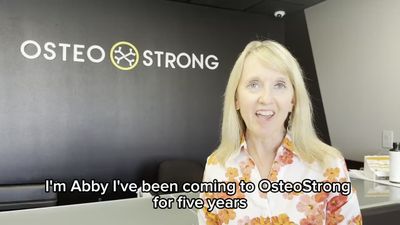
Abby: five years, two follow-up DEXAs, both up
Spine +4% at her first follow-up DEXA, +11% at her most recent, over five years of weekly sessions
Abby is the long game. A first gain most people would have coasted on, and then, because she kept the weekly rhythm, a bigger one.
"Two years ago I had a 4% increase in my spine, and a couple months ago I had an 11% increase in my spine, so I'm thrilled."
Verbatim from Abby's on-camera testimonial. Full case study.

Rebecca: the jar opens again
Could not open jars; can again after a year of weekly sessions
Living well is measured in kitchens as much as on scans. Rebecca got her grip back.
"I've gone from not being able to open jars, which was very frustrating, to actually being able to open them again."
Verbatim from Rebecca's on-camera testimonial. Full case study.

Karen: a whole-body benefit from the same weekly session
A1C 6.1 to 5.8 in six months, alongside the everyday changes she was already making
The rhythm pays dividends beyond bone. Karen paired sessions with everyday changes and watched a metabolic number move.
"My A1C went from 6.1 to 5.8."
Verbatim from Karen's on-camera testimonial. Full case study.
The bottom line
Living well with osteoporosis is not about being careful. It is about running a small, repeatable plan in the background so you can stop being careful: one real loading session a week, the raw materials every day, balance practice at the counter, a home that does not trip you, and numbers you can watch move. Keep the rhythm for years and the scan, the jar, and the grandchild take care of themselves.
Want help building a rhythm you can actually keep? Book a free Bone Health Roadmap Call, bring your DEXA and your calendar, and we will walk through it with you.
Full case studies referenced in this article
- Abby: spine +4% at first follow-up, +11% at most recent DEXA, five-year member
- Rebecca: grip strength restored, opening jars again after one year
- Karen: A1C 6.1 to 5.8 in six months
Browse the full case studies hub or read the verification standard behind every story above.
This article is for general education and is not medical advice. Talk to your own doctor before starting, stopping, or changing any medication, supplement, or exercise program, especially if you have a diagnosis of osteopenia or osteoporosis.
Your simple plan from here
- Book your free Bone Health Call. 15 minutes, phone or Zoom, no pressure.
- Come in for a guided first session. A coach walks you through all four devices.
- Track your strength week after week. 15 minutes, once a week. The numbers rise.
Frequently asked questions
Can you live a normal life with osteoporosis?
Yes. Osteoporosis is a bone density measurement, not a limit on your life, and most women who manage it well keep traveling, gardening, dancing, and lifting grandchildren for decades. Living well with osteoporosis comes down to a weekly rhythm you can keep for years: a loading signal strong enough to make bone adapt, protein and calcium at recommended levels, daily walking, balance work, and a follow-up DEXA every 12 to 24 months so you can see the plan working.
What is a good weekly routine for someone with osteoporosis?
One weekly osteogenic loading session (about 15 minutes at OsteoStrong), protein at every meal, a daily walk, two or three short balance practices, and one fixed slot for medications if you take them. Add a monthly height check and a yearly review with your physician. The routine is deliberately small, because the plan you keep for ten years beats the ambitious one you abandon in March.
What should you avoid if you have osteoporosis?
The habits that quietly cost bone: smoking, more than moderate alcohol, crash dieting that starves the skeleton of protein, and long stretches of sitting. Skip forward bending under load and loaded twisting. Do not skip follow-up scans, and never stop Prolia (denosumab) without your physician's exit plan, because rebound bone loss after stopping is well documented. Our post on what never to do with osteoporosis goes deeper.
How do I keep track of whether my osteoporosis plan is working?
Use several clocks. DEXA is the slow one, every 12 to 24 months, and only changes larger than the scanner's least significant change (roughly 3 to 5 percent) count. Between scans, watch the fast numbers: force output measured every session at OsteoStrong, single-leg balance time, grip strength, and your height once a year. When the fast numbers climb steadily, the slow one usually follows.
How do I travel safely with osteoporosis?
Pack lighter than you think you need and use a rolling bag so you are never hoisting a heavy suitcase overhead. Wear shoes with grip, ask for a room near the elevator, keep a nightlight on in unfamiliar rooms, and keep your medication schedule on your home time zone if the timing matters (oral bisphosphonates in particular). Book your loading session for the week you get back so the rhythm never breaks for more than a week or two.
Does OsteoStrong replace my osteoporosis medication?
No. Medication works on bone chemistry; osteogenic loading delivers the mechanical signal bone is designed to respond to, and the two work on different pathways. More than 100 Austin-area physicians refer patients to OsteoStrong alongside their prescriptions. Any change to a medication is a decision for you and your physician, and Prolia in particular must never be stopped without a physician's follow-on plan.