How often you need DEXA scans to monitor treatment depends on what you are monitoring. For screening, USPSTF recommends a DEXA for all women at 65 and earlier with risk factors, and Medicare covers a screening scan every 24 months for eligible people. For monitoring an active osteoporosis plan, most physicians rescan every 12 to 24 months, on the same machine, and only call a change real when it exceeds the scanner's least significant change, usually about 3 to 5 percent. Sooner than 12 months rarely shows anything, because bone remodeling takes months to appear on the image. At OsteoStrong Austin and Georgetown, members track force output every week between scans, so the DEXA confirms a trend they already watched build.
Screening and monitoring are two different questions
You have probably heard two different answers to "how often should I get a DEXA?" and both are right. They answer different questions.
Screening asks whether you have low bone density at all. USPSTF recommends a screening DEXA for all women at 65, and earlier with risk factors like a parental hip fracture, long-term steroid use, or early menopause.
Monitoring asks whether the plan you are on is working. Once you have a diagnosis and a treatment plan, whether that is medication, osteogenic loading, nutrition, or all three, the follow-up scan exists to compare against your baseline. Its timing is set by biology, not by the calendar on the wall.
If your question is whether an ultrasound-based REMS scan can fill the gap between DEXAs, we covered that in REMS scans vs DEXA for tracking bone density. This article is about the DEXA interval itself, and what to do with the months in between.
How often do you need DEXA scans to monitor treatment?
For most women on an active osteoporosis plan, the answer is every 12 to 24 months, and closer to 24 for most.
Here is why. Your skeleton is remodeled in cycles: osteoclasts clear out old bone, osteoblasts lay down new bone, and that new bone then mineralizes over the following months. A DEXA only picks up mineral that has already hardened. Rescan at six months and you are photographing a construction site before the concrete has set.
Rescan at 12 months and you may see the first real movement, especially in the spine, which tends to respond before the hip. Rescan at 18 to 24 months and the hip and femoral neck have had time to show what they are doing. That is why so many of the follow-up intervals on our results page land at 15 to 18 months.
When a 12-month scan is justified
A shorter interval makes sense when the stakes or the pace are higher. Physicians commonly move to 12 months when:
- You have just started an anabolic medication (Forteo, Tymlos, or Evenity), which acts faster than the antiresorptive classes and runs for a fixed course.
- You take long-term glucocorticoids such as prednisone, which can drive loss quickly.
- Your last scan showed a steep drop, or you had a fragility fracture while already on treatment.
- You have a condition that accelerates bone loss, such as hyperparathyroidism, malabsorption, or certain cancer treatments.
- Your physician wants an early checkpoint before deciding whether to continue, switch, or add something.
Outside those situations, an earlier scan mostly adds anxiety without adding information. Ask your physician which bucket you are in.
What Medicare covers, and when sooner is allowed
Medicare covers a screening DEXA every 24 months for eligible people, which is where "every two years" comes from. A scan sooner than that can be covered when your physician documents medical necessity, for example to monitor an osteoporosis medication or to check on long-term steroid therapy. Private plans have their own rules, and some require a referral or prior authorization even at 24 months.
Before you schedule, ask your physician's office to confirm the coverage reason they are submitting, and check your own plan. Paying out of pocket is also possible if you want a scan sooner than coverage allows; we listed local imaging options in our guide to getting a DEXA scan in Austin.
Why does the follow-up scan need to be on the same machine?
Two DEXA machines from different manufacturers, or even the same model at two different imaging centers, do not produce interchangeable numbers. Calibration differs, software differs, and the way the technologist positions your hip and spine matters more than most patients realize. That is why physicians who take monitoring seriously ask for:
- The same machine, or at least the same make and model at the same facility.
- The same sites, meaning the lumbar spine (usually L1 to L4) and the same hip, not the opposite one.
- The same positioning, which is the technologist's job, and a reason experienced DEXA centers matter.
- A report that gives bone mineral density in grams per square centimeter, not only the T-score, because percent change is calculated from that BMD number.
If you do change machines, keep both reports and bring them together; the comparison is still possible, just less precise. Our free DEXA report guide shows where each number lives on the page.
What is least significant change on a DEXA?
Every DEXA machine has a measurement wobble. Scan the same person twice in an afternoon and you will not get identical numbers. Imaging centers quantify that wobble as the least significant change, or LSC, and it typically lands around 3 to 5 percent depending on the site and the machine.
The rule is simple: a change smaller than the LSC is not yet a change. A 2 percent spine gain at 12 months could be real and could be noise. A 5 percent gain at 18 months has cleared the bar. This cuts both ways, which is good news on the day a follow-up shows a tiny dip: that is probably noise too.
Ask your imaging center for its LSC at the spine and the hip, so you know the threshold before you read the next report. For the language around the scores themselves, see what your DEXA T-score actually means.
How to monitor progress between scans
Bone density is a lagging indicator. The things that predict where your DEXA is heading are measurable every week, and they move first.
At our Austin and Georgetown centers, every session records force output on all four devices: how many pounds of force your skeleton produced against the machine at your strongest joint angle. Those numbers climb week over week in members who show up consistently, long before a DEXA can show anything. We explained how to read that trend in how to know your bone training is working before your next DEXA.
Between scans, the trend line to watch has three parts:
- Force output. Rising force means rising load on bone. Load above roughly 4.2 times body weight is the threshold the osteogenic loading literature associates with bone adaptation (Deere et al., 2012).
- Balance. Single-leg stand time and how quickly you recover from a stumble are trainable, and they change fracture risk directly by lowering fall risk. Our fall prevention and balance training program tracks both.
- Grip strength. It tracks overall strength and takes seconds to test; see grip strength as a mortality predictor for why physicians watch it.
None of these replace the DEXA. Member DEXA scans are performed by independent third-party imaging providers, not by OsteoStrong, and we encourage every member to rescan on schedule regardless of how they feel. Feeling stronger is a signal. The scan is the proof.
Two members who let the calendar do its job
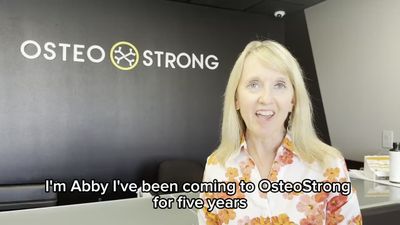
Abby: two follow-up DEXAs, both up
Spine +4% at her first follow-up DEXA, +11% at her most recent, across five years of weekly sessions
Abby did not rescan every few months hoping for a headline. She waited out the interval, saw a 4 percent spine gain that cleared the noise, kept showing up, and waited for the next one.
"Two years ago I had a 4% increase in my spine, and a couple months ago I had an 11% increase in my spine, so I'm thrilled."
Verbatim from Abby's on-camera testimonial. Full case study.

Diane: the first improvement in many years
Spine +5% on her most recent DEXA, the first improvement in many years
Diane, in her 70s, had years of follow-up scans that told the same story. A 5 percent spine gain clears a typical LSC comfortably, which is why her physician treated it as real.
"My spine improved by 5%, the first time in many, many years I saw that great of an improvement. My doctor was over the moon."
Verbatim from Diane's on-camera testimonial. Full case study.
Setting up your next scan for a fair comparison
A short checklist that makes the follow-up worth the wait:
- Book the same facility and, if possible, the same machine as your baseline.
- Ask for BMD in grams per square centimeter and the percent change from your prior scan.
- Ask the center for its LSC at the spine and hip.
- Bring your prior report so your physician compares like with like.
- Put the next scan date on the calendar now, at the interval your physician sets.
- Keep the appointment whether you feel great or discouraged.
Among OsteoStrong members who follow the weekly protocol and complete a follow-up DEXA, 8 out of 10 see measurable improvement. The two biggest factors are consistency and starting point, and both are visible in the force output data long before scan day. Our session protocols are reviewed on an ongoing basis with the physicians who refer to us, and more than 100 Austin-area physicians do. See how a session works on our how it works page, and where loading fits alongside a physician's plan in our guide to drug-free osteoporosis treatment in Austin.
The bottom line
Screening DEXAs run on a 24-month rhythm. Monitoring DEXAs run every 12 to 24 months because that is how long remodeling takes to show up, with 12 months reserved for situations where the pace or the stakes are higher. Whatever the interval, use the same machine, know your LSC, and do not read a change smaller than that number as a verdict. In between, watch the numbers that move first: force output, balance, and grip.
Want to know what to track before your next scan? Book a free Bone Health Roadmap Call, bring your DEXA, and we will walk through it with you.
Full case studies referenced in this article
Browse the full case studies hub or read the verification standard behind every number above.
This article is for general education and is not medical advice. Talk to your own doctor before starting, stopping, or changing any medication, supplement, or exercise program, especially if you have a diagnosis of osteopenia or osteoporosis.
Your simple plan from here
- Book your free Bone Health Call. 15 minutes, phone or Zoom, no pressure.
- Come in for a guided first session. A coach walks you through all four devices.
- Track your strength week after week. 15 minutes, once a week. The numbers rise.
Frequently asked questions
How often should you get a DEXA scan if you have osteoporosis?
Most physicians rescan every 12 to 24 months once you are on an active osteoporosis plan, with 24 months the most common interval. The bone remodeling cycle takes months, so scanning sooner than a year rarely shows a real change. Your physician may shorten the interval to 12 months if you have started an anabolic medication, take long-term steroids, or had a steep drop on your last scan.
Does Medicare pay for a DEXA scan every year?
Medicare covers a screening DEXA every 24 months for eligible people. A scan sooner than that can be covered when your physician documents medical necessity, such as monitoring an osteoporosis medication or long-term steroid therapy. Private plans set their own rules and may require a referral or prior authorization, so confirm the coverage reason with your physician's office and check your own plan before you schedule.
Can I get a DEXA scan at 12 months instead of 24?
Yes, when there is a reason. Physicians commonly move to a 12-month interval after starting Forteo, Tymlos, or Evenity, for patients on prednisone or similar glucocorticoids, after a fracture on treatment, or when the previous scan showed rapid loss. Without one of those reasons, a 12-month scan is more likely to show measurement noise than a real change, so ask your physician which situation applies to you.
Why does my doctor want the follow-up DEXA on the same machine?
Different DEXA machines are calibrated differently and run different software, so two scans from two centers are not directly comparable. Rescanning on the same machine, at the same sites, with the same positioning lets your physician calculate a true percent change from your baseline. If you must switch machines, keep both reports and bring them together so the comparison can be interpreted with the right caution.
How much does bone density have to change on a DEXA to be real?
It has to exceed the scanner's least significant change, or LSC, which is typically around 3 to 5 percent depending on the site and the machine. A change smaller than the LSC could be measurement noise in either direction. Ask your imaging center for its LSC at the spine and hip so you know the threshold before you read your next report. See how members track progress in the meantime on our results page.
How do I know my osteoporosis treatment is working before my next DEXA?
Track the leading indicators that move before density does. At OsteoStrong, force output is measured on every device at every weekly session, and a rising trend means the loading stimulus on bone is rising. Balance tests and grip strength are quick to measure and change fracture risk directly by lowering fall risk. None of these replace the DEXA, but they tell you the plan is on track while bone does its slow work.