How long does it take to improve bone density? On a DEXA scan, usually 12 to 24 months. Bone remodels in cycles measured in months, and a scan only registers a change once it exceeds the machine's least significant change, typically 3 to 5 percent, which is why physicians space follow-up scans a year or two apart. Other things move much sooner: force output climbs within weeks, balance and grip within months. Among OsteoStrong members who follow the weekly protocol and complete a follow-up DEXA, 8 out of 10 see measurable improvement, and the members who documented a category change did so on scans taken 15 to 18 months in. OsteoStrong measures the fast-moving numbers every session so you are never guessing between scans.
How long it takes to improve bone density, and why
Twelve to 24 months. That is how long it usually takes for improvement in bone density to show up on a DEXA, and it is the interval most physicians in Austin and Georgetown use between scans.
That number frustrates people, and it should not. It is not a measure of how long bone takes to start responding. It is a measure of how long it takes for a slow tissue to change by more than a scanner can reliably detect. Those are different things, and the difference is the whole point of this article.
We have written about the momentum that builds after year one and about how force output tells you the plan is working before a scan can. This post is the timeline that connects them: what happens in the first weeks, the first year, and the years after, and which number you should be watching at each stage.
Why bone is slow: the remodeling cycle
Your skeleton is rebuilt continuously by two crews. Osteoclasts dissolve small pockets of old bone. Osteoblasts fill the pockets with new bone, which then hardens over the following weeks. A single remodeling unit takes months to complete, and the skeleton is turned over gradually, a small fraction at a time.
That is the clock everything else runs on. When you deliver a loading signal strong enough to cross the adaptation threshold (Wolff's law, refined by Frost's mechanostat), you are not adding bone that afternoon. You are telling the next round of remodeling units to fill their pockets a little fuller than the last round did. The effect accumulates one cycle at a time, which is why it compounds, and why it cannot be rushed.
Why DEXA scans are spaced 12 to 24 months apart
Every DEXA machine has a least significant change, or LSC: the smallest difference between two scans that is real rather than noise from positioning and the machine itself. Depending on the site and the scanner, the LSC is typically around 3 to 5 percent.
Bone that is remodeling toward higher density gains a fraction of a percent per cycle. Stack enough cycles and you cross the LSC. Scan too soon and you have a number that cannot be trusted in either direction. Physicians therefore wait 12 to 24 months, and they want the follow-up on the same machine, because two different scanners can disagree by more than the change you are trying to see. Medicare covers a screening DEXA every 24 months for eligible people, which is why two years became the default interval. Understanding your DEXA T-score explains the rest of the report.
What changes first, and what moves last
Here is the order things happen in, for almost everyone.
- Weeks: force output. The nervous system learns to recruit more muscle before muscle or bone has time to grow. On the loading devices this shows up as a rising force number within the first several sessions. It is measured every week.
- Months: balance, reaction time, grip. Reflexes are trainable at any age. This is the stage where members stop bracing on the handrail and start catching themselves.
- 12 to 24 months: the DEXA. The last thing to move and the only one that changes the category on your report.

Ada: single-leg balance from 9 seconds to 35 in six months
Single-leg balance time nearly quadrupled in 6 months
Ada's DEXA was not due yet. Her balance number was, and it is the stage-two change that shows up long before a scan can.
"I went from like 9 seconds to 35 seconds. It was amazing."
Verbatim from Ada's on-camera testimonial. Full case study.
Year one, year two, year three
What realistic looks like, stage by stage.
| Timeframe | What is happening in the bone | What you can measure | Member examples |
|---|---|---|---|
| Weeks 1 to 12 | Remodeling units begin responding to the new signal | Force output climbing session over session | Every member, every week |
| Months 3 to 12 | Cycles accumulate; the years-long decline slows and stops | Balance, grip, posture, everyday strength | Ada at 6 months |
| First follow-up DEXA (12 to 18 months) | Change has crossed the LSC | Stabilized or improved scan; sometimes a category change | Nicole at 15 months; Jane and DeeDee at 18 |
| Second follow-up and beyond (2 to 3+ years) | Each cycle starts from a higher floor | Larger gains; more sites crossing thresholds | Abby: +4%, then +11% |
Two members whose timelines anchor the table:

Nicole: a reclassified spine at 15 months
Spine +12.8%, hip +10.5%, femoral neck +8.8% in 15 months
Nicole's first follow-up came at 15 months, inside the normal scan interval, and it moved her spine out of the osteoporosis category. All three sites had crossed the LSC by a wide margin.
"To my surprise, I found out that my spine no longer was osteoporotic. I improved my bone density by 12.8%, and my hip had improved by 10.5%, and the femoral neck had improved by 8.8%."
Verbatim from Nicole's on-camera testimonial. Full case study.
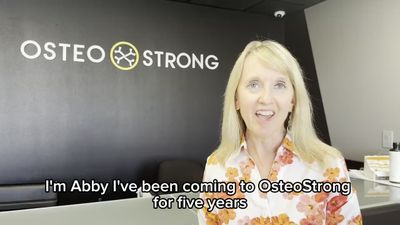
Abby: +4% on the first scan, +11% on a later one
Spine +4% at first follow-up, +11% at most recent DEXA, 5-year member
Abby is the clearest example we have of the year-two-and-beyond effect. Her first follow-up cleared the LSC. Her later scan nearly tripled the gain.
"Two years ago I had a 4% increase in my spine, and a couple months ago I had an 11% increase in my spine, so I'm thrilled."
Verbatim from Abby's on-camera testimonial. Full case study.
Jane, who drives from Temple, crossed from osteoporosis back to osteopenia at 18 months. DeeDee, at our Georgetown center, measured a 19% spine gain at about 18 months. Both timelines are in our osteoporosis treatment success stories.
Why does bone density improve faster for some people?
Two factors explain most of the difference between the members above and the members whose first scan only held steady.
Consistency. The loading signal has to keep arriving. Each remodeling cycle responds to the strain it saw during that cycle, so a month of missed sessions is a month of cycles that filled their pockets to the old level. Among members who follow the weekly protocol and complete a follow-up DEXA, 8 out of 10 see measurable improvement. The weekly protocol is the operative phrase.
Starting point. A site at -2.7 has a shorter trip back across the osteopenia line than a site at -3.5. Both move; one takes more cycles. A site that has been declining for 15 years may spend most of its first year simply stopping.
Three smaller levers: protein at every meal (the raw material), vitamin D at a level your physician is happy with (the NIH Office of Dietary Supplements sets the RDA at 600 IU through age 70 and 800 IU after), and reviewing with your doctor any medication that causes bone loss.
What the timeline looks like at OsteoStrong
The weekly session is about 15 minutes: four devices, a coach beside you, street clothes, no impact. Each device positions you in your strongest range of motion, which is what lets you safely produce force above the roughly 4.2-times-body-weight threshold the osteogenic loading literature cites, after Deere and colleagues. Then the device progresses in very small joint-angle increments, so the stimulus keeps rising as bone gets stronger. How it works shows each device.
Your force output is recorded every session. That is the stage-one number, and it is the reason you are never guessing for 18 months. When the scan date arrives, we encourage every member to re-scan whether or not she feels different, on the same machine as her baseline, because the scan is the scoreboard. It is performed by an independent imaging provider and read by her own physician, never by us. Our session protocols are reviewed on an ongoing basis with the physicians who refer to us, and OsteoStrong fits alongside whatever plan your physician has set.
The bottom line
How long does it take to improve bone density? Weeks for strength, months for balance, and 12 to 24 months for a DEXA to show a change larger than the scanner's noise floor. That is not slowness in your bone. It is the remodeling cycle doing what it does, one round at a time, and compounding. The members who documented a category change did it on scans taken 15 to 18 months in, and the members with the largest gains are the ones who kept going into year two and three.
Want to map your own timeline against your last scan? Book a free Bone Health Roadmap Call, bring your DEXA, and we will walk through it with you.
Full case studies referenced in this article
- Ada: single-leg balance from 9 seconds to 35 in 6 months
- Nicole: spine no longer osteoporotic at 15 months
- Abby: spine +4% at first follow-up, +11% at most recent DEXA
- Jane: osteoporosis back to osteopenia at 18 months
- DeeDee: spine +19% in about 18 months
Browse the full case studies hub or read the verification standard behind every number above.
This article is for general education and is not medical advice. Talk to your own doctor before starting, stopping, or changing any medication, supplement, or exercise program, especially if you have a diagnosis of osteopenia or osteoporosis.
Your simple plan from here
- Book your free Bone Health Call. 15 minutes, phone or Zoom, no pressure.
- Come in for a guided first session. A coach walks you through all four devices.
- Track your strength week after week. 15 minutes, once a week. The numbers rise.
Frequently asked questions
How long does it take to improve bone density?
Measurable change on a DEXA scan usually takes 12 to 24 months, because bone remodels in cycles measured in months and a scan only registers a change once it exceeds the machine's least significant change, typically 3 to 5 percent. Strength, balance, and grip improve far sooner, often within weeks, and at OsteoStrong they are measured every session. Our members who documented a category change on DEXA did so on scans taken 15 to 18 months after starting.
Why do doctors wait two years between DEXA scans?
Two reasons. Bone changes slowly, so a scan taken too soon shows noise rather than signal, and every DEXA machine has a least significant change below which a difference cannot be trusted. Spacing scans 12 to 24 months apart, on the same machine, gives real change time to exceed that floor. Medicare also covers a screening DEXA every 24 months for eligible people, which is why two years is the common interval.
What improves first when you start bone training?
Force output on the loading devices climbs first, usually within the first few weeks, because the nervous system learns to recruit muscle before bone has time to respond. Balance and reaction time follow over a few months; Ada, an Austin member, took her single-leg balance from 9 seconds to 35 in six months. Grip and everyday strength come next. The DEXA is last, because bone tissue is the slowest to remodel.
Can bone density improve in 6 months?
Bone is already responding within six months, but a DEXA taken that early rarely shows it, because the change has not yet exceeded the scanner's least significant change. What you can measure at six months is strength and balance. If you re-scan early and see little change, that is expected and not a sign the plan is failing. Plan the follow-up scan for 12 to 24 months out, on the same machine.
What does year one look like compared with year two?
For many members the first follow-up scan shows that a decline of many years has stopped, sometimes with early gains. The larger gains tend to appear on the second scan, because each remodeling cycle starts from a higher floor. Abby, an Austin member, measured a 4% spine gain at her first follow-up and an 11% gain on a later scan. Read what happens after your first year for the momentum effect.
What slows bone density improvement down?
Missed weeks are the biggest one, because the loading signal has to keep arriving for the remodeling cycle to keep adding bone. Low protein intake, low vitamin D, and medications that cause bone loss, such as long-term steroids, slow it as well. Starting point matters too: a site far below -2.5 has further to travel. Among OsteoStrong members who follow the weekly protocol and complete a follow-up DEXA, 8 out of 10 see measurable improvement.