Every OsteoStrong session ends with one number that proves you're getting stronger - the pounds of force your body can produce, measured right on the machine. It's the weekly evidence that you're making progress between DEXA scans, two years apart. Five Austin women have the receipts - Susan W. +272% overall, Selma +297% overall with +574% on the leg-press station, Debbie 526 to 585 pounds, Leslie 1,255 to 1,298 pounds, Mary Jane a personal best of 1,363 pounds. When that number climbs, your bones are getting the signal that builds them.
The hardest part isn't the work. It's not knowing if it's working.
You're doing everything right. You show up, you push, you wait. But your next DEXA scan is months away, and until then you have no idea whether any of it is reaching your bones - or whether you're quietly losing ground while you wait to find out. That uncertainty is exhausting. It's the reason most women quit before they ever see proof.
Here's the good news: you don't have to wait two years to know. There's a number that tells you today.
Every OsteoStrong session ends with one: your peak force, in pounds, on each device. Your coach writes it down, pulls it up next visit, and you aim higher. That single number answers the question that's been keeping you up:
- Am I reaching my bones? Force output tells you whether you created enough compression to trigger an adaptation - the signal that builds new bone.
- Am I getting stronger or standing still? You see it move week over week, not in two years.
- Will my body protect me when it counts? The force you can produce is the force you'll have when you trip, catch a grandchild, or push up off the floor.
Bone density takes 12 to 24 months to show on a DEXA. Your force number changes weekly. That's the difference between training in the dark and watching yourself get stronger in real time.
Want to see your own first number?
Book a free 15-minute Bone Health Call. We measure your baseline at your first visit - and from then on you watch it climb every week.
Book Your Free Bone Health CallFive verified force-output gains
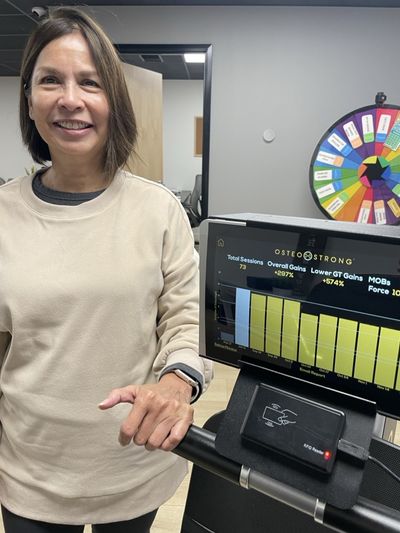
Selma - 73 sessions, 574% on the leg press
Overall gains +297%, leg press +574%
Selma's multi-year record is one of the most thorough in our Austin center. Across 73 weekly sessions she got 297 percent stronger overall. Her single biggest gain came on the leg-press station - the lower-body station where she started weakest - where the force she could produce grew by 574 percent. That kind of multi-fold increase usually happens only when the member starts from a low baseline and stays consistent for 18+ months.
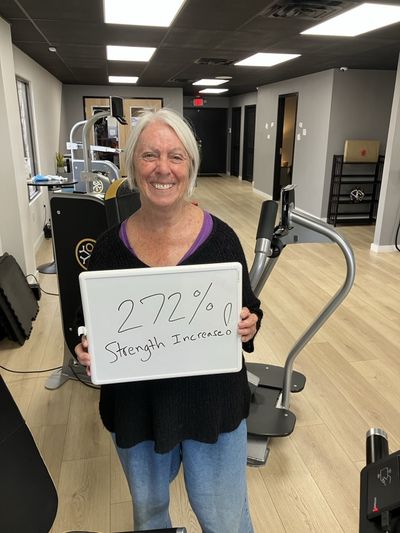
Susan W. - 272% overall strength increase
272 percent overall strength increase
Susan's 272 percent overall increase is the cleanest summary number we have in Austin. Nearly four times the strength she walked in with. This is what sustained weekly loading looks like over multiple years.
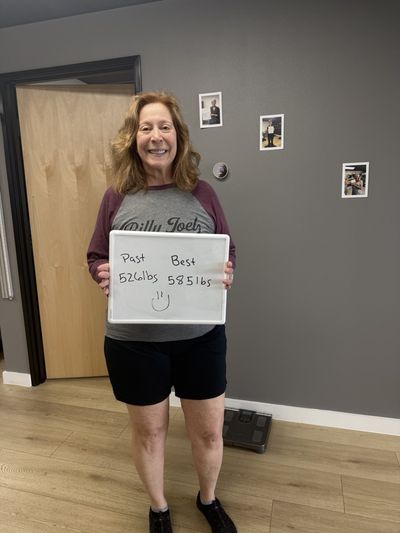
Debbie H. - 526 to 585 pounds
Force output: 526 lbs to 585 lbs
Debbie's 59-pound gain on her primary station is a more moderate number, and it's representative of what many members see over a shorter window. An 11 percent jump is real, measured progress - which means everyday lifting and carrying got noticeably easier for her.
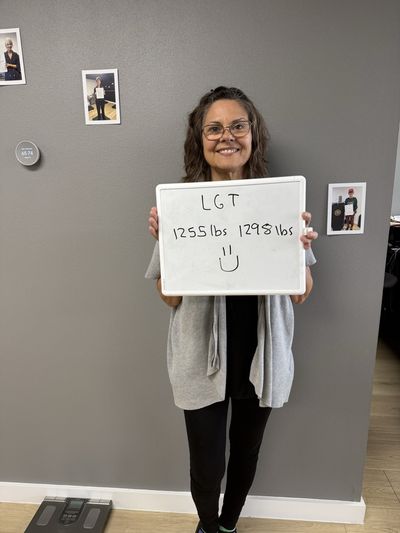
Leslie - 1,255 to 1,298 pounds on the leg press
Leg press: 1,255 to 1,298 lbs
Leslie shows what continued progress looks like at the upper range. When you're already pushing 1,000+ pounds on the leg press, even smaller gains still trigger new bone. Here's the key idea: 1,298 pounds triggers an adaptation for her today, and as she keeps adding load, she'll keep triggering one. When she first started she was pushing 500 pounds. If she pushed 500 now, nothing would happen - her body is already capable of 1,298, so it takes more than it used to. That's why the number has to keep climbing.
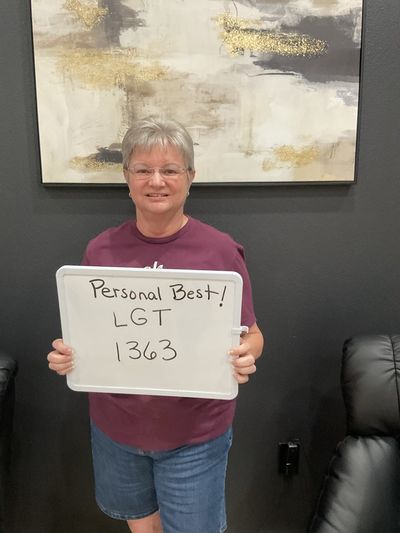
Mary Jane S. - personal best of 1,363 pounds
Personal best: leg press 1,363 lbs
Mary Jane's 1,363-pound personal best on the leg press puts her among the strongest members in our Austin center. A number in this range is multiple times her own body weight - far more than enough compression to keep building bone.
Who you become when the number climbs
The women above aren't training for a competition. They're training to stay the person who handles her own life. A climbing force number isn't a vanity stat - it's the woman who gets off the floor without thinking, who catches herself when she trips instead of going down, who stops noticing the stairs. Here is what the numbers translate into, in everyday terms.
Rising from the floor. Members who double their lower-body force usually go from struggling to rise off the floor to standing up without thinking about it. Ability to rise from the floor without hands is one of the most validated single predictors of mortality in older adults.
Catching a stumble. When you trip and your body has to fire hip and leg muscles in the first 300 milliseconds, the amount of force those muscles can produce determines whether you catch yourself or go down. Stronger force numbers, fewer falls becoming fractures.
Carrying groceries, grandkids, garden soil. Grip strength and upper-body force scale together. Everything heavy gets lighter.
Climbing stairs. Members routinely tell us the stairs at their home, their gym, their grandkids' school - stairs they noticed before they got stronger - have disappeared as a conscious event.
Why fixed-resistance matters
A free weight only delivers the force you chose when you picked it up. To create more compression you have to pick up a heavier weight - and to keep progressing, you'd have to keep adding load every session, which quickly becomes impossible to do safely. Free weights can't progressively load you to the levels of compression that build bone without putting you at risk of injury. That's exactly the problem OsteoStrong's bone-building loading solves.
A fixed-resistance force plate lets you produce the maximum your body can safely generate in that moment. The device does not move. You push. The gauge records what you did.
That means:
- You never lift more than your body allows.
- You never under-train on a day when you could have gone harder.
- The load is always calibrated to your present-day capacity.
The result is a training environment where older adults - including women in their 80s - can safely reach the loads that build bone every week, without injury risk and without plateauing.
Stop training in the dark
You don't have to wait for your next DEXA to find out if you're getting stronger. Here's how it works:
- Book a free 15-minute call - phone or Zoom, no pressure.
- Get your first number - we measure your strength at your first visit.
- Watch it climb - every week, you see proof you're getting stronger.
Not ready to book? Get our free guide, Top 10 Questions About OsteoStrong - clear, honest answers to what women over 50 ask most before their first visit. Read it on your own time, then come back for your first number.
Related reading:
- Grip Strength as a Mortality Predictor
- How OsteoStrong Works
- Reversing Osteoporosis: What Women Over 50 Actually Accomplish
- Fall Prevention That Actually Works
Full case studies referenced in this article
Clearest strength-trajectory outcomes on this site, each with a full case study page:
- Deborah Byrd: reversed a multi-year strength decline into year-over-year gains
- Beverly Newsom: cancer survivor with member-reported gains in strength, balance, and grip
- Julie Beckman: measurable balance-and-recovery gains after a lifetime of falls
Browse the full case studies hub or read the verification standard behind every number above.
Your simple plan from here
- Book your free Bone Health Call. 15 minutes, phone or Zoom, no pressure.
- Come in for a guided first session. A coach walks you through all four devices.
- Track your strength week after week. 15 minutes, once a week. The numbers rise.
Frequently asked questions
Is OsteoStrong safe if I already have osteoporosis?
We hear this one a lot, and the honest answer is that a new osteoporosis diagnosis is exactly why most of our members walked in. You stay in complete control the entire session - the devices don't move, you push against a fixed resistance, and a certified coach is beside you cueing every breath. More than 100 Austin-area physicians refer patients here, including women with severe DEXA results. The safest next step is simply to talk to us. Book your free 15-minute Bone Health Call and we'll walk through your DEXA together.
Can I really build bone density at my age?
Yes, and the question tells us you already suspected the answer. Bone is living tissue that responds to a specific mechanical signal at any age. Our members in their 70s, 80s, and 90s routinely see measurable DEXA improvements, and 8 out of 10 who follow the weekly protocol see bone density gains on follow-up scans. If your doctor has told you 'it's just age,' that's half the story. The best way to find out what's possible for your body is a free Bone Health Call.
What actually happens during a session?
Most women show up nervous and leave surprised at how simple it was. You arrive in street clothes, meet your coach, and walk through four supported devices that produce the exact force your bones need to rebuild. Total time: about 15 minutes. No cardio. No sweat. No locker room. You never change clothes. Most members come on their lunch break.
Do I really only need to come once a week?
Yes, and we know that sounds too easy to be real. When your body receives the osteogenic-loading signal, it keeps rebuilding for 7 to 10 days afterward. More frequent sessions don't produce more results - consistency, once a week, is what creates lasting change. This is the whole reason this method works for women over 50 who do not want a gym routine.
How is this different from going to the gym?
A regular gym trains muscles, which is wonderful but doesn't move the needle on bone. Research suggests bone only rebuilds when it receives roughly 4.2 times your body weight in force - a level you cannot safely produce with free weights, yoga, or Pilates. OsteoStrong's devices let your body generate that precise force safely, in four short efforts, in 15 minutes. Same room. Same coach. Every week.
What does it cost?
We know price is on your mind, and we respect that. We don't post pricing online because memberships vary by location and household (individual, couple, family). Your free 15-minute call covers pricing, location options, and any questions about your specific situation - no sales pressure, no long form to fill out in between.
Will my doctor approve?
Most do. Over 100 Austin-area physicians already refer patients to us, and we're glad to send educational materials to yours. We always recommend sharing your DEXA results with us so we can track your progress alongside your physician's plan. If it helps your decision, ask your doctor what she thinks of osteogenic loading - and then book your free call.
What if I've never exercised?
You are exactly who this was built for. Most of our members aren't athletes. You do not need to be fit, flexible, or experienced, and you will not be asked to do anything your body cannot do. A certified coach is beside you every session, adjusting everything to you. If you've been avoiding gyms for 30 years, this is the place you don't have to.
Do I have to sign a long contract?
No surprises here. We offer month-to-month and longer memberships, and the pros and cons of each are walked through on your free call. We'll never pressure you into a commitment that doesn't fit your situation.
How soon will I feel a difference?
Most members notice improvements in energy, balance, and posture within the first 4 to 6 weeks - long before any DEXA change. On DEXA, the typical pattern is a halt of bone loss in year one with measurable density gains showing up in year two. Bone remodels slowly. We plan the journey in years, not months, and your weekly force-output numbers give you something to watch in the meantime.
How does OsteoStrong help with osteoporosis?
Osteoporosis means your bones have lost enough mineral that a simple fall can become a fracture. OsteoStrong adds the one thing your body cannot get from medication alone: the mechanical signal that tells bone to rebuild. Four devices, 15 minutes a week, and a coach who has seen hundreds of women in your exact spot. The best first step is a free Bone Health Call where we look at your DEXA together.
Is OsteoStrong a replacement for my osteoporosis medication?
No - we're not here to replace your doctor or your prescriptions. We're here to give you a simple weekly routine that supports your bone health alongside your medical plan. Some members, after sustained DEXA gains, have worked with their physician to taper or discontinue medications. That decision is always between you and your doctor, never between you and us.
Is OsteoStrong right for postmenopausal women?
It's built for you. Postmenopausal women are our largest group of members, because menopause is when bone loss accelerates and estrogen protection drops. Osteogenic loading delivers the signal your body needs without the high-impact movement that menopausal joints often cannot tolerate. If that sounds like the season you're in, book your free call.
Does insurance cover OsteoStrong?
Usually not, and we'll give you the straight answer: OsteoStrong is a non-pharmaceutical wellness service, so most U.S. insurance plans don't cover it. Some members use HSA or FSA funds. Your free Bone Health Call covers pricing and payment options for your specific situation.
How is OsteoStrong different from physical therapy or the gym?
Physical therapy is medical rehabilitation and usually ends when you've recovered. A gym provides general exercise but rarely reaches the force threshold associated with bone rebuilding. OsteoStrong is a single-purpose service focused on triggering the osteogenic-loading signal. One coach, four devices, 15 minutes, once a week, indefinitely. Many of our members keep their PT or their gym and simply add OsteoStrong for bone health.
What happens if I don't do anything about bone loss?
This is the question we wish more women asked, and we'll give you a gentle but honest answer. Bone loss is quiet. It compounds year after year until a simple trip becomes a fracture. One in two women over 50 will break a bone because of osteoporosis in her lifetime. Forty percent of hip-fracture patients lose the ability to live independently, and nearly one in four dies within a year. Those are the stakes. The good news: the next step is small, it's free, and it's a 15-minute phone call. Book your free Bone Health Call - we'll meet you where you are.
I'm scared. What should I do first?
Of course you are. Bone loss is a quiet thing that suddenly becomes very loud at a doctor's appointment, and no one sat with you and walked through what comes next. Start with the smallest, safest step: book a free 15-minute Bone Health Call. It's a phone or Zoom conversation with someone who has helped hundreds of women in your exact situation. We'll read your DEXA with you, answer your questions, and help you decide whether to come in. You don't commit to anything. You just get a real person to talk to.
What is force output at OsteoStrong?
Force output is the amount of force, measured in pounds, that a member produces against one of the four fixed-resistance Spectrum devices. Every session, at every device, we record peak force. Those numbers become the weekly evidence of progress between DEXA scans. They are not the same thing as bone density - they are a measurement of how much force the body is able to generate, which is what drives bone and muscle adaptation over time.
How are these numbers measured?
Each of the four Spectrum devices has a built-in force gauge. You press, pull, or push against a fixed resistance. The device measures the peak force in pounds and records it to your member profile. At the start of your next session, the coach pulls up your last numbers and you aim higher. It is the simplest possible feedback loop.
Why does force output matter if DEXA is the real outcome?
Three reasons. First, bone density takes 12 to 24 months to meaningfully change on DEXA. Force output changes every week. Second, force output is what creates the bone-loading signal in the first place - higher force means a stronger bone-building stimulus. Third, force is correlated with real-world strength: members who double their force output can usually do ordinary life tasks (lifting groceries, getting off the floor, catching a stumble) more easily.
How much can force output improve?
A large range. Susan W. increased her overall strength by 272 percent. Selma saw a 297 percent overall gain and a 574 percent increase on the leg-press station, where she started weakest, across 73 sessions. Debbie added 59 pounds (526 to 585). Leslie and Mary Jane pushed their leg-press numbers into the 1,200-1,300+ pound range. Newer members often double their numbers in the first 12 months.
Are those 'percent increase' numbers real or marketing?
They are recorded session-by-session numbers taken by the device. The percentages come from dividing the latest reading by the intake baseline. Some stations (particularly the lower-body leg press) can show very large percent gains because members often start at a low baseline, so small pound increases produce large percent changes. We show the raw pounds alongside percentages for exactly this reason.
Is this the same as being able to lift more in the gym?
Related but not identical. OsteoStrong devices are fixed-resistance force plates, not free weights. You don't lift an object; you produce force against something immovable. The strength you build transfers to everyday activity - opening jars, climbing stairs, rising from a chair without pushing off - and to any free-weight program you want to pursue alongside OsteoStrong.