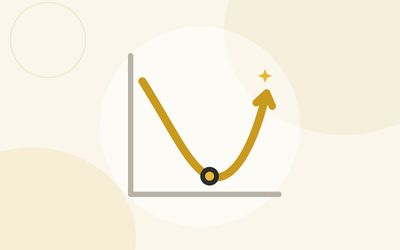
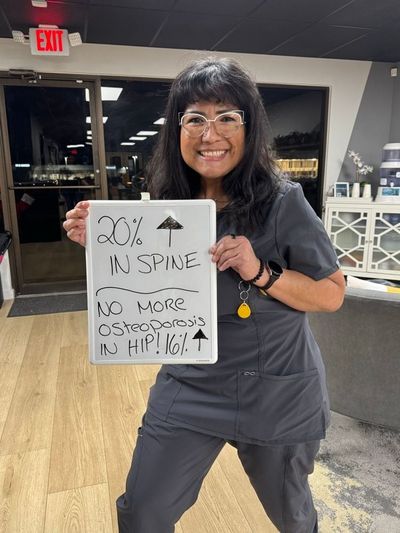
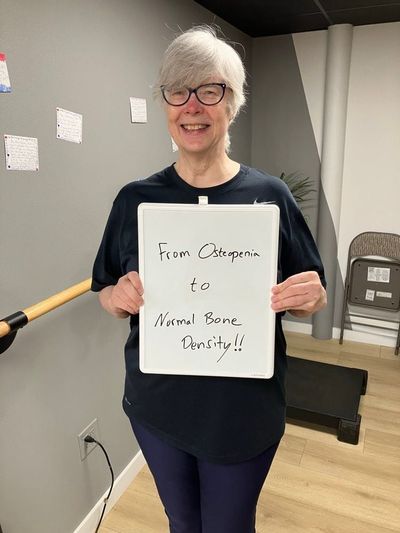
If you've completed your first year of weekly osteogenic loading, here's what the data usually shows: bone loss has stopped, and for some members, gains have already started - with the larger increases coming in year two. That's not the finish line - it's proof the direction has changed. It took roughly 30 years to arrive at osteoporosis; you're one year into rebuilding. The destination is normal bone density, and the smartest thing you can do right now is keep going.
Where are you on this drive?
You showed up for a year.
Fifty-something sessions. Through the busy weeks, the holidays, the days you didn't feel like it. You kept the appointment with yourself, and your body noticed. And you didn't do it for a number on a chart. You did it to stay strong, upright, and independent - to be the woman who still carries her own groceries and gets down on the floor with her grandkids.
Now you're looking at your second DEXA scan, or getting close to it, and you might be asking the question almost everyone asks at this milestone: "Okay - is it working? And do I keep going?"
The answer to both is yes - and part of you already senses it, or you wouldn't still be here. Here's what your scan is actually telling you.
It took 30 years to get here
Osteoporosis didn't happen to you overnight. For most women, bone density peaks in the early 30s and then begins a slow, quiet decline - one that accelerates sharply in the years around menopause. By the time a DEXA scan puts a number on it, you're often looking at two or three decades of gradual loss.
Nobody felt that happening. There's no symptom, no ache, no warning. The bone just quietly left, year after year, because the loading that would have told it to stay never arrived.
Hold that timeline in your mind for a second: 30 years down.
Now look at where you are: one year back up.
When you frame it that way, the first year isn't a disappointment if you haven't fully reversed everything - it's a remarkable turnaround. You changed the direction of a trend that had been running since before your kids were born.
What the first year actually does
Bone is slow tissue. We say it constantly because it's the single most important thing to understand about this journey. The remodeling cycle - your body dissolving old bone and building new bone - runs in months, not days. (For more on the mechanism, see the science of osteogenic loading.)
So here's the pattern we see most often across members at OsteoStrong Austin and Georgetown:
- Year one: the loss stops. The decline that had been running for years flattens out - on DEXA, density holds steady instead of dropping, and some members already see early gains. This is the turnaround, and it's a bigger deal than it sounds.
- Year two: the gains. This is where we see the larger increases in members who keep following the protocol - the rebuild side outpacing the breakdown side week after week, and the density numbers climbing.
If your first scan after a year shows stabilized numbers, that is not a plateau. That is the engine catching. You spent 30 years going downhill; the first thing momentum has to do is bring you to a stop before it can carry you back up.
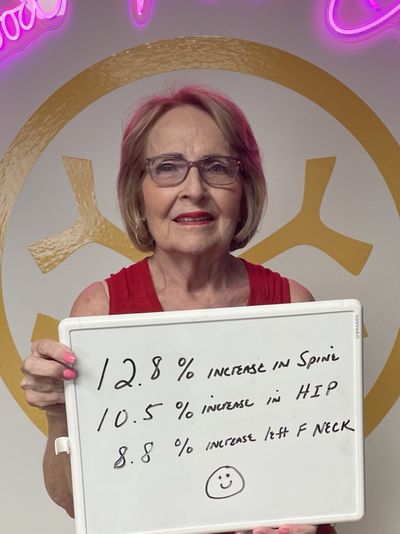
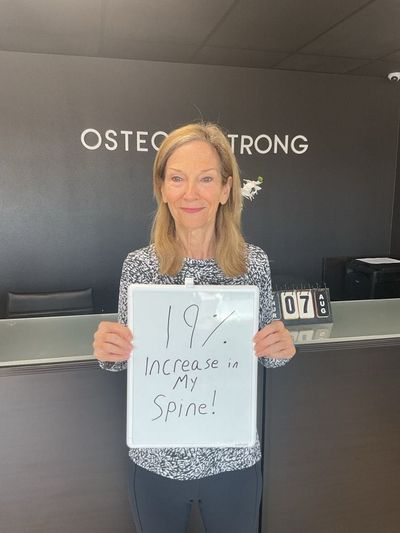
And some members do see more than a halt in year one - real, measurable gains. Stay with it and the odds are firmly on your side: at our Austin and Georgetown centers, about 8 in 10 members who follow the weekly protocol see bone density gains on follow-up scans. The operative phrase is follow the weekly protocol - those gains belong to the people who keep showing up. Either way, the meaning is the same: the direction has changed. (We've documented this exact pattern across members who moved out of the osteoporosis range in what women over 50 actually accomplish at OsteoStrong.)
Momentum is the whole point
Here's the thing about momentum: the hardest part is always changing direction. A trend that's been moving one way for decades takes real, sustained force to turn around. You've already supplied that force. You've already done the hard part.
What comes next is easier in a specific sense - not effortless, but easier - because now you're building on a base instead of fighting a decline. Every session adds to the last one. Force output keeps climbing (you can watch it on your tracking sheet, week after week - this is exactly how we measure your strength gains). Each DEXA scan starts from a higher floor than the one before.
That's what momentum means for your bones: you've stopped starting over. You're compounding.
Just know the climb keeps asking a little more of you. Your body adapts only relative to what you can already do - not to some fixed number that's the same for everyone - so it takes a bit more each time to keep building. That isn't a flaw in the plan; it's the reason the plan is to keep showing up. It's also why walking eventually stops moving the needle. (More on that here.)
Why now is exactly the wrong time to coast
There's a quiet villain at the one-year mark, and it isn't your bones - it's the voice that says "this is probably good enough." It doesn't feel like quitting. It feels like being reasonable. The scary diagnosis feels further away, the loss has stopped, and things feel handled. That's exactly what makes the voice dangerous: the loss it lets back in is as silent as the loss that got you here.
We understand the pull. After a hard year, "good enough" sounds like permission to finally relax - and you've earned the right to want that. But consider what's actually true right now:
- You're closer to your goal than you've been in decades - but you're not there yet. The destination is normal bone density (a T-score above -1.0), not "stopped getting worse."
- The system only works while the stimulus continues. Bone responds to what you keep doing. The moment the weekly signal stops, the same biology that turned your trend around runs in reverse. And bone you can't feel leaving is bone you won't feel coming back - until the day it matters, on a curb or an icy step. Stopping now doesn't freeze your progress in place; it quietly hands it back.
- The compounding is just kicking in. Years two and three are often where the most satisfying density gains happen. Stepping back now means walking away right as the return on your effort gets bigger.
You didn't start this to stop the bleeding. You started it to stay the woman who carries her own groceries and gets down on the floor with her grandkids - strong, upright, and independent for the decades ahead. That's the destination. And you're on the road to it now - not still idling in the driveway.

You're in Memphis, not Cape Cod
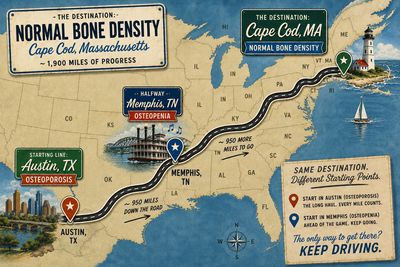
Picture the whole thing as a road trip. You came to us in Austin with one destination in mind: normal bone density. Think of it as Cape Cod, Massachusetts - about 1,900 miles away. You knew going in it was a long drive. That's why you committed.
One year in, if Austin was your starting line, you've made it to Memphis. That's real progress - you're hundreds of miles down the road, pointed the right way, making good time. But here's the question that decides everything: did you get in the car to reach Memphis, or to reach Cape Cod?
Stopping in Memphis doesn't erase the miles you've already driven. But it doesn't get you where you came to go, either. You'd be parking the car a few hundred miles into a journey you started specifically to finish - and calling that "close enough."
Memphis means something different depending on where you got on. Bone density runs on a spectrum - osteoporosis, then osteopenia, then normal - and Memphis is the osteopenia stop, right in the middle of the drive.
For some, Memphis is the starting line: if you walked in with osteopenia rather than full osteoporosis, you pulled onto the road already halfway - a real head start, and a shorter drive to the same Cape Cod. And if you came in with full osteoporosis? A year of work has climbed your bones out of osteoporosis and up into osteopenia - you earned, mile by mile, the very head start the osteopenia drivers were handed at the door. That's not halfway to nowhere.
That's halfway to normal - and halfway was never why you started.
Wherever Memphis sits for you - your starting line or a hard-won milestone - the coast is still ahead. Coasting to a stop here, with the hardest miles already behind you, is the one version of this drive that would actually be a shame.
So the only question worth answering is the honest one: do you want to get to normal bone density, or not?
If the answer is yes - and it was yes the day you started - then there's exactly one thing to do.
Keep driving.
If you want a map for the rest of the drive - what years two and three look like for your numbers specifically - that's exactly what the Roadmap Call is for. The hard part is already behind you; this next stretch is about not letting up.
Keep your foot on the gas
So here's our honest, direct encouragement at the one-year mark:
Don't stop until you reach your destination.
You've proven you can do the hard part - changing direction. You've earned the easier part - riding the momentum. The worst possible move is to pull over right when the road finally starts pointing toward where you wanted to go all along.
Keep the weekly appointment. Keep watching your force output climb. Keep showing up. (If you ever need a reminder of why consistency is the whole game, this honest take says it plainly.)
Right now, before you close this tab: look at your next scheduled session and treat it like a doctor's appointment you can't move. Protecting that weekly slot is the whole plan.
The members who reach normal bone density and hold it are not the ones with special genetics or extra time. They're the ones who treated year two and year three the same way they treated year one: non-negotiable.

There's something quietly wrong about quitting on the version of yourself you committed to a year ago - the one who did the hard first year so this one would be easier, and who's counting on you to finish what she started. Don't leave her stranded in Memphis.
You started for a reason. That reason hasn't changed. It's just closer now.
The bottom line
One year in, the loss has stopped, and for some, the gains have already begun - and year two is where the bigger increases come. That's not the finish - it's the proof that you turned a 30-year trend around in 12 months. The destination is normal bone density - and picture what that actually buys you: the trip you don't cancel because of the stairs, the grandchild you pick up without doing the math first, the stumble that becomes a story instead of a hospital stay. That's Cape Cod. That's what the rest of the drive is for. Momentum is finally working for you instead of against you.
Now is the time to keep your foot on the gas.
If you want to talk through your numbers and map out what years two and three could look like for your specific situation, book your free Bone Health Roadmap Call - about 15 minutes, phone or Zoom. Bring your DEXA results and we'll show you exactly where the momentum can take you next.
Either way, do the one thing that matters before you go: protect your next session like it's non-negotiable. Keep driving.
Your simple plan from here
- Protect your next session. Treat the weekly slot like an appointment you can't move. That one habit is the whole plan.
- Book your free Roadmap Call. Bring your DEXA results and we'll map what years two and three can look like for you.
- Keep showing up - and watch the numbers. Force output climbs week over week, and each DEXA scan starts from a higher floor than the last.
Frequently asked questions
Why does bone density take so long to improve?
Bone is slow tissue. The remodeling cycle - the process of dissolving old bone and laying down new bone - runs in months, not days. A single DEXA scan only captures meaningful change after about 6 to 12 months. That's why we plan the journey in years. The good news is that the same slowness that made progress feel invisible early on is what makes it durable once it arrives.
Is it normal to see loss stop before I see gains?
Yes - that's the most common year-one pattern we see. The first thing consistent loading does is halt the decline that had been running for years. For many members, gains on DEXA show up in year two of weekly sessions. Stopping the loss is not a plateau; it's the turnaround. It means the rebuild side of the equation has finally caught up to the breakdown side.
My first-year scan only held steady - did it not work?
Holding steady is the win we look for in year one. You spent decades losing bone; stopping that decline is the turnaround, not a failure. It means the rebuild side has caught up to the breakdown side - and that stabilized scan is the platform every year-two gain gets built on. The mistake would be reading 'held steady' as 'done' and easing off right when the momentum is about to pay you back.
Should I stop once my numbers improve?
No. The goal isn't a single good scan - it's reaching and holding normal bone density, then protecting it. Bone responds to what you keep doing. The members who keep their foot on the gas in years two and three are the ones who reach their destination and stay there. Stopping the stimulus eventually lets the old pattern return.
What does 'momentum' actually mean for my bones?
It means your body has shifted from a losing pattern to a building one. Force output climbs session over session, the remodeling cycle is being signaled every week, and each scan builds on the last instead of starting over. Momentum is the compounding effect - the hardest part was changing direction, and you've already done that.
Can I take a few months off and pick back up later?
You can always come back - but a pause isn't free. Bone responds to what you keep doing, so when the weekly signal stops, the same biology that turned your trend around quietly runs in reverse. A few months off doesn't freeze your progress in place; it hands some of it back, the way it left the first time. The honest move at year one isn't to pause - it's to protect the weekly slot so the momentum keeps compounding.