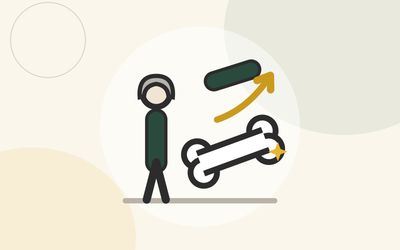
Osteogenic loading tells your bones to build. But bones don't build out of willpower - they build out of protein. Roughly a third of bone's weight is a protein scaffold (collagen), and the mineral that makes bone hard crystallizes onto it. So if you're working to rebuild bone, two things have to be true at once:
- The signal. A load heavy enough to tell bone to add tissue - that's what a weekly OsteoStrong session delivers.
- The material. Enough protein, every day, for your body to actually fill the order. The target most longevity physicians converge on is about 1 gram of protein per pound of ideal body weight - roughly double the government RDA, and the intake that supports building muscle and the collagen scaffold rather than just holding steady.
Food protein comes first. Complete essential-amino-acid blends like Fortagen or PerfectAmino are a tool for closing the gap when food alone won't get you there - a small, low-calorie dose of the exact building blocks your body assembles protein from. Here's the science, and how much you actually need.
There's a version of the bone-density story that only talks about calcium, and it quietly misses half of what bone is made of. You can take calcium, take vitamin D, and load your skeleton perfectly on the machines - and still leave gains on the table, because the one raw material bone is mostly built from was in short supply the whole time.
That material is protein. This article is about why it matters as much as the loading, how much you actually need when you're trying to rebuild rather than just maintain, and where complete amino-acid blends like Fortagen and PerfectAmino fit in.
Loading is the signal. Protein is the material. OsteoStrong's job is to tell your bones to build; your job the other six days is to make sure there's something to build with.
Bone isn't a rock. It's a protein scaffold that mineral hardens onto.
Picture reinforced concrete. The steel rebar cage goes up first; then concrete is poured around it and hardens. Take the rebar away and you don't have a weaker building - you have a brittle one that cracks under load.
Bone works the same way. The rebar is type I collagen, a protein. Roughly a third of bone's weight and about half its volume is that collagen framework, and the mineral - calcium and phosphate as hydroxyapatite - crystallizes onto it, hardening the scaffold into something that can carry your body weight [1]. The mineral gives bone its stiffness; the collagen gives it the toughness that lets it bend a little instead of shattering.
This is why bone strength isn't the same as bone density. Two people can have the same DXA number and different fracture risk, because the protein scaffold underneath differs in quality. And it's why you cannot build bone out of minerals alone. Pour concrete with no rebar and it sets brittle. Give your skeleton the signal to build but not the collagen to build with, and you've asked for a wall with no framing.
Collagen is protein. Protein is made of amino acids. Which means the entire building project runs on your amino-acid supply.
The signal and the material are two different jobs
Here's the mental model that ties the whole thing together.
When you load a bone above its habitual threshold - the roughly 4x-body-weight range osteogenic loading is designed to reach, as we cover in the science of osteogenic loading - you send bone a signal: this region is under demand, reinforce it. That's the order. It's specific, it's directional, and it's the thing walking and light weights don't deliver.
But an order isn't a delivery. Once the order is placed, bone-building cells go looking for raw material - amino acids to lay down new collagen, minerals to harden it. If the material is on hand, the order gets filled. If it isn't, the order sits.
That's the relationship in one line: loading places the order; protein fills it. Neither one works alone.
- Protein without loading doesn't build bone. With no signal telling your body where to reinforce, the amino acids get used for other things or cleared out. This is why "just eat more protein" isn't a bone-density strategy on its own.
- Loading without enough protein sends the order to an empty warehouse. You did the hard part - you reached the threshold - and then ran out of the one thing needed to act on it.
Most people who train consistently and still feel like their results are slow assume the problem is the loading. Often it's the material. The signal was fine. The shelves were bare.
Talk to your coach at your next session.
We deliver the signal on the machines. The material - enough protein, every day - is the half most people miss. Ask your coach how to keep those shelves stocked with the two amino-acid blends we carry.
New to OsteoStrong? Book a Free Visit"Maintenance mode" vs. "growth mode": why your target moves
Think of your body as running in one of two modes.
In maintenance mode, you're holding steady - replacing what wears out, keeping what you have. This is the state most nutrition minimums are designed for. The protein RDA of about 0.8 grams per kilogram of body weight is a maintenance-and-don't-get-deficient number. It was never meant to describe someone building new tissue.
In build mode, you're trying to add - more muscle, denser bone, more collagen scaffold than you had last year. Building takes more raw material than maintaining, the same way a construction site burns through far more lumber than a finished house ever needs for repairs.
If you have osteopenia or osteoporosis and you're actively working to reverse it, you're trying to build. That's the honest version of the "growth mode" idea: it isn't a medical diagnosis or a switch that flips - it's a frame for a simple truth. You're asking your body to do construction, so you should feed it like a construction site, not like a house at rest. Eating at the maintenance floor while asking for growth is the quiet way good training underperforms.
How much protein you actually need
Here's where it pays to be precise, because there's a wide gap between the government minimum and the loudest number on the internet.
The floor. The RDA is ~0.8 g/kg/day. Adequate to avoid deficiency in a sedentary adult. Too low for building bone or muscle, and too low for many older adults, who absorb and use protein less efficiently than they did at 30.
The conservative floor. Expert consensus from the International Osteoporosis Foundation (IOF) and ESCEO concluded that protein above the RDA is associated with higher bone density, slower bone loss, and lower hip-fracture risk - provided calcium intake is adequate [2]. Bone-specific meta-analysis in older adults put the supported range at roughly 1.0-1.2 g/kg/day [3]. That's real evidence, but it's a cautious floor drawn from studies that mostly compared "a bit more" to "a bit less" - not from anyone testing what an actively building older adult needs.
The target most longevity doctors actually recommend. Step outside the osteoporosis-guideline literature and into longevity and muscle-centric medicine, and the number climbs. Dr. Gabrielle Lyon, who founded the field of muscle-centric medicine, recommends about 1 gram of protein per pound of ideal body weight per day - roughly 1.6-2.2 g/kg - to preserve and build muscle and the collagen framework as you age [6]. The logic is the same one this whole article is built on: after about 50, your body gets worse at turning food protein into new tissue, so you have to send more raw material to get the same building done. If you're trying to add bone and muscle rather than slowly lose both, this is the target to aim for.
One precision point that keeps this safe and sane: it's 1 gram per pound of ideal (or goal) body weight, not necessarily your current scale weight. For someone carrying extra weight, sizing protein to actual weight would overshoot; sizing it to a healthy target weight is what the recommendation actually means.
So what should you do? A workable rule for someone rebuilding:
Aim for about 1 gram of protein per pound of your ideal body weight per day while you're in a building phase. For someone whose goal weight is 150 pounds, that's roughly 150 grams of protein a day. Food first; use a complete amino-acid blend to close whatever gap food leaves. And make sure calcium and vitamin D are covered too - protein builds the scaffold, and mineral is what hardens it.
And put to rest the old fear that protein is bad for bone. The "protein makes your blood acidic and leaches calcium from your skeleton" theory drove a generation of low-protein advice. It hasn't survived the evidence. The consensus now runs the other way: with adequate calcium, more protein means better bone, not worse [2].
Hitting your number is easier than it looks - talk to your coach.
A gram per pound sounds like a lot of chicken. In practice it's a five-calorie fix. At your next session, ask your coach to set you up with Fortagen or PerfectAmino, and we'll show you exactly how to close the gap.
New to OsteoStrong? Book a Free VisitWhy amino acids - and why "complete" is the whole point
Every protein in your body - collagen in bone, actin in muscle, antibodies, enzymes - is assembled from the same 20 amino acids. Nine of them are essential: your body can't make them, so they have to come from food. The other eleven your body can build itself.
Here's the part that makes complete protein matter: protein synthesis is all-or-nothing on the essentials. To build a given protein your body needs every required amino acid present at once, in the right proportion. If even one essential amino acid is short, synthesis stalls - the way an assembly line stops if one part runs out, even when every other bin is full. The amino acids you do have don't get built into new protein; they get burned for energy or cleared as waste.
This is the real difference between protein sources. When you eat protein, only the fraction that's complete and correctly balanced gets used to build new tissue. The rest becomes calories and nitrogen your kidneys process out. A whole-food protein like eggs or meat carries a good usable fraction plus the collagen-relevant amino acids; a shake of collagen powder, ironically, is an incomplete protein and a poor driver of new protein synthesis on its own - though, as we'll see, it has a narrower job where it genuinely earns its place.
Complete essential-amino-acid (EAA) blends are built to sidestep the waste. They deliver all the essential amino acids in a balanced ratio, so a small, low-calorie dose supplies usable building blocks rather than mostly filler. The manufacturers cite very high "utilization" numbers for their products - Jaquish Biomedical describes Fortagen's net utilization as near-100% versus a much smaller usable fraction for whey; BodyHealth makes a similar claim for PerfectAmino [4][5]. Those specific figures are the companies' own, so weigh them as marketing. But the principle underneath is legitimate: complete essential amino acids in the right ratio are used efficiently for protein synthesis, and that's exactly what you want when the goal is building.
One honest nuance for bone specifically. Bone collagen is unusually rich in glycine and proline - and those two are non-essential, meaning your body makes them itself. So an EAA scoop is not literally "collagen in a glass." What it does is more upstream and more important: it removes the essential-amino-acid bottleneck that would otherwise stall all protein-building, and it supplies lysine - an essential amino acid that forms the crosslinks giving collagen its tensile strength. Keep the gate open with complete EAAs and adequate total protein, and your body can do the collagen assembly it's built to do.
And this is exactly where a collagen supplement earns its place - where the "incomplete protein" knock on collagen stops being the whole story. A collagen peptide powder essentially is "the scaffold's amino acids in a glass": it delivers the glycine, proline, and hydroxyproline that bone collagen is built from - the very ones the EAA blend leaves your body to make on its own. Your body can make them, but in build mode, laying down more collagen than usual, that demand can outrun easy supply (which is why glycine is sometimes called conditionally essential). Collagen peptides also carry small di- and tri-peptides that appear to signal bone and connective-tissue cells to build more matrix, and there's early - though limited and industry-associated - evidence that specific collagen peptides, taken with the vitamin C collagen synthesis requires, improve bone density in postmenopausal women [8]. So the two aren't rivals: complete EAAs are the gate on all protein-building; collagen peptides are targeted raw material and a nudge for the scaffold specifically. Just don't mistake collagen for your main protein - it's incomplete, so it can't fill that role, and it shouldn't count toward your daily gram-per-pound target.
The products we carry - and why we chose them
Here's where hitting your target gets easy. You could chase 1 gram per pound with food alone - but for a lot of our members that means forcing down more chicken, eggs, and shakes than their appetite or digestion will allow, dragging a load of extra calories along with it. That gap is widest for women on a GLP-1 like Ozempic, Wegovy, or Mounjaro, whose appetite is suppressed by design - if that's you, Ozempic and Your Bones covers how to protect bone and muscle while the weight comes off. That's the exact problem a complete essential-amino-acid blend solves, and it's why we stock the two best on the market: Fortagen and PerfectAmino.
Both deliver all nine essential amino acids in the precise ratio your body assembles protein from, so you can mix and match them to taste. Here's what sets a serving apart from a scoop of whey or another chicken breast:
- ~99% utilized. The manufacturers measure that nearly all of what's in a serving actually gets built into new protein - versus the much smaller usable fraction of whey or plant protein, where most of what you swallow is broken down for energy or cleared as waste. You're paying for building blocks, and nearly all of them build.
- Easy on your kidneys. Because so little goes unused, there's almost no leftover nitrogen for your kidneys to process. The nitrogen load that makes people nervous about "eating a lot of protein" comes from the unused fraction of ordinary protein - and that's precisely the part these blends don't leave behind.
- About 5 calories - for the usable-protein equivalent of roughly 50 grams of whey. One serving carries the building power of a big protein shake or an 8-ounce steak at essentially no caloric cost. That's what makes an aggressive protein target realistic: you close the gap without blowing your calorie budget.
- Fast and simple. Mixes into water, digests in minutes, no insulin spike - so it fits before a session, between meals, or first thing on an empty stomach.
Put those together and hitting 1 gram per pound stops being a chore. Food still does the heavy lifting; when you're short for the day, one of these closes the gap in about five calories instead of a meal you don't have room for.
And there's a detail we love: Fortagen was formulated by Dr. John Jaquish - the researcher behind the bioDensity osteogenic-loading technology OsteoStrong is built on, the same work we cite when we explain why LIFTMOR-M didn't test the machine as designed. The mind that worked out how to load bone to the building threshold also built the material side of the equation. PerfectAmino, from BodyHealth (Dr. David Minkoff), is the other blend we trust and carry. Ask your coach which one to start with.
The fuel for the drive
If you've read what happens after your first year, you know how we picture rebuilding bone: a long road trip. You got on in Austin - osteoporosis. You're making your way through Memphis - osteopenia, the halfway stop. And the destination is Cape Cod: normal bone density, about 1,900 miles up the coast. We tell members the same thing at every check-in - keep your foot on the gas.
Here's the part that piece didn't spell out. Your weekly OsteoStrong session is your foot on the accelerator - the signal that keeps the car pointed north and moving. But an accelerator only does something if there's fuel in the tank. Floor the pedal on empty and you go nowhere, no matter how hard you press. Bone works the same way: the loading tells your body to build, and building burns raw material to do it.
That raw material - the fuel - is protein and minerals. There are three things worth keeping in the tank:
- Complete protein - Fortagen or PerfectAmino. Your main fuel: all nine essential amino acids, the gate on building any new protein, and the efficient way to hit your daily gram-per-pound target.
- Collagen peptides - AlgaeCal collagen. A targeted top-up aimed straight at the scaffold: it delivers the glycine and proline bone collagen is built from - the exact building blocks the complete blend leaves your body to make itself - plus peptide signals that nudge your cells to lay down more matrix. Not a stand-in for complete protein (collagen is incomplete); a specialist working alongside it. Timing is easy: take it whenever's convenient, before or after your session - it works the same either way.
- AlgaeCal calcium, with D3 and K2. The mineral half - the concrete that hardens the collagen rebar into bone that carries your weight [7].
Complete protein and collagen build the rebar; the minerals pour the concrete; your weekly session is the crew that shows up to do the work. Run low on any of it and the drive stalls - you can keep your foot on the gas all you want, but the car just coasts. Keep the tank topped off, week after week, and the momentum you earned in that hard first year keeps carrying you toward Cape Cod.
That's why we carry all three at OsteoStrong Austin - and why your coach will ask not just whether you're loading, but whether you're fueled.
Here's the whole stack at a glance:
| What it is | Its job (the metaphor) | Counts as your protein? | |
|---|---|---|---|
| Fortagen or PerfectAmino (pick one) | Complete essential amino acids - all 9 EAAs, ~99% utilized, ~5 calories a serving | Fills the tank. The gate on building any protein, and the easy way to hit your ~1g-per-pound target | Yes - this is your protein |
| AlgaeCal Collagen | Collagen peptides - an incomplete protein | Premium fuel for the rebar. The glycine and proline the bone scaffold is built from, plus a signal to lay down more | No - a targeted add-on; don't count it toward your target |
| AlgaeCal Calcium | Plant-sourced calcium with vitamin D3 and K2 | Pours the concrete. The mineral that hardens the collagen scaffold into load-bearing bone | No - it's the mineral half |
And the weekly OsteoStrong session? That's the accelerator - and the crew that actually puts all that fuel to work.
One last thing - and we mean this more than any product pitch above it. If you take nothing else from this article, take this: get your protein. The supplements make an aggressive target easier - they're not the point. The protein is. If you hit your number every day with chicken, eggs, fish, and Greek yogurt and never buy a single scoop from us, we will count that a win. Food first, food always; the blends are just there for the days food comes up short. So whatever else you do - with us or without us - get your protein. Just get it.
Putting it together
If you're serious about rebuilding bone, the plan has two halves that map onto the two things bone actually needs:
- Send the signal - weekly. Reach the loading threshold your bones respond to. That's the 15-minute osteogenic-loading session once a week, coached so the force actually lands where it counts. This is the part that tells your skeleton where and how much to build - and it's measured, so you can see your force output climb before your next DEXA.
- Keep the tank full - daily. Aim for about 1 gram of protein per pound of your ideal body weight, every day - the target most longevity physicians recommend for building rather than just maintaining. Food first; use a complete EAA blend like Fortagen or PerfectAmino to close the gap when food falls short. Add AlgaeCal collagen as a targeted top-up for the scaffold, and handle the mineral half with AlgaeCal calcium - the plant-based calcium, D3, and K2 that harden what protein builds. Protein, collagen, and minerals are the fuel; the loading is the accelerator.
Do one without the other and you leave results on the table. Load hard on an empty warehouse and the order can't be filled. Eat perfectly with no loading signal and the material never gets directed into bone. Do both, consistently, and you've given your skeleton the one thing it can't manufacture on its own: a reason to build, and something to build with.
If you're just getting oriented on where you stand, start with osteopenia vs. osteoporosis and what it really takes to reverse bone loss.
The easiest place to start is your next session. Come in for your weekly load, and ask your coach to set you up with Fortagen or PerfectAmino and AlgaeCal before you leave - so you walk out with both halves of the equation handled: the signal your bones respond to, and the fuel they build with. Skip either one and you leave results on the table. Handle both, week after week, and you give your skeleton the one thing it can't make on its own - a reason to build, and something to build with. That's how bone actually gets stronger. Not with one perfect thing. With both, every week.
References
- Viguet-Carrin S, Garnero P, Delmas PD. The role of collagen in bone strength. Osteoporos Int. 2006;17(3):319-336. doi:10.1007/s00198-005-2035-9
- Rizzoli R, Biver E, Bonjour JP, et al. Benefits and safety of dietary protein for bone health - an expert consensus paper endorsed by the European Society for Clinical and Economical Aspects of Osteoporosis, Osteoarthritis, and Musculoskeletal Diseases and by the International Osteoporosis Foundation. Osteoporos Int. 2018;29(9):1933-1948. doi:10.1007/s00198-018-4534-5
- Groenendijk I, den Boeft L, van Loon LJC, de Groot LCPGM. High Versus Low Dietary Protein Intake and Bone Health in Older Adults: A Systematic Review and Meta-Analysis. Comput Struct Biotechnol J. 2019;17:1101-1112. doi:10.1016/j.csbj.2019.07.005
- Jaquish Biomedical. Fortagen essential amino acids - product information. https://www.jaquishbiomedical.com/products/fortagen/ (manufacturer claims)
- BodyHealth. What PerfectAmino Is Actually Doing In Our Body - PerfectAmino User's Guide. https://bodyhealth.com/blogs/news (manufacturer claims)
- Lyon G. Forever Strong: A New, Science-Based Strategy for Aging Well. Atria Books; 2023. (muscle-centric medicine; approximately 1 g of protein per pound of ideal body weight)
- AlgaeCal. Plant-sourced calcium with vitamin D3, K2, and trace minerals - product information. https://www.algaecal.com (manufacturer information)
- König D, Oesser S, Scharla S, Zdzieblik D, Gollhofer A. Specific Collagen Peptides Improve Bone Mineral Density and Bone Markers in Postmenopausal Women - A Randomized Controlled Study. Nutrients. 2018;10(1):97. doi:10.3390/nu10010097 (specific branded collagen peptides; industry-associated authorship)
This article is for general education and is not medical or nutritional advice. Protein needs vary with kidney function, medications, and overall health - talk to your own doctor or a registered dietitian before making a significant change to your protein intake, especially if you have reduced kidney function or an existing diagnosis of osteoporosis. OsteoStrong Austin carries Fortagen, PerfectAmino, and AlgaeCal calcium and collagen for our members; the utilization, calorie, and protein-equivalence figures cited above are the manufacturers' own measurements, the collagen-peptide bone-density research was conducted on a specific branded peptide by industry-associated authors, and product names are the property of their respective owners.
Your simple plan from here
- Book your free Bone Health Call. 15 minutes, phone or Zoom, no pressure.
- Come in for a guided first session. A coach walks you through all four devices.
- Track your strength week after week. 15 minutes, once a week. The numbers rise.
Frequently asked questions
Is OsteoStrong safe if I already have osteoporosis?
We hear this one a lot, and the honest answer is that a new osteoporosis diagnosis is exactly why most of our members walked in. You stay in complete control the entire session - the devices don't move, you push against a fixed resistance, and a certified coach is beside you cueing every breath. More than 100 Austin-area physicians refer patients here, including women with severe DEXA results. The safest next step is simply to talk to us. Book your free 15-minute Bone Health Call and we'll walk through your DEXA together.
Can I really build bone density at my age?
Yes, and the question tells us you already suspected the answer. Bone is living tissue that responds to a specific mechanical signal at any age. Our members in their 70s, 80s, and 90s routinely see measurable DEXA improvements, and 8 out of 10 who follow the weekly protocol see bone density gains on follow-up scans. If your doctor has told you 'it's just age,' that's half the story. The best way to find out what's possible for your body is a free Bone Health Call.
What actually happens during a session?
Most women show up nervous and leave surprised at how simple it was. You arrive in street clothes, meet your coach, and walk through four supported devices that produce the exact force your bones need to rebuild. Total time: about 15 minutes. No cardio. No sweat. No locker room. You never change clothes. Most members come on their lunch break.
Do I really only need to come once a week?
Yes, and we know that sounds too easy to be real. When your body receives the osteogenic-loading signal, it keeps rebuilding for 7 to 10 days afterward. More frequent sessions don't produce more results - consistency, once a week, is what creates lasting change. This is the whole reason this method works for women over 50 who do not want a gym routine.
How is this different from going to the gym?
A regular gym trains muscles, which is wonderful but doesn't move the needle on bone. Research suggests bone only rebuilds when it receives roughly 4.2 times your body weight in force - a level you cannot safely produce with free weights, yoga, or Pilates. OsteoStrong's devices let your body generate that precise force safely, in four short efforts, in 15 minutes. Same room. Same coach. Every week.
What does it cost?
We know price is on your mind, and we respect that. We don't post pricing online because memberships vary by location and household (individual, couple, family). Your free 15-minute call covers pricing, location options, and any questions about your specific situation - no sales pressure, no long form to fill out in between.
Will my doctor approve?
Most do. Over 100 Austin-area physicians already refer patients to us, and we're glad to send educational materials to yours. We always recommend sharing your DEXA results with us so we can track your progress alongside your physician's plan. If it helps your decision, ask your doctor what she thinks of osteogenic loading - and then book your free call.
What if I've never exercised?
You are exactly who this was built for. Most of our members aren't athletes. You do not need to be fit, flexible, or experienced, and you will not be asked to do anything your body cannot do. A certified coach is beside you every session, adjusting everything to you. If you've been avoiding gyms for 30 years, this is the place you don't have to.
Do I have to sign a long contract?
No surprises here. We offer month-to-month and longer memberships, and the pros and cons of each are walked through on your free call. We'll never pressure you into a commitment that doesn't fit your situation.
How soon will I feel a difference?
Most members notice improvements in energy, balance, and posture within the first 4 to 6 weeks - long before any DEXA change. On DEXA, the typical pattern is a halt of bone loss in year one with measurable density gains showing up in year two. Bone remodels slowly. We plan the journey in years, not months, and your weekly force-output numbers give you something to watch in the meantime.
How does OsteoStrong help with osteoporosis?
Osteoporosis means your bones have lost enough mineral that a simple fall can become a fracture. OsteoStrong adds the one thing your body cannot get from medication alone: the mechanical signal that tells bone to rebuild. Four devices, 15 minutes a week, and a coach who has seen hundreds of women in your exact spot. The best first step is a free Bone Health Call where we look at your DEXA together.
Is OsteoStrong a replacement for my osteoporosis medication?
No - we're not here to replace your doctor or your prescriptions. We're here to give you a simple weekly routine that supports your bone health alongside your medical plan. Some members, after sustained DEXA gains, have worked with their physician to taper or discontinue medications. That decision is always between you and your doctor, never between you and us.
Is OsteoStrong right for postmenopausal women?
It's built for you. Postmenopausal women are our largest group of members, because menopause is when bone loss accelerates and estrogen protection drops. Osteogenic loading delivers the signal your body needs without the high-impact movement that menopausal joints often cannot tolerate. If that sounds like the season you're in, book your free call.
Does insurance cover OsteoStrong?
Usually not, and we'll give you the straight answer: OsteoStrong is a non-pharmaceutical wellness service, so most U.S. insurance plans don't cover it. Some members use HSA or FSA funds. Your free Bone Health Call covers pricing and payment options for your specific situation.
How is OsteoStrong different from physical therapy or the gym?
Physical therapy is medical rehabilitation and usually ends when you've recovered. A gym provides general exercise but rarely reaches the force threshold associated with bone rebuilding. OsteoStrong is a single-purpose service focused on triggering the osteogenic-loading signal. One coach, four devices, 15 minutes, once a week, indefinitely. Many of our members keep their PT or their gym and simply add OsteoStrong for bone health.
What happens if I don't do anything about bone loss?
This is the question we wish more women asked, and we'll give you a gentle but honest answer. Bone loss is quiet. It compounds year after year until a simple trip becomes a fracture. One in two women over 50 will break a bone because of osteoporosis in her lifetime. Forty percent of hip-fracture patients lose the ability to live independently, and nearly one in four dies within a year. Those are the stakes. The good news: the next step is small, it's free, and it's a 15-minute phone call. Book your free Bone Health Call - we'll meet you where you are.
I'm scared. What should I do first?
Of course you are. Bone loss is a quiet thing that suddenly becomes very loud at a doctor's appointment, and no one sat with you and walked through what comes next. Start with the smallest, safest step: book a free 15-minute Bone Health Call. It's a phone or Zoom conversation with someone who has helped hundreds of women in your exact situation. We'll read your DEXA with you, answer your questions, and help you decide whether to come in. You don't commit to anything. You just get a real person to talk to.
Does protein actually matter for bone density, or is that just about calcium?
It matters as much as calcium. Roughly a third of bone's weight is protein - almost all of it type I collagen - and the mineral that makes bone hard crystallizes onto that protein scaffold. So bone is a protein framework that mineral hardens onto, not a block of calcium. Expert consensus from the International Osteoporosis Foundation and ESCEO concluded that protein intake above the RDA is linked to higher bone density, slower bone loss, and lower hip-fracture risk - as long as calcium is adequate. The old worry that protein 'leaches' calcium from bone has not held up.
How much protein do I need to build bone?
Far more than the government minimum. The RDA of about 0.8 g per kg of body weight is a floor set to prevent deficiency, not a target for building tissue. Older bone-health guidance put the range at roughly 1.0-1.2 g/kg/day, but that's a conservative floor. Longevity-focused physicians like Dr. Gabrielle Lyon, who built the field of muscle-centric medicine, now recommend about 1 gram of protein per pound of ideal body weight per day (roughly 1.6-2.2 g/kg) to preserve and build muscle and the collagen scaffold as you age. Note the wording: per pound of ideal or goal body weight, not necessarily your current scale weight. For someone rebuilding bone, that 1g-per-pound target is the one to aim for, with food first and amino acids to close the gap.
What does 'growth mode' mean for someone with osteopenia or osteoporosis?
It's a frame, not a diagnosis. When you have low bone density and you're actively working to rebuild it, your goal is to add tissue - which is a different job than simply holding steady. Building tissue takes more raw material than maintaining it, the same way a construction site needs more lumber than a finished house needs for repairs. So it makes sense to eat at the building end of the protein range while you're in that phase, rather than the minimum that keeps a sedentary person out of deficiency.
Why take amino acids like Fortagen or PerfectAmino instead of just eating more protein or drinking whey?
Food protein is the foundation - always eat it first. Amino acid blends are a tool for closing the gap when hitting your target with food alone is hard (small appetite, GI issues, or you're just short by 20-30 grams a day). Essential amino acids in a complete, balanced ratio are the raw inputs your body actually assembles protein from, so a small dose delivers usable building blocks with very few calories. The manufacturers cite very high utilization figures for their blends; those are their own numbers, but the underlying principle - that complete essential amino acids are efficiently used for protein synthesis - is sound.
What's the difference between Fortagen and PerfectAmino?
Both are complete essential-amino-acid (EAA) blends built on the same principle, so for practical purposes they're interchangeable - mix and match by taste and preference. A serving of either delivers roughly the usable-protein equivalent of about 50 grams of whey for around 5 calories, with near-complete utilization, so you can hit an aggressive protein target without the calories or the digestive load of that much food. Worth noting for our members: Fortagen was formulated by Dr. John Jaquish, the same researcher behind the bioDensity osteogenic-loading technology that OsteoStrong is built on. PerfectAmino is made by BodyHealth (Dr. David Minkoff). We carry both at OsteoStrong Austin - ask your coach which to start with.
Do I need a calcium supplement like AlgaeCal too, or is protein enough?
You need both - they build different parts of bone. Protein (from food, or a blend like Fortagen or PerfectAmino) lays down the collagen scaffold; calcium is the mineral that hardens it. One without the other is like rebar with no concrete, or concrete with no rebar. AlgaeCal is the calcium we carry - a plant-sourced calcium that comes with the vitamin D3 and K2 that help direct calcium into bone rather than soft tissue. Picture it this way: your weekly OsteoStrong session is the accelerator, and protein plus AlgaeCal are the fuel in the tank. You need both to keep moving toward normal bone density.
Collagen is an incomplete protein - so why take a collagen supplement at all?
Because it has a specific job that's different from hitting your protein target. As a general protein, collagen is indeed incomplete - it lacks tryptophan and is low in several essentials - so it's a poor main protein, and you shouldn't count it toward your daily gram-per-pound. But bone's collagen scaffold is unusually rich in glycine, proline, and hydroxyproline, and collagen peptides deliver exactly those, plus small peptides that appear to signal your cells to build more collagen. When you're actively rebuilding, that demand is high. Early research on specific collagen peptides - taken with the vitamin C collagen synthesis needs - suggests a bone-density benefit in postmenopausal women, though the studies are limited and industry-associated. The working model: complete protein (Fortagen or PerfectAmino) and food hit your total; AlgaeCal collagen is a targeted add-on for the scaffold; AlgaeCal calcium supplies the mineral.
When should I take AlgaeCal collagen - before or after my OsteoStrong session?
Whenever's convenient - the timing doesn't matter. AlgaeCal's own bone-health team confirms the collagen can be taken at any time of day, before or after your session, with no difference in benefit. So take it when you'll actually remember it. One reminder worth repeating: collagen is not a complete protein, so don't rely on it alone to hit your daily protein target - pair it with a complete protein like Fortagen or PerfectAmino (or with food), and treat the collagen as a targeted top-up for the bone scaffold.
Isn't eating that much protein hard on your kidneys?
The kidney worry comes from nitrogen - the waste left over when your body breaks down protein it can't use. Ordinary proteins leave a lot of that unused fraction behind. Complete essential-amino-acid blends like Fortagen and PerfectAmino are built to be almost fully utilized, so very little nitrogen is left for your kidneys to clear - which is exactly why they're an efficient way to reach a high protein target. For healthy kidneys, protein intake at these levels is well tolerated. If you have existing kidney disease, that's the one situation to clear a high-protein plan with your doctor first.
If I take amino acids, do I still need OsteoStrong?
Yes - they do opposite halves of the same job. Loading is the signal that tells bone where and how much to build; protein is the material it builds with. Protein without a loading stimulus doesn't get directed into bone - your body uses it elsewhere or clears it. Loading without enough protein sends the order but leaves the shelves empty. You need both: the weekly osteogenic-loading stimulus to place the order, and enough protein every day to fill it.