No. LIFTMOR-M is the only study that put heavy barbells head-to-head against osteogenic loading on a bioDensity machine, so it's the research people mean by "barbells beat the machine." But when you evaluate the data, it doesn't hold up - because the machine arm wasn't run the way osteogenic loading is designed to be done:
- The loading was never documented. The bioDensity device shows peak force on a digital readout and logs it every session - yet the trial reported only relative changes in peak force, never the actual loads, so there's no way to confirm participants ever loaded hard enough to build bone.
- The wrong person ran it. The machine sessions were supervised by a general exercise scientist, not a certified osteogenic-loading coach - in our system, that certification runs roughly 120 hours of training on how to position and load each person correctly before a coach works solo.
- Osteogenic loading isn't isometric. The trial ran it as a static "isometric" hold - but in the correct position the joint angle changes visibly through the effort; a static hold is what it looks like when the position is wrong. The trial never reported positioning.
- They doubled the dose. Sessions ran twice a week; the protocol calls for once a week. (For reference, among our members who follow the once-weekly protocol and bring us both a baseline and a follow-up DEXA scan, 8 in 10 show measurable gains - the only results we count are ones a scan can verify.)
And the bone-density numbers were thin to begin with: the primary outcome (femoral neck) was null, and all but one DXA measure fell within the scanner's own margin of error. Here's the full evaluation.
You may have heard there's a study proving you should lift heavy weights instead of using an osteogenic-loading machine like OsteoStrong. That study is LIFTMOR-M - and it's worth actually evaluating, because it's the single piece of research that put the two approaches head-to-head.
One piece of context first. The famous original LIFTMOR trial was done in women, and it compared heavy lifting to an inactive control group - there was no machine, no osteogenic loading in it at all. The men's follow-up, LIFTMOR-M, is the only one that added an osteogenic-loading arm. So when someone says "the research shows barbells beat the machine," this is the only research they can mean - which makes how it was run worth a close look.
What LIFTMOR-M actually was
Credit where it's due: LIFTMOR-M was a real, supervised, 8-month clinical trial, and many parts of it were well conducted. It enrolled 93 men with an average age of 67 and assigned them to one of three groups [1]:
- HiRIT (barbell): heavy deadlifts, back squats, overhead presses, and jumping impact.
- IAC (the machine): machine-based isometric axial compression on the bioDensity device - the same osteogenic-loading technology OsteoStrong is built on.
- Control: no change to usual activity.
But there's an important detail that's easy to miss. Although the study is usually described as involving men with "osteopenia and osteoporosis," most of the participants did not actually have osteoporosis. Only 13 of the 93 men (about 14%) were osteoporotic at any measured site; the other 86% were not. The average participant had:
- Femoral-neck T-score of about -1.6 - osteopenia.
- Lumbar-spine T-score of about 0.0 - matching the bone density of the average healthy 20 to 30-year-old man.
Participants qualified with low bone density at either the hip or the spine, not necessarily both - so many entered the trial with a normal lumbar spine and only osteopenia at the hip. This wasn't primarily a study of established osteoporosis throughout the skeleton; it was largely a study of men with osteopenia, many of whom still had normal spines.
That matters, because the pre-specified primary outcome was femoral-neck bone density - the one region where the average man actually had low bone density. The trial concluded that heavy lifting outperformed the machine at some bone outcomes, and that result is what gets cited to argue barbells beat osteogenic loading. So the question this article answers is narrow and fair: did LIFTMOR-M actually show that - and did it test the osteogenic-loading device the way that technology is designed to be used?
The principle both sides share
Both approaches rest on the same law of bone. Bone is living tissue that builds when it's loaded harder than it's used to, and lets density go when it isn't. As we cover in the science of osteogenic loading, everyday activity like walking (about 1 to 1.5 times body weight) sits well below the roughly 4.2x threshold associated with active bone building. A heavy barbell is one way to cross that threshold; osteogenic loading on a device is another. The disagreement isn't about the principle - it's about whether LIFTMOR-M tested the device version of it properly. It didn't.
How the trial ran the machine
The trial favored barbells, so it's fair to ask how the machine side was actually run. The paper answers that, in its own words - and the answer undermines the comparison.
It wasn't osteogenic loading as the method is performed. The trial ran its machine arm as "isometric axial compression" - a static, five-second hold [1]. But osteogenic loading isn't isometric. OsteoStrong's own protocol depends on getting into a biomechanically optimal position to generate force in multiples of body weight [2], and the technology's inventor, Dr. John Jaquish, is blunt: "It's not isometric... It's osteogenic loading" [3]. The trial tested a static version of the device, not the method.
No one running it was trained in that method. Both groups were supervised by a general university exercise scientist - not anyone certified in osteogenic loading [1]. You can only produce true peak force in your body's strongest range of motion - put a joint at the wrong angle and you physically cannot generate enough load to cross the bone-building threshold, no matter how strong you are. Getting each person into that exact position is precisely the job a method-certified coach is trained to do.
The effort was never verified. The machine's load cells measured the force every participant produced - yet the actual loads never appear in the results, only percentage changes [1]. Intensity was self-rated by perceived exertion, while the barbell group's loads were set by objective one-rep-max testing. So we know in pounds how hard one group worked; for the other, only relative change - the absolute loads existed and were simply never reported. Why?
It didn't follow the device's own schedule. The researchers ran the machine twice weekly - which, the paper acknowledges, differs from the bioDensity manufacturer's once-weekly recommendation [1]. Why?
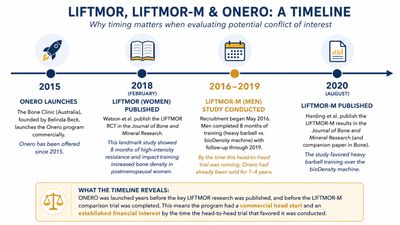
And it wasn't an independent comparison. Two of the study's authors were directors of The Bone Clinic, the organization that developed and sells the Onero barbell program [1]. By the time LIFTMOR-M was conducted, Onero had already been a commercial program for years.
What the trial actually found
Set aside how the machine arm was run, and look at the bone-density numbers themselves. They're thinner than the headline.
The trial's primary outcome - femoral-neck bone density - showed no significant difference between any group, and neither did total hip. At the femoral neck, the untrained control group gained as much as the machine arm. The barbell group's one clear edge was at the lumbar spine, a secondary site - and even that reached significance in one statistical analysis but not the more conservative one.
Then there's measurement error - and here the trial was actually careful. Rather than relying on manufacturer specifications, the investigators measured precision on their own Medix DR scanner, exactly as the ISCD recommends. Using those values, the least significant change - the smallest shift that can be told apart from the scanner's own error - was 2.5% at the lumbar spine, 4.2% at the femoral neck, and 2.4% at the total hip. Against that bar:
| DXA site (LSC) | Barbell | Machine | Control | Clears its LSC? |
|---|---|---|---|---|
| Lumbar spine (2.5%) | +4.1% | +2.0% | +0.9% | Only the barbell group |
| Femoral neck (4.2%) (primary) | +2.4% | +1.5% | +1.8% | None |
| Total hip (2.4%) | +1.2% | +0.8% | +1.2% | None |
Out of every bone-density result in the study, exactly one cleared the scanner's own measurement error: the barbell group's lumbar-spine gain. The primary femoral-neck outcome didn't reach its threshold in any group - and at that site the control group gained more than the machine. The machine, for its part, raised spine BMD about +2.0% on its own, just shy of the threshold.
And it lands in the wrong place. As we saw, these men's spines were already at normal, young-adult density at baseline - so the trial's one measurable gain happened in bone that wasn't even osteopenic, while the hip and femoral neck, where they actually had bone loss, showed no significant between-group benefit.
What the trial can't tell you
Even at face value, one trial of 93 screened, supervised men over 8 months answers "can this happen under ideal conditions?" - not "what works for ordinary people over years." That's the difference between trial proof and track-record proof: one shows a result is possible once; the other shows the same result again and again in real life. For a decision you'll live with for decades, the second matters at least as much.
Barbells build bone - but who can actually do them?
I'm not recommending heavy lifting to women who have osteoporosis - and if you know someone who's broken a bone before, you'll know exactly why. But suppose you take the barbell result at full strength anyway. There's still the practical question the trial can't address: who can safely do this? A heavy deadlift or squat is a technical lift with a real learning curve, and the load that builds bone only arrives after you've built the skill to handle it. The weight a deconditioned 70-year-old can safely move often stays below the bone-building threshold for a long while. And the jumping-impact component is frequently cautioned against for people with existing vertebral fractures, severe osteoporosis, joint replacements, or balance concerns [1] - often the very people whose bones need loading most.
So even on its best reading, LIFTMOR-M points to a path many at-risk people can't safely take.
What actually builds bone for most people
If the barrier is reaching the threshold safely, and the flaw in the trial is that the machine was never tested as designed, the obvious question is what osteogenic loading looks like done properly.
You generate force against robotic Spectrum devices, working from a coached position to drive force up to a high multiple of your body weight - about 15 minutes once a week, fully coached, no skill ramp and no impact. That's also why the coaching is the whole ballgame, not a nicety - on a device where you generate the force, the right position is the difference between loading bone and just going through the motions, which is why our coaches complete three weeks of full-time certification before they run a single session.
It also lets you do something a barbell can't: progress in tiny, consistent steps. Loading from a fixed, coached position means the resistance can be advanced in increments as fine as a single degree of joint-angle adjustment - enough to keep raising the load while keeping you in your strongest range of motion the whole way, where a barbell is capped by the weakest point in the lift and moves in whole-plate jumps. That steady, fine-grained progression in the strongest range is what keeps the load above your habitual threshold over time instead of stalling - another reason exact positioning, not raw effort, is what makes or breaks the result.
And because the device measures it, you get the number LIFTMOR-M left out: your force output in pounds, every visit. As we cover in how to know your training is working before your next DEXA, that weekly number is how you confirm you're still exceeding your habitual load. The proof shows up where it counts: more than 100 Austin-area physicians refer their patients to our centers, and among members who follow the weekly protocol and bring us a before-and-after DEXA, 8 out of 10 show measurable gains on that next scan - we only count results we can verify against a scan. And we encourage every member to re-scan regardless of what their numbers show, so that figure reflects the members who keep training - not only the ones who already sensed they were improving. You can see it in our members' real DEXA stories.
Barbell vs. osteogenic loading, at a glance
| Heavy barbell (LIFTMOR-M / Onero) | Osteogenic loading (OsteoStrong) | |
|---|---|---|
| Loading method | Heavy free-weight barbell + jumping impact | Robotic Spectrum devices, coached position |
| Reaching the threshold | Add plates over time; capped by skill & joints | Force in multiples of body weight, self-limited |
| Skill required | Significant - barbell technique | Minimal - coached each visit |
| Joint impact | High (by design) | None |
| Session | ~30 min, 2x/week | ~15 min, 1x/week |
| Frail / high-fracture-risk fit | Limited; impact often cautioned | Well suited, with medical clearance |
| Effort verified? | 1RM testing sets the load | Force output measured every visit |
| Evidence type | One head-to-head trial (thin, primary outcome null) | Real-world track record; of members with pre/post DEXA, 8 in 10 see gains |
| Safety profile | Heavy free weights + impact loading | No free weights or impact - controlled loading |
What's actually at stake
Here's the part the "just lift heavy" message never mentions: the cost of waiting. The longer bone loss goes unaddressed, the harder it becomes to regain what's lost. And the sequence rarely starts with a diagnosis. It starts with a fall, then a fracture, then a hospital stay, then the slow erosion of living on your own terms. Roughly one in two women over 50 will break a bone because of osteoporosis. Picking a path you can sustain beats waiting for the perfect one you never start.
The verdict: did LIFTMOR-M prove barbells beat osteogenic loading?
No. It compared barbells to a stripped-down version of the machine - a static hold the technology's own inventor says isn't osteogenic loading, run by someone not trained in the method, at the wrong frequency, with the actual loads produced never reported, in a trial co-authored by the barbell program's owners. Its primary outcome came back null, and the single bone-density change that cleared the scanner's measurement error was at one secondary site, in bone that was already normal.
None of that means heavy lifting doesn't build bone - it clearly can. It means this one trial isn't the verdict on osteogenic loading it's made out to be. If you love the barbell and your body tolerates it, lift - it's a legitimate path. If you can't, the research doesn't say you're out of options; it says you need to reach the same threshold another way. If you're weighing that against where you are today, starting OsteoStrong in your 60s, 70s, or 80s walks through what the first months really look like.
References
- Harding AT, Weeks BK, Lambert C, Watson SL, Weis LJ, Beck BR. A Comparison of Bone-Targeted Exercise Strategies to Reduce Fracture Risk in Middle-Aged and Older Men with Osteopenia and Osteoporosis: LIFTMOR-M Semi-Randomized Controlled Trial. J Bone Miner Res. 2020;35(8):1404-1414. doi:10.1002/jbmr.4008
- OsteoStrong. OsteoStrong is NOT Isometrics. OsteoStrong Franchising, Inc. https://www.osteostrong.me/testimonial/osteostrong-is-not-isometrics-work-smarter-with-osteostrong/
- Jaquish J, interviewed by Durak E. Jaquish Biomedical, May 2019. https://www.jaquishbiomedical.com/blogs/press/2019-05-09-eric-durak
- Watson SL, Weeks BK, Weis LJ, Harding AT, Horan SA, Beck BR. High-Intensity Resistance and Impact Training Improves Bone Mineral Density and Physical Function in Postmenopausal Women With Osteopenia and Osteoporosis: The LIFTMOR Randomized Controlled Trial. J Bone Miner Res. 2018;33(2):211-220. doi:10.1002/jbmr.3284
This article is for general education and is not medical advice. Onero is a registered program of its respective owners; we are not affiliated with it. Talk to your own doctor before starting, stopping, or changing any exercise program - especially if you have existing fractures or a diagnosis of osteoporosis.
Your simple plan from here
- Book your free Bone Health Call. 15 minutes, phone or Zoom, no pressure.
- Come in for a guided first session. A coach walks you through all four devices.
- Track your strength week after week. 15 minutes, once a week. The numbers rise.
Frequently asked questions
Is OsteoStrong safe if I already have osteoporosis?
We hear this one a lot, and the honest answer is that a new osteoporosis diagnosis is exactly why most of our members walked in. You stay in complete control the entire session - the devices don't move, you push against a fixed resistance, and a certified coach is beside you cueing every breath. More than 100 Austin-area physicians refer patients here, including women with severe DEXA results. The safest next step is simply to talk to us. Book your free 15-minute Bone Health Call and we'll walk through your DEXA together.
Can I really build bone density at my age?
Yes, and the question tells us you already suspected the answer. Bone is living tissue that responds to a specific mechanical signal at any age. Our members in their 70s, 80s, and 90s routinely see measurable DEXA improvements, and 8 out of 10 who follow the weekly protocol see bone density gains on follow-up scans. If your doctor has told you 'it's just age,' that's half the story. The best way to find out what's possible for your body is a free Bone Health Call.
What actually happens during a session?
Most women show up nervous and leave surprised at how simple it was. You arrive in street clothes, meet your coach, and walk through four supported devices that produce the exact force your bones need to rebuild. Total time: about 15 minutes. No cardio. No sweat. No locker room. You never change clothes. Most members come on their lunch break.
Do I really only need to come once a week?
Yes, and we know that sounds too easy to be real. When your body receives the osteogenic-loading signal, it keeps rebuilding for 7 to 10 days afterward. More frequent sessions don't produce more results - consistency, once a week, is what creates lasting change. This is the whole reason this method works for women over 50 who do not want a gym routine.
How is this different from going to the gym?
A regular gym trains muscles, which is wonderful but doesn't move the needle on bone. Research suggests bone only rebuilds when it receives roughly 4.2 times your body weight in force - a level you cannot safely produce with free weights, yoga, or Pilates. OsteoStrong's devices let your body generate that precise force safely, in four short efforts, in 15 minutes. Same room. Same coach. Every week.
What does it cost?
We know price is on your mind, and we respect that. We don't post pricing online because memberships vary by location and household (individual, couple, family). Your free 15-minute call covers pricing, location options, and any questions about your specific situation - no sales pressure, no long form to fill out in between.
Will my doctor approve?
Most do. Over 100 Austin-area physicians already refer patients to us, and we're glad to send educational materials to yours. We always recommend sharing your DEXA results with us so we can track your progress alongside your physician's plan. If it helps your decision, ask your doctor what she thinks of osteogenic loading - and then book your free call.
What if I've never exercised?
You are exactly who this was built for. Most of our members aren't athletes. You do not need to be fit, flexible, or experienced, and you will not be asked to do anything your body cannot do. A certified coach is beside you every session, adjusting everything to you. If you've been avoiding gyms for 30 years, this is the place you don't have to.
Do I have to sign a long contract?
No surprises here. We offer month-to-month and longer memberships, and the pros and cons of each are walked through on your free call. We'll never pressure you into a commitment that doesn't fit your situation.
How soon will I feel a difference?
Most members notice improvements in energy, balance, and posture within the first 4 to 6 weeks - long before any DEXA change. On DEXA, the typical pattern is a halt of bone loss in year one with measurable density gains showing up in year two. Bone remodels slowly. We plan the journey in years, not months, and your weekly force-output numbers give you something to watch in the meantime.
How does OsteoStrong help with osteoporosis?
Osteoporosis means your bones have lost enough mineral that a simple fall can become a fracture. OsteoStrong adds the one thing your body cannot get from medication alone: the mechanical signal that tells bone to rebuild. Four devices, 15 minutes a week, and a coach who has seen hundreds of women in your exact spot. The best first step is a free Bone Health Call where we look at your DEXA together.
Is OsteoStrong a replacement for my osteoporosis medication?
No - we're not here to replace your doctor or your prescriptions. We're here to give you a simple weekly routine that supports your bone health alongside your medical plan. Some members, after sustained DEXA gains, have worked with their physician to taper or discontinue medications. That decision is always between you and your doctor, never between you and us.
Is OsteoStrong right for postmenopausal women?
It's built for you. Postmenopausal women are our largest group of members, because menopause is when bone loss accelerates and estrogen protection drops. Osteogenic loading delivers the signal your body needs without the high-impact movement that menopausal joints often cannot tolerate. If that sounds like the season you're in, book your free call.
Does insurance cover OsteoStrong?
Usually not, and we'll give you the straight answer: OsteoStrong is a non-pharmaceutical wellness service, so most U.S. insurance plans don't cover it. Some members use HSA or FSA funds. Your free Bone Health Call covers pricing and payment options for your specific situation.
How is OsteoStrong different from physical therapy or the gym?
Physical therapy is medical rehabilitation and usually ends when you've recovered. A gym provides general exercise but rarely reaches the force threshold associated with bone rebuilding. OsteoStrong is a single-purpose service focused on triggering the osteogenic-loading signal. One coach, four devices, 15 minutes, once a week, indefinitely. Many of our members keep their PT or their gym and simply add OsteoStrong for bone health.
What happens if I don't do anything about bone loss?
This is the question we wish more women asked, and we'll give you a gentle but honest answer. Bone loss is quiet. It compounds year after year until a simple trip becomes a fracture. One in two women over 50 will break a bone because of osteoporosis in her lifetime. Forty percent of hip-fracture patients lose the ability to live independently, and nearly one in four dies within a year. Those are the stakes. The good news: the next step is small, it's free, and it's a 15-minute phone call. Book your free Bone Health Call - we'll meet you where you are.
I'm scared. What should I do first?
Of course you are. Bone loss is a quiet thing that suddenly becomes very loud at a doctor's appointment, and no one sat with you and walked through what comes next. Start with the smallest, safest step: book a free 15-minute Bone Health Call. It's a phone or Zoom conversation with someone who has helped hundreds of women in your exact situation. We'll read your DEXA with you, answer your questions, and help you decide whether to come in. You don't commit to anything. You just get a real person to talk to.
What is the LIFTMOR-M study?
LIFTMOR-M (Harding et al., 2020) is the men's follow-up to the well-known LIFTMOR trial. Over 8 months it compared three groups of older men: high-intensity barbell training (deadlift, squat, overhead press plus jumping), a machine-based isometric program on the bioDensity device, and a non-randomized control. It is the only trial that has put heavy barbell training head-to-head against osteogenic loading, which is why it gets cited in that debate.
Did LIFTMOR-M prove barbells beat osteogenic loading?
No. It favored barbells at one secondary site (the lumbar spine), while its own primary outcome - femoral-neck bone density - showed no significant difference between any group. And the machine arm wasn't osteogenic loading as the method is delivered: it was run as a static 'isometric' hold (which the technology's inventor says isn't osteogenic loading), supervised by a general exercise scientist rather than a method-certified coach, with the actual loads participants produced never reported, at twice the manufacturer's recommended frequency.
Was the osteogenic-loading (bioDensity) arm done correctly?
Not the way the method is actually performed. The trial ran it as a single self-initiated static contraction, twice weekly - contrary to the device maker's once-weekly protocol - supervised by a university exercise scientist with no osteogenic-loading certification. The device's load cells recorded the force each man produced, but the actual values were never reported - only percentage changes - so there's no way to know whether participants were loaded hard enough to expect a result.
What were the actual bone-density results?
Lumbar spine: barbell +4.1%, machine +2.0%, control +0.9%. Femoral neck (the primary outcome) and total hip: no significant difference between any group. Using the trial's own scanner precision, the least significant change was about 2.5% at the spine and 4.2% at the femoral neck - and only the barbell group's spine gain cleared that threshold. Every other change, including the primary outcome, fell within the scanner's measurement error.
Is there a conflict of interest in LIFTMOR-M?
Yes, and it's disclosed in the paper: two authors are directors of The Bone Clinic, which sells the commercial barbell program (Onero). That program had been operating commercially since 2015, several years before this comparison trial was completed. A disclosed conflict doesn't make findings wrong, but it's a reason to read a competitor comparison carefully - especially when the data that would test the machine fairly was never reported.
What's a better-supported way to load bone without a barbell?
Osteogenic loading done as designed: a trained coach positions you to generate force in multiples of your body weight, the force is measured every visit, and the protocol runs about 15 minutes once a week. That's the OsteoStrong model. Its case rests on a real-world track record - more than 100 Austin-area physicians refer patients, and among members who follow the weekly protocol and bring in both a baseline and a follow-up DEXA scan, 8 in 10 show measurable gains - we only count what a scan can verify.