The natural ways to reverse bone loss, ranked by how much each one moves, are: mechanical loading strong enough to make bone adapt, enough protein, vitamin D and calcium (food first), balance training to prevent the fracture while density rebuilds, sleep and stress management, cutting alcohol and smoking, and reviewing medications that cause bone loss with your physician. Loading is the only lever that tells bone to get denser; the rest supply the materials or remove the drag. Together they can move a DEXA, and members at OsteoStrong Austin and Georgetown have gone from osteopenia back to normal on this kind of plan, alongside their physician's care.
What "reverse" means before you rank anything
"Reverse bone loss" can mean a percentage gain on your DEXA, a category change (osteopenia back to normal, osteoporosis back to osteopenia), or a lower fracture risk. All three are real, and they move at different speeds. We answer the yes-or-no question in can you reverse osteoporosis without medication? and lay out the four-pillar plan in osteoporosis treatment without medication. This article is the ranking: which natural levers move the number most, and what each one realistically does.
One principle organizes the list. Bone is built by two inputs: a signal that tells it to get stronger, and materials to build with. Almost everything called "natural" is a material or a drag-remover. Only one item is a signal.
The natural ways to reverse bone loss, ranked by effect size
1. Mechanical loading above the adaptation threshold
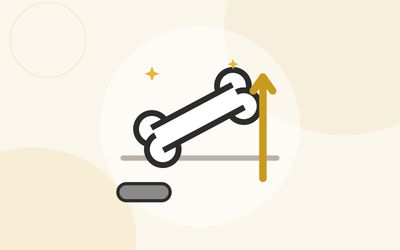
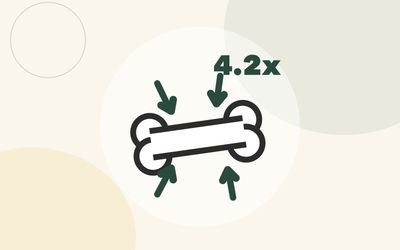
The biggest lever by a wide margin, and the only one that gives bone a reason to get denser. Bone follows Wolff's law and Frost's mechanostat: it adapts to strain above a threshold and ignores strain below it. Research on hip bone (Deere and colleagues, 2012) associates meaningful adaptation with loads of roughly 4.2 times body weight. Walking, swimming, and most classes stay far below that. Heavy barbell work can reach it but is capped by the weakest point in your range of motion, a real limit for a woman with a low spine T-score.
Osteogenic loading was designed to cross the threshold safely: you push against a fixed device from your strongest joint angle, so the force comes from your own effort with no impact and no weight to drop. In the osteogenic loading study by Hunte and colleagues in the Journal of Osteoporosis and Physical Activity, postmenopausal women averaged a 14.9% hip and 16.6% spine density increase over 24 weeks. Because the stimulus rises as you get stronger (the devices progress in very small joint-angle increments), the gains do not flatten the way a fixed routine does. The science of osteogenic loading goes into the mechanism.
What it realistically moves: DEXA percentage gains and, over 18 to 36 months, category changes.
2. Protein, every meal
Bone is a collagen scaffold with mineral packed into it, and collagen is protein. Under-eating it is one of the most common reasons a well-intentioned plan stalls, especially in women who are dieting or simply eating less after 60. Protein also builds the muscle that pulls on bone and catches you when you trip. Aim for a solid serving at every meal; how much protein you actually need has the numbers.
What it realistically moves: it does not raise density on its own; without it the loading signal has nothing to build with.
3. Vitamin D and calcium, food first
The NIH Office of Dietary Supplements sets the calcium RDA for women 51 and older at 1,200 mg a day, food first: dairy, canned fish with bones, leafy greens. Vitamin D is 600 IU a day to age 70 and 800 IU after, with a tolerable upper limit of 4,000 IU, and many physicians target a 25-hydroxyvitamin D blood level of at least 30 ng/mL. Get the blood test; Texas sun is no guarantee. Magnesium (320 mg a day for women 31 and older) helps activate vitamin D, and vitamin K2 has promising but mixed evidence. Our supplements guide ranks each one.
What it realistically moves: correcting a deficiency matters a lot; adding more on top of adequate does little. Calcium and D are materials, not a signal.
4. Balance and reaction-time training
This one does not move your DEXA, and it belongs this high on the list anyway, because the point of reversing bone loss is to not fracture and most fractures begin with a fall. Reflexive balance and reaction time are trainable in your 60s and 70s, and they improve in months rather than years. Our fall prevention and balance training page covers what works.
What it realistically moves: fracture risk, starting within weeks.
5. Sleep and stress
The hormones that govern bone remodeling follow sleep and stress rhythms, and chronically high cortisol works against bone formation (the same reason long-term steroid medication causes bone loss). Prioritize seven to eight hours and get sleep apnea treated if you have it. This lever is real but modest.
What it realistically moves: the background conditions; not a number you will see on a scan by itself.
6. Alcohol and smoking
Both are FRAX risk factors. Smoking slows bone formation and blood supply; heavy drinking (three or more drinks a day is the FRAX threshold) interferes with calcium and raises fall risk the same night. Quitting removes a drag rather than adding a signal, but the drag is large.
What it realistically moves: the rate of loss, and fall risk.
7. Reviewing medications that cause bone loss
Long-term corticosteroids, some acid-reducing medications, certain seizure and breast-cancer drugs, and rapid weight-loss medications can all accelerate bone loss. This lever belongs to your physician: never stop or change a medication on your own, but ask for the review. Sometimes a dose, a duration, or an alternative can be adjusted.
What it realistically moves: the rate of loss, sometimes substantially.
The ranking at a glance
| Lever | Signal or material? | What it realistically moves |
|---|---|---|
| Loading above threshold | Signal | DEXA percentage and category |
| Protein | Material | Enables the gains; muscle for fall protection |
| Vitamin D and calcium | Material | Big if deficient, small if already adequate |
| Balance training | Protection | Fracture risk, within weeks |
| Sleep and stress | Drag remover | Background conditions |
| Alcohol and smoking | Drag remover | Rate of loss and fall risk |
| Medication review | Drag remover | Rate of loss, with your physician |
Why walking and diet alone rarely reverse bone loss
The two most common "natural" plans are walking more and eating better. Both are good for you. Neither reverses bone loss for a skeleton that has been walking for sixty years, because your bones adapted to that load decades ago and food only supplies materials: lumber delivered to a job site where nobody has been told to build. We unpack the research in does walking build bone? and the food side in what foods help build bone density. Keep both. Add the signal.
Two members whose osteopenia went back to normal
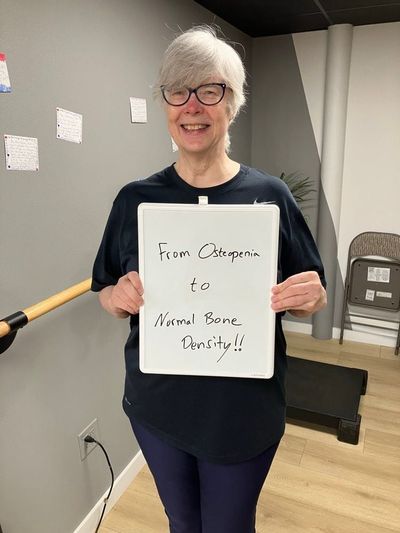
Kaye: from osteopenia to normal bone density
Follow-up DEXA reclassified from osteopenia to normal
Kaye came in with the diagnosis most women are told to "watch." She loaded her bones weekly for several years and let the next DEXA answer.
"From osteopenia to normal bone density."
Member-reported DEXA, shared with OsteoStrong Austin. Full case study.

Marjorie: normal after 15 years of osteopenia
DEXA normal at spine and femoral neck after 18 months
Marjorie had worked the natural list for 15 years: barbell weightlifting, a lot of walking, and hormone therapy with her physician. The DEXA kept sliding until she added an above-threshold signal.
"I was doing barbell weightlifting, walking a lot, doing the things you're supposed to do for bone density. I went on hormone therapy. None of it was making it stop."
"I just had my DEXA and I'm normal. After 15 years of being osteopenic. I didn't think I would ever get to normal. This place works."
Verbatim from Marjorie's on-camera testimonial. Full case study.
Walking, lifting, and hormone therapy were all in place. What was missing was lever number one.
When natural is not enough on its own
Some starting points call for medication as well: a prior fragility fracture, a T-score well below -2.5, a FRAX score above the U.S. treatment thresholds (20% ten-year major fracture risk or 3% hip, per BHOF guidance), or bone loss driven by a medical cause. That is a reason to run both at once: medication works on chemistry, loading on the mechanical signal, and they do not compete. Whether medication belongs in your plan is a decision that belongs to you and your physician. If hormone therapy is part of your picture, HRT for bone health covers how it fits with loading.
What this looks like at OsteoStrong
Lever one and lever four are what a weekly OsteoStrong session delivers: about 15 minutes on four devices, in street clothes, with a coach beside you. On each device you push or pull from your strongest joint angle, producing force in the bone-building range with no impact and nothing to drop. Your force output is measured every session, so you can watch the signal grow long before the next scan, and the balance plate in the same visit trains the reflexes that keep a stumble from becoming a fracture. Levers two through seven are yours and your physician's, and we talk through all of them on the Roadmap call.
Among members who follow the weekly protocol and complete a follow-up DEXA, 8 out of 10 see measurable improvement; consistency and starting point are the biggest factors. Member scans are read by independent imaging providers, not by us. How long it takes to improve bone density covers the timeline, and our osteopenia support page is the place to start if your scan is in the early band. More than 100 Austin-area physicians refer patients to us.
The bottom line
The natural ways to reverse bone loss are not equal. One of them, mechanical loading above the adaptation threshold, is the signal that tells bone to get denser. Protein, vitamin D, and calcium are the materials. Balance training prevents the fracture while density rebuilds. Sleep, alcohol, smoking, and a medication review remove the drag. Do the whole list, but put the signal first, because a skeleton with every material and no signal stays exactly where it is.
Want to know which levers matter most for your scan? Book a free Bone Health Roadmap Call, bring your DEXA, and we will walk through it with you.
Full case studies referenced in this article
Browse the case studies hub or read the verification standard behind every number above.
This article is for general education and is not medical advice. Talk to your own doctor before starting, stopping, or changing any medication, supplement, or exercise program, especially if you have a diagnosis of osteopenia or osteoporosis.
Your simple plan from here
- Book your free Bone Health Call. 15 minutes, phone or Zoom, no pressure.
- Come in for a guided first session. A coach walks you through all four devices.
- Track your strength week after week. 15 minutes, once a week. The numbers rise.
Frequently asked questions
What are the best natural ways to reverse bone loss?
Ranked by effect size: mechanical loading strong enough to make bone adapt, enough protein at every meal, vitamin D and calcium from food first, balance training to prevent the fracture while density rebuilds, sleep and stress management, cutting alcohol and smoking, and a physician review of medications that cause bone loss. Loading is the only lever that signals bone to get denser; the rest supply materials or remove a drag.
Can you reverse bone loss without medication?
For many women, yes, depending on the starting point. Bone adapts to load above a threshold at any age, and members at OsteoStrong Austin and Georgetown have moved from osteopenia back to normal on follow-up DEXA. Some starting points, such as a prior fragility fracture or a very low T-score, call for medication as well, and that decision belongs to you and your physician. Loading and medication work on different pathways and do not compete.
How much calcium and vitamin D do I need to rebuild bone?
The NIH Office of Dietary Supplements sets the calcium RDA for women 51 and older at 1,200 mg a day, food first. Vitamin D is 600 IU a day to age 70 and 800 IU after, with a tolerable upper limit of 4,000 IU; many physicians target a 25-hydroxyvitamin D blood level of at least 30 ng/mL. Correcting a deficiency matters a lot. Adding more on top of adequate does little, because both are materials, not a signal.
Does walking reverse bone loss?
Walking is good for your heart, mood, and general fall risk, but it does not reverse bone loss for a skeleton that has been walking for decades. Your bones adapted to that load long ago, and research associates new bone formation with loads near 4.2 times body weight, far above what walking produces. Keep walking for everything else it gives you, and add a loading stimulus that crosses the threshold.
How long does it take to reverse bone loss naturally?
Strength and balance improve within weeks to months. DEXA changes take longer because bone remodels over months and a scan only shows a real change once it exceeds the machine's least significant change, usually 3 to 5 percent. Most members re-scan 12 to 24 months after starting; Marjorie's DEXA came back normal at 18 months after 15 years of osteopenia. Category changes typically take 18 to 36 months.
Do natural methods replace osteoporosis medication?
They are different tools, not substitutes. Medication works on bone chemistry; loading delivers the mechanical signal bone is designed to respond to; nutrition supplies the materials. Many women do all three at once, and more than 100 Austin-area physicians refer patients to OsteoStrong while those patients stay on their prescriptions. Any decision to start, stop, or change a medication belongs to you and your physician. See the full non-drug plan.