Yes, for many women it is possible to reverse osteoporosis without medication, if "reverse" means what it means on a DEXA report: a site that was classified as osteoporotic moves back into the osteopenia or normal range. Bone is living tissue that adapts to load at any age, and loads above roughly 4.2 times body weight are associated with new bone formation. Among OsteoStrong members who follow the weekly protocol and complete a follow-up DEXA, 8 out of 10 see measurable improvement, and several have documented a category change at the spine or hip. Medication is still the right call in specific situations, and that decision belongs to you and your physician. OsteoStrong delivers the mechanical loading signal no prescription provides, alongside whatever plan your doctor sets.
The question behind the question
You are not really asking whether a number can move. You are asking whether you have to take the prescription to be safe, and whether there is something you can do with your own body that counts.
The short version: bone responds to what you ask of it, at 55 and at 80. This article covers what "reverse osteoporosis without medication" means in clinical terms, why bone can respond to load at any age, what the research and our members' DEXA reports show, and when medication is still clearly the right call.
If you want the member roundup, read what women over 50 actually accomplish at OsteoStrong. If you want the plan itself, the four-pillar non-drug osteoporosis plan lays it out. This post is the yes-or-no answer, with the reasoning shown.
What "reverse" actually means on a DEXA
"Reverse" gets used loosely. It can mean three precise things.
1. Category reversal
The WHO defines osteoporosis by T-score: normal is above -1.0, osteopenia is -1.0 to -2.5, and osteoporosis is -2.5 and below. Category reversal means a site that was at or below -2.5 rises above it. Your report no longer says osteoporosis at that site. This is the definition most people mean.
2. Percent gain
Bone mineral density at a site (grams per square centimeter) went up. To count, the gain has to exceed the scanner's least significant change, usually around 3 to 5 percent depending on the site and the machine. A 1 percent bump is noise. A 9 percent gain at the hip is real.
3. Risk reversal
Your FRAX 10-year fracture probability dropped. FRAX is built on your femoral neck T-score plus clinical factors, so a real gain at the femoral neck pulls the risk number down with it. Ruth, an Austin member, watched hers fall from 57% to 24%; her story is in our FRAX article.
All three can happen without a prescription. All three can also happen with one, which is the point we will come back to.
Why bone can respond at any age
Bone is not a fixed structure that wears down. It is living tissue, constantly torn down and rebuilt by two cell types: osteoclasts remove old bone, osteoblasts lay down new bone. After menopause the removal crew starts to outpace the building crew, which is why density drifts down.
Wolff's law, in the medical literature for over a century, says bone adapts to the loads placed on it. Harold Frost's mechanostat refined it: bone has a strain threshold. Below it, bone sees no reason to build. Above it, osteoblasts get to work. That threshold does not disappear with age. Your skeleton at 70 is still listening for the signal. It just is not hearing it, because ordinary activity does not reach it.
How high is the bar? Deere and colleagues, studying hip bone in adolescents, found that meaningful adaptation was associated with loads above roughly 4.2 times body weight, a threshold the osteogenic loading literature has adopted. Walking produces a fraction of that. Most weight-room work is capped by the weakest point in your range of motion, well short of it.
That is why so many women "do everything right" and still watch the scan decline. They are supplying raw materials (calcium, protein, vitamin D) without supplying the signal.
What the evidence shows
Two sources, kept separate on purpose.
Published research. Hunte and colleagues, writing in the Journal of Osteoporosis and Physical Activity, followed postmenopausal women doing osteogenic loading and reported a 14.9% increase in hip density and a 16.6% increase in spine density over 24 weeks. Those are gains of a size that moves categories, not just decimals. The science of osteogenic loading goes deeper on the mechanism and the study.
Our members' DEXA reports. Every scan our members bring in is performed by an independent imaging provider, not by us, and read by their own physician. Among members who follow the weekly protocol and complete a follow-up DEXA, 8 out of 10 see measurable improvement. What separates the 8 from the 2 is consistency (did the weekly session actually happen) and starting point (how far the site had to travel). Three members whose reports document category reversal:
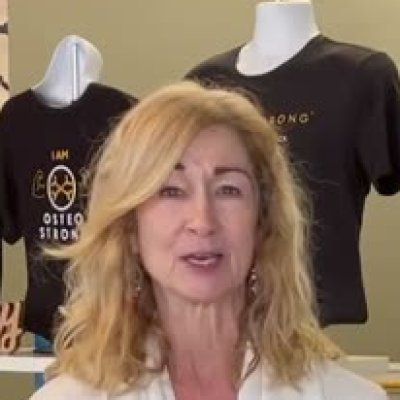
Kathleen: osteoporosis to normal at two sites
Spine and hip from osteoporosis to normal; femur now osteopenia
Kathleen started with osteoporosis at both the spine and the hip, the two-site profile that usually pushes toward the most aggressive prescriptions. She wanted a non-drug plan she could verify on her next scan.
"In my hip and my spine, I'm completely normal. My femur is osteopenia, no longer osteoporosis. I feel like a new person."
Verbatim from Kathleen's on-camera testimonial. Full case study.
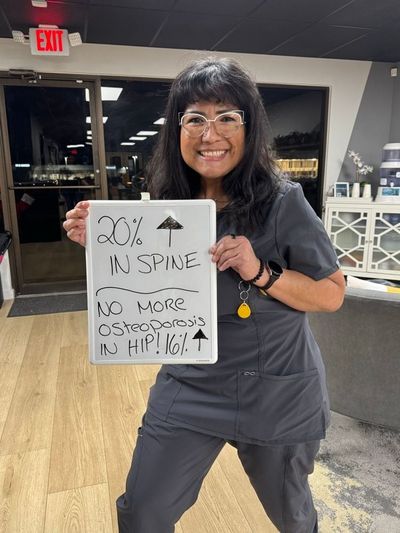
Dora: no more osteoporosis in her hip
Spine +20%, hip +16%, hip no longer osteoporotic
Dora's numbers show two definitions of "reverse" at once: a large percent gain and a category change at the hip.
"20% increase in my spine, and no more osteoporosis in my hip, which went up 16%."
Member-reported DEXA, verified on the whiteboard at OsteoStrong Austin. Full case study.
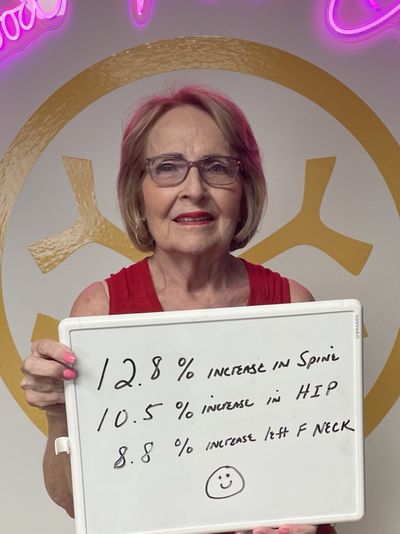
Nicole: her spine is no longer osteoporotic
Spine +12.8%, hip +10.5%, femoral neck +8.8% in 15 months
Nicole came in with an osteoporosis diagnosis and a decision to make. Fifteen months later her follow-up DEXA, read by her own physician, reclassified her spine.
"To my surprise, I found out that my spine no longer was osteoporotic. I improved my bone density by 12.8%, and my hip had improved by 10.5%, and the femoral neck had improved by 8.8%."
Verbatim from Nicole's on-camera testimonial. Full case study.
When is osteoporosis medication still the right call?
Reversing osteoporosis without medication is possible. That is not the same as saying medication is never the answer. Physicians lean toward a prescription, often with good reason, when:
- You have already had a fragility fracture. A break from a fall from standing height, or from less, is the single strongest predictor of the next one. Physicians treat it as an urgent signal from your skeleton, and the next fracture does not wait for a remodeling cycle.
- Your T-score is well below -2.5. The further a site is from the threshold, the longer any non-drug plan needs to bring it back, and the more time you spend exposed.
- Your FRAX is high. The U.S. thresholds from the Bone Health & Osteoporosis Foundation are a 20% ten-year major osteoporotic fracture risk or a 3% hip fracture risk.
- There is a secondary cause. Long-term steroids, thyroid or parathyroid disease, celiac disease, and certain cancer treatments accelerate loss. The cause needs treating, and the bone often needs protection in the meantime.
In each of these, the medication does a job loading cannot do on the timeline that matters: it protects the bone you have while the slower work of building new bone gets underway. Every drug class is covered in plain English in our osteoporosis medications guide. One thing to know if Prolia (denosumab) is on the table: it must never be stopped without a follow-on plan from your physician, because rebound bone loss and vertebral fractures are well documented when it is simply dropped.
None of this is either-or. Medication works on bone chemistry. Loading supplies the mechanical signal. Many of our members do both, and more than 100 Austin-area physicians refer patients to us while those patients stay on their prescriptions.
What reversing osteoporosis without medication looks like at OsteoStrong
So the answer is yes, for many women, and the number can move the other way. The next question is how. We keep the full drug-free plan (the loading signal, the nutrition, the balance work, and how to track it on DEXA) in one place: how to treat osteoporosis without medication.
Our part of that plan is the signal. One session a week, about 15 minutes, four devices, a coach beside you, in street clothes, with your force output measured every session so you see progress long before a scan can show it. How it works walks through each device. Our session protocols are reviewed on an ongoing basis with the physicians who refer to us. If you are in the Austin area, see how our drug-free osteoporosis treatment alternative in Austin works alongside your doctor.
Before your next appointment, get your actual numbers: the T-score at each site (understanding your DEXA T-score explains each line) and your FRAX if it was calculated. Then ask which of the four conditions above apply to you, and whether adding a loading program changes the plan. Most Austin and Georgetown physicians say go.
The bottom line
Can you reverse osteoporosis without taking medication? For many women, yes: bone adapts to load at any age, the published osteogenic loading data show double-digit gains, and members like Kathleen, Dora, and Nicole hold physician-read DEXA reports that moved a site out of the osteoporosis category. Medication remains the right call after a fracture, at very low T-scores, at high FRAX, or when a secondary cause is driving the loss, and it pairs with loading rather than competing with it. Either way, the mechanical signal is the piece no prescription supplies.
Want to know whether your numbers can move without a prescription? Book a free Bone Health Roadmap Call, bring your DEXA, and we will walk through it with you.
Full case studies referenced in this article
- Kathleen: spine and hip from osteoporosis to normal
- Dora: spine +20%, hip +16%, no more osteoporosis in her hip
- Nicole: spine no longer osteoporotic, +12.8% spine, +10.5% hip
Browse the full case studies hub or read the verification standard behind every number above.
This article is for general education and is not medical advice. Talk to your own doctor before starting, stopping, or changing any medication, supplement, or exercise program, especially if you have a diagnosis of osteopenia or osteoporosis.
Your simple plan from here
- Book your free Bone Health Call. 15 minutes, phone or Zoom, no pressure.
- Come in for a guided first session. A coach walks you through all four devices.
- Track your strength week after week. 15 minutes, once a week. The numbers rise.
Frequently asked questions
Can you reverse osteoporosis without medication?
For many women, yes, in the sense that matters clinically: a DEXA site that was osteoporotic can move back into the osteopenia or normal range through mechanical loading strong enough to trigger bone adaptation, paired with adequate protein, vitamin D, and calcium. Among OsteoStrong members who follow the weekly protocol and complete a follow-up DEXA, 8 out of 10 see measurable improvement. Whether medication belongs in your plan too is a decision for you and your physician.
What does it mean to reverse osteoporosis?
There are three honest definitions. Category reversal means a site's T-score rises above -2.5, so it is no longer classified as osteoporotic. Percent gain means bone mineral density at a site increased by more than the scanner's least significant change, typically 3 to 5 percent. Risk reversal means your FRAX 10-year fracture probability dropped. The first is the one most people mean, and it is the one several of our members have documented on physician-read scans.
Can bone density increase after 60 without drugs?
Yes. Bone remains living tissue for life and adapts to the loads placed on it at any age, a principle known as Wolff's law. What changes with age is not the ability to respond but the size of the stimulus required. Loads above roughly 4.2 times body weight are associated with new bone formation, which is why walking and light weights rarely move a DEXA and osteogenic loading can.
How long does it take to reverse osteoporosis naturally?
Bone remodels in cycles measured in months, so physicians space follow-up DEXA scans 12 to 24 months apart. Our members who moved out of the osteoporosis category documented it on scans taken 15 to 18 months after starting, with continued gains on later scans. Strength and balance improve much sooner, usually within weeks, and are measured every session. See how long it takes to improve bone density for the full timeline.
When is osteoporosis medication still the right choice?
Physicians generally lean toward medication when there has been a prior fragility fracture, when a T-score is well below -2.5, when FRAX shows a 10-year major fracture risk of 20 percent or more or hip fracture risk of 3 percent or more, or when bone loss has a secondary cause that needs treating. Medication and mechanical loading work on different pathways, so many of our members do both. If you are on Prolia, never stop it without your physician's exit plan.
Does OsteoStrong replace osteoporosis medication?
No. OsteoStrong is a non-pharmaceutical option that delivers the mechanical loading signal medications do not, and it works alongside any prescription. More than 100 Austin-area physicians refer patients to us while those patients stay on their medication. Some members later revisit their prescription with their doctor after sustained DEXA gains; that decision always belongs to the member and her physician.