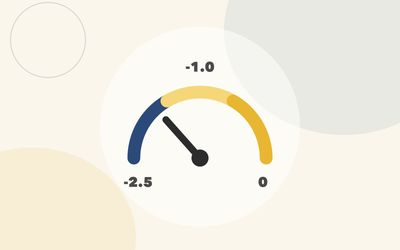
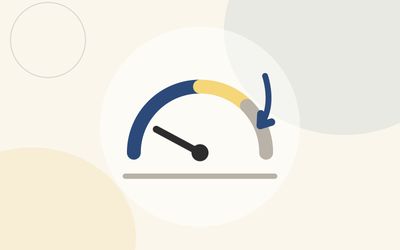
Your DEXA scan results drive treatment through three numbers. The lowest T-score among your lumbar spine, total hip, and femoral neck sets your label: normal above -1.0, osteopenia from -1.0 to -2.5, osteoporosis at -2.5 and below (WHO), and the lowest site rules, so a normal spine with an osteoporotic hip is osteoporosis. FRAX turns your femoral neck T-score plus clinical factors into a 10-year fracture risk, and U.S. guidance uses 20% major or 3% hip risk as thresholds for considering medication. A fragility fracture overrides both. The Z-score, which compares you to your own age, flags secondary causes. Every branch of the resulting plan includes mechanical loading, nutrition, and balance work, which is where osteogenic loading at OsteoStrong fits alongside your physician's decision.
The report in your hand
The letter says one word. The report behind it has four T-scores, a Z-score, a percentage or two, and a line about "least significant change" that nobody explained. Somewhere in there is the number your physician is actually deciding on, and this article is about finding it.
If you want the basics of what a T-score is, read what your DEXA T-score actually means first. If you need a scan or want to know where to get one locally, see DEXA scans in Austin. This article assumes you have the report and asks the next question: what do the DEXA scan results mean for treatment?
Which DEXA scan results drive treatment decisions?
A standard DEXA measures the lumbar spine (usually L1 through L4 averaged) and one or both hips, reporting the total hip and the femoral neck separately. For each site you get:
- BMD in g/cm², the raw density. Useful for percent change between scans, not for diagnosis.
- A T-score, your density compared to a healthy young adult. This is the diagnostic number after menopause.
- A Z-score, your density compared to women your own age. This is the number that flags secondary causes.
Then comes FRAX, the 10-year fracture-risk estimate built from your femoral neck T-score and clinical factors. And sitting above all of it is your fracture history: a fragility fracture (a break from standing height or less) is osteoporosis by definition, whatever the T-scores say.
Your treatment recommendation comes from those pieces in roughly that order: fracture history, then the lowest T-score, then FRAX, then the Z-score if something looks unusual.
Why the lowest site rules
The WHO categories are simple: normal above -1.0, osteopenia from -1.0 to -2.5, osteoporosis at -2.5 and below. The rule that surprises people is which site gets used. Diagnosis is made on the lowest T-score among the spine, total hip, and femoral neck. Not the average. Not the one that looks best.
So a report reading spine -0.8, total hip -2.1, femoral neck -2.6 is osteoporosis, driven entirely by the femoral neck. It reflects how fractures happen: bone breaks at its weakest site. The femoral neck is the fracture site that matters most for exactly this reason.
What a normal spine with an osteoporotic hip means
It means your diagnosis is osteoporosis, and your physician's attention goes to hip fracture risk. It also raises a question worth asking out loud. Lumbar spine readings can be pushed artificially high by degenerative changes: arthritis, bone spurs, calcified ligaments, and old compression fractures all add density to the picture without adding strength. Physicians sometimes exclude an outlier vertebra or lean on the hip readings for this reason. If your spine and hip disagree by a wide margin, ask which one your plan is built around.
What does a Z-score mean?
The T-score asks "how do you compare to peak bone?" The Z-score asks "how do you compare to women your age?" After menopause, the T-score drives diagnosis. Before menopause, or under 50, the Z-score is the one that matters.
For treatment, the Z-score is a smoke detector. A Z-score well below zero means you are losing more bone than age and menopause explain, and that prompts a search for a secondary cause: an overactive parathyroid, thyroid disease, celiac disease, kidney disease, vitamin D deficiency, or a medication such as long-term steroids. Finding and fixing the cause can matter more than any bone medication. Our article on whether you should see an endocrinologist covers when that workup is worth a specialist.
How FRAX turns your DEXA into a decision
FRAX takes your femoral neck T-score and adds age, sex, body mass index, prior fracture, parental hip fracture, smoking, steroid use, rheumatoid arthritis, secondary causes, and alcohol. It produces two numbers: 10-year risk of a major osteoporotic fracture and 10-year risk of hip fracture. BHOF guidance in the United States treats 20% major fracture risk or 3% hip fracture risk as thresholds for considering medication.
This is why two women with the same T-score can get different recommendations. A -2.2 femoral neck at 58 with no other risk factors and a -2.2 at 74 with a mother who broke her hip produce very different FRAX numbers. The femoral neck is also the one FRAX input you can move. Ruth, an Austin member, watched her 10-year fracture risk drop from 57% to 24%, and we walk through how in lowering your FRAX fracture risk without medication.
From numbers to a treatment plan
Here is how the pieces usually map to a recommendation. Your physician may weigh them differently, but this is the shape of it:
- A fragility fracture, at any T-score: medication is commonly recommended, and the fall that caused it gets as much attention as the bone.
- Osteoporosis by T-score (-2.5 or below at any of the three sites): medication is commonly recommended, with the class chosen by how low, which site, kidney function, dental plans, and tolerance.
- Osteopenia with FRAX above the thresholds: medication is considered, and the conversation is a real one in both directions.
- Osteopenia with FRAX below the thresholds: a non-drug plan and a scheduled re-scan, with triggers agreed in advance.
- Normal: prevention, and a baseline to compare against later.
Every prescribing decision belongs to you and your physician; nothing about your numbers is a reason to start, stop, or change a medication on your own. And every branch includes the non-drug work: a mechanical loading signal, protein and the raw materials, and balance. The four-pillar non-drug plan is the floor under every one of those recommendations, not an alternative to the top ones.
Setting a benchmark for your next scan
Turn this report into a target for the next one. Four steps:
- Write down each site's T-score and BMD, not just the label. The label can stay the same while the numbers move a lot.
- Ask for the scanner's least significant change. It is typically around 3 to 5 percent depending on the site and machine. A change smaller than that is inside the noise; a change larger than that is real. Bone remodels over months, which is why follow-up scans are usually 12 to 24 months apart.
- Book the next scan on the same machine. Different machines add noise you cannot subtract out. Medicare covers a screening DEXA every 24 months for eligible people; ask whether your situation justifies 12.
- Track something between scans. Force output, balance time, grip strength. Knowing your bone training is working before your next DEXA is what keeps people showing up long enough for the scan to move.
What site-specific gains look like at OsteoStrong
Bone adapts to mechanical strain above a threshold (Wolff's law), and osteogenic loading at our Austin and Georgetown centers delivers that load in your strongest range of motion, on four devices, with a coach beside you, in about 15 minutes once a week, with no impact. Member DEXAs are performed by independent imaging providers, not by us. Two follow-up reports show what site-by-site reading teaches.

Kathleen: two sites reclassified, one still being watched
Spine and hip from osteoporosis to normal; femur now osteopenia, no longer osteoporosis
Kathleen's report is the lowest-site rule in action. Three sites, three different results: two crossed all the way to normal, and the third crossed one line but not two. Her femur, still osteopenic, is the site that sets her current label and the one her physician keeps watching.
"In my hip and my spine, I'm completely normal. My femur is osteopenia, no longer osteoporosis. I feel like a new person."
Verbatim from Kathleen's on-camera testimonial. Full case study.

Jane: back to osteopenia, with the biggest gains at the hips
Osteoporosis back to osteopenia at 18 months; spine +1.8%, hips +5.4% and +8.8%
Jane's numbers show why percent change by site matters. A 1.8% spine change on its own would sit inside most scanners' least significant change. Her hip gains were well outside it, and her overall classification crossed from osteoporosis back to osteopenia. Read as one word, her report says "better." Read by site, it says exactly where.
"I drive an hour and a half each way to come here. I just got my DEXA scan results back and I have gone from osteoporosis back to osteopenia."
Verbatim from Jane's on-camera testimonial. Full case study.
Among members who follow the weekly protocol and complete a follow-up DEXA, 8 out of 10 see measurable improvement, with consistency and starting point as the biggest factors. Whether a change like Kathleen's or Jane's alters a prescription is a decision for the member and her physician, made with the full report on the table. How the loading side pairs with that decision is laid out on our page on drug-free osteoporosis treatment in Austin.
The bottom line
Your DEXA scan results mean something specific for treatment once you know which numbers to look at: the lowest site sets the label, the femoral neck drives FRAX, the Z-score flags a hidden cause, and a fragility fracture outranks all of them. Write down every site, learn your scanner's least significant change, and book the next scan on the same machine so the report has a benchmark to beat. The decision about medication belongs to you and your physician. The decision to give your next report a reason to move is yours, and you can make it this week.
Want to know what your numbers mean for your plan? Book a free Bone Health Roadmap Call, bring your DEXA, and we will walk through it with you, site by site.
Full case studies referenced in this article
- Kathleen: spine and hip from osteoporosis to normal, femur now osteopenia
- Jane: osteoporosis back to osteopenia at 18 months, hips +5.4% and +8.8%
Browse the full case studies hub or read the verification standard behind every number above.
This article is for general education and is not medical advice. Talk to your own doctor before starting, stopping, or changing any medication, supplement, or exercise program, especially if you have a diagnosis of osteopenia or osteoporosis.
Your simple plan from here
- Book your free Bone Health Call. 15 minutes, phone or Zoom, no pressure.
- Come in for a guided first session. A coach walks you through all four devices.
- Track your strength week after week. 15 minutes, once a week. The numbers rise.
Frequently asked questions
What do DEXA scan results mean for treatment?
Three numbers drive the decision. The lowest T-score among your spine, total hip, and femoral neck sets your label: normal above -1.0, osteopenia from -1.0 to -2.5, osteoporosis at -2.5 and below (WHO). FRAX turns your femoral neck T-score plus clinical factors into a 10-year fracture risk; 20% major or 3% hip risk are the U.S. thresholds for considering medication. A fragility fracture overrides both. Every branch of the plan includes mechanical loading, nutrition, and balance work.
Which T-score does the doctor use if my spine and hip are different?
The lowest one. Diagnosis is made on the lowest T-score among the lumbar spine, total hip, and femoral neck, so a normal spine with an osteoporotic hip is osteoporosis. Physicians also read each site on its own: the femoral neck feeds FRAX, and the spine reading can be pushed artificially high by arthritis or compression, which is why a hip reading sometimes gets more weight than the spine number suggests.
What does a normal spine and an osteoporotic hip mean?
It means your diagnosis is osteoporosis, because the lowest site rules, and it means your physician will focus on hip fracture risk specifically. The femoral neck is the site that drives FRAX and the site where fractures cost the most independence. It also raises the question of whether the spine reading is accurate: degenerative changes in the lumbar spine can inflate the number. Ask your physician which site your plan is built around.
What is the difference between T-score and Z-score on a DEXA?
The T-score compares your bone density to a healthy young adult and is the number used for diagnosis after menopause. The Z-score compares you to women your own age and is the number that matters most before menopause or under 50. A Z-score well below zero means you are losing more bone than expected for your age, which prompts a search for a secondary cause such as a parathyroid, thyroid, or absorption problem.
How much does bone density need to change to matter on a DEXA?
More than the scanner's least significant change, which is typically around 3 to 5 percent depending on the site and machine. A change inside that range cannot be separated from measurement noise. That is why follow-up DEXAs are usually 12 to 24 months apart and on the same machine, and why you should ask your physician for the percent change by site rather than a single summary word.
Can DEXA scan results improve enough to change a treatment plan?
Yes. Members at our Austin center have had sites reclassified on follow-up DEXA: Kathleen's spine and hip moved from osteoporosis to normal, and Jane went from osteoporosis back to osteopenia at 18 months with hip gains of 5.4% and 8.8%. Whether a change like that alters a prescription is a decision for you and your physician, made with the full report in hand. What OsteoStrong does is give that report a reason to move.