The best exercise program for osteoporosis is the one that loads bone above its adaptation threshold (roughly 4.2 times body weight, per Deere et al.), does it safely for a fragile spine, and is something you can keep doing for years. LIFTMOR-style supervised heavy lifting and its commercial version, Onero, reach high loads with a barbell and impact and have published trial data. Physical therapy, walking, yoga, and Pilates protect you and improve balance but stay well below the bone-building load. Osteogenic loading at OsteoStrong reaches loads above the threshold with no impact, in about 15 minutes once a week, with a coach beside you, which is why it fits the widest range of women over 50.
You have been told to lift heavy. You have also been told to just walk, to try yoga, and to see a physical therapist. Every source sounds sure, and none of them agree.
This post is the side-by-side: the main exercise programs people consider for osteoporosis, compared on load reached, supervision, spine safety, time, and evidence. We have written in depth about the one head-to-head trial in did the LIFTMOR-M study prove barbells beat osteogenic loading? and about the commercial version in Onero vs. OsteoStrong, so here we stay at the level of choosing.
What "best" has to mean for bone
Bone responds to strain, not effort. Wolff's law and Frost's mechanostat describe the rule: load bone above a threshold and it adapts; load it below and it holds or slowly loses, no matter how tired you feel afterward. Deere and colleagues put that threshold at roughly 4.2 times body weight for hip bone.
That single fact sorts every program into two piles. Programs that reach the threshold can build density. Programs that do not are still worth doing for balance, posture, strength, and fall prevention, but they are protection rather than construction.
A second rule matters just as much: as bone gets stronger, a fixed load produces less strain, so the stimulus has to keep rising or gains stall. The best program is one whose load can keep climbing safely for years, and one you will actually show up for.
LIFTMOR: what the study actually showed
LIFTMOR (Watson et al., 2018) is the trial behind the "lift heavy" advice. Postmenopausal women with low bone mass did eight months of twice-weekly, 30-minute, supervised high-intensity resistance and impact training: deadlifts, back squats, overhead presses, and jumping chin-ups with drop landings, progressed toward heavy loads. The comparison group did a low-intensity home program.
The headline result was a lumbar spine density gain of about 2.9% in the lifting group versus a decline in the control group, with an improvement in posture. It was a well-run trial, and it established that heavy, supervised lifting is feasible and can move the spine in women with low bone mass. Two things sit alongside the headline. The spine gain was modest and close to what a DEXA scanner can reliably detect on an individual scan. And at the femoral neck, the site that matters most for hip fracture, the lifting group roughly held its density while controls lost some; the gain itself was close to zero.
The follow-up in men, LIFTMOR-M (2020), is the only trial that put heavy lifting head-to-head against an osteogenic loading device. Its primary endpoint, femoral neck density, showed no between-group difference, and neither did total hip. Only the spine showed a between-group advantage for barbells, and only in one of two analyses. The device arm was also run differently from the technology's own protocol; our LIFTMOR-M post walks through it point by point.
Onero: the commercial version of LIFTMOR
Onero is the clinic-delivered program built on LIFTMOR-style training: supervised heavy lifting and impact, typically twice a week, delivered by The Bone Clinic in Australia and its licensed providers. The documented timeline matters when you weigh the evidence. Onero was already being delivered commercially by The Bone Clinic in 2015, before the LIFTMOR results were published in 2018 and before LIFTMOR-M (published 2020) was completed. Two LIFTMOR-M authors are directors of The Bone Clinic, a conflict the paper discloses. A disclosed interest does not make findings wrong; it is simply context for reading a comparison trial carefully.
For someone in central Texas, the practical questions are access (Onero is delivered through licensed providers, so check whether one operates near you), whether you are a candidate for heavy barbell work with impact, and whether you can sustain two supervised sessions a week for years. We compare the two paths in more detail in Onero vs. OsteoStrong.
Physical therapy, walking, yoga, and Pilates: what each one is for
None of these reach the bone-building threshold, and each of them earns its place anyway.
- Physical therapy teaches the hip hinge, spine-safe lifting, posture, and balance, and is the right first call after a fracture; its loads are kept low by design. More in physical therapy for osteoporosis: does it help?
- Walking loads bone at a little over one times body weight. It is superb for your heart, mood, and general fitness, and it is not a density program. Our post on whether walking builds bone explains the adaptation trap.
- Yoga and Pilates improve flexibility, core control, and balance at body-weight loads or less, and some positions involve loaded forward bending or twisting that should be modified. The one widely cited yoga study is examined in does yoga build bone?
Keep whichever of these you enjoy, and see safe exercises for osteoporosis for the full green-light, yellow-light, red-light list.
Osteogenic loading: the highest load with the lowest impact
Osteogenic loading is the approach OsteoStrong is built on. Four devices let you generate force in your strongest range of motion, near your maximum, at multiples of your body weight, with no barbell, no impact, and nothing to drop. A coach positions you and stays beside you. The session is about 15 minutes once a week, in street clothes.
Two design details explain why it fits so many women a barbell does not. First, a lift is capped by the weakest point in its range of motion. Osteogenic loading loads you at your strongest angle, which is why the forces reach and exceed the threshold without a heavy object on your back. Second, the progression happens in very small joint-angle increments, so the load keeps rising as bone gets stronger, exactly what the mechanostat requires. Force output is measured every session, so you see the stimulus climb long before your next DEXA.
Members' follow-up scans are performed by independent imaging providers, not by us. Among members who follow the weekly protocol and complete a follow-up DEXA, 8 out of 10 see measurable improvement; consistency and starting point are the biggest factors. More than 100 Austin-area physicians refer patients to OsteoStrong. See how it works.
How do the programs compare side by side?
| Program | Load reached | Supervision | Impact and spine risk | Time per week | Evidence |
|---|---|---|---|---|---|
| LIFTMOR-style heavy lifting | High; barbell near maximum, capped by weakest joint angle | Required, expert | Impact landings; loaded spine; needs lifting competence | About 60 min plus travel | Published RCT (Watson 2018): about 2.9% spine gain in 8 months; femoral neck roughly maintained |
| Onero | Same as LIFTMOR | Required, clinic-based | Same as LIFTMOR | About 60 min plus travel | Built on LIFTMOR; delivered commercially since 2015 through licensed providers |
| Physical therapy | Low by design | Required, licensed PT | Low; spine-safe by training | 1 to 3 visits, time-limited course | Strong for balance, posture, post-fracture function; not a density program |
| Walking | About 1x body weight | None | Very low | Any | Heart and mood benefits; below bone threshold |
| Yoga / Pilates | Body weight or less | Optional | Low if flexion and twisting are modified | 1 to 3 hours | Balance and flexibility; density evidence weak |
| Osteogenic loading (OsteoStrong) | Above 4.2x body weight in strongest range; progresses in small angle steps | Coach beside you every session | No impact; nothing to drop; street clothes | About 15 min | Hunte et al. reported 14.9% hip and 16.6% spine gains over 24 weeks; 8 of 10 members improve on follow-up DEXA |
Which is the best exercise program for osteoporosis?
It depends on who you are.
Choose supervised heavy lifting if you already lift, you enjoy it, your joints tolerate impact, your physician is comfortable with a loaded barbell given your T-score, and you can commit to two expert-supervised sessions a week for years.
Start with physical therapy if you have a recent fracture, ongoing back pain, a rounding upper back, or you do not yet know how to move safely. Then add a loading program once you are cleared.
Keep walking, yoga, and Pilates for cardiovascular health, flexibility, balance, and enjoyment, not for your DEXA.
Choose osteogenic loading if you want the bone-building load without impact or a barbell, you have a low T-score or a history of fracture, you are over 60 and new to strength work, or you want something that takes 15 minutes a week and can keep progressing for years. It also pairs cleanly with any medication your physician prescribes; that decision belongs to you and your physician.
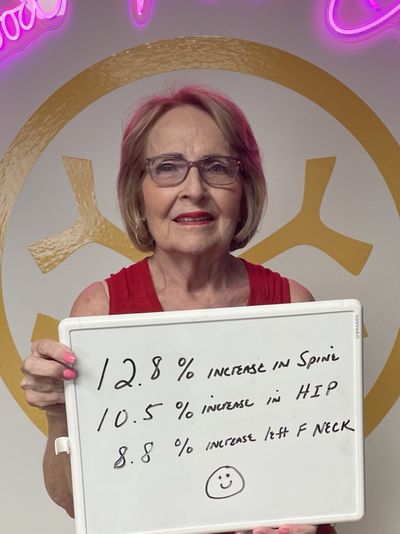
Nicole: her spine is no longer osteoporotic
Spine +12.8%, hip +10.5%, femoral neck +8.8% in 15 months
Nicole, an Austin member in her 60s, came in with an osteoporosis diagnosis. Fifteen months of one short session a week, with no impact and no barbell, moved all three sites, including the femoral neck.
"To my surprise, I found out that my spine no longer was osteoporotic. I improved my bone density by 12.8%, and my hip had improved by 10.5%, and the femoral neck had improved by 8.8%."
Verbatim from Nicole's on-camera testimonial. Full case study.
The bottom line
The best exercise program for osteoporosis is the one that reaches the bone-building load, protects your spine while it does, and fits your life well enough that you keep doing it. LIFTMOR and Onero prove heavy lifting can move the spine under expert supervision. Physical therapy, walking, and yoga protect you without building density. Osteogenic loading reaches the highest loads with the lowest impact in the least time, which is why it fits the widest range of women over 50 in Austin and Georgetown. Whichever you choose, keep your physician in the loop and keep showing up.
Want to know where osteogenic loading fits in your plan? Book a free Bone Health Roadmap Call, bring your DEXA, and we will walk through it with you.
Full case studies referenced in this article
Browse the full case studies hub or read the verification standard behind every number above.
This article is for general education and is not medical advice. Talk to your own doctor before starting, stopping, or changing any medication, supplement, or exercise program, especially if you have a diagnosis of osteopenia or osteoporosis.
Your simple plan from here
- Book your free Bone Health Call. 15 minutes, phone or Zoom, no pressure.
- Come in for a guided first session. A coach walks you through all four devices.
- Track your strength week after week. 15 minutes, once a week. The numbers rise.
Frequently asked questions
What is the best exercise program for osteoporosis?
The best exercise program for osteoporosis is the one that loads bone above its adaptation threshold (roughly 4.2 times body weight), does it safely for a fragile spine, and is something you can keep doing for years. Supervised heavy lifting (LIFTMOR, Onero) reaches high loads with impact and a barbell. Osteogenic loading reaches higher loads with no impact in about 15 minutes a week. Walking, yoga, and physical therapy protect you but rarely build density.
What is the LIFTMOR exercise program?
LIFTMOR is a research protocol published by Watson and colleagues in 2018: eight months of twice-weekly, supervised, high-intensity barbell training (deadlift, squat, overhead press) plus jumping chin-ups with drop landings, in postmenopausal women with low bone mass. It reported a lumbar spine density gain of about 2.9% versus a control group. Onero is the commercial program delivered by The Bone Clinic in Australia based on that style of training.
Is heavy lifting safe if you have osteoporosis?
It can be, with expert supervision and a careful progression, which is exactly how LIFTMOR was run. The concerns are real: a loaded barbell on a fragile spine, impact landings, and the fact that a lift is capped by the weakest point in your range of motion. For many women over 60 with a low T-score, no lifting history, or joint issues, a no-impact way to reach the same or higher loads is the safer fit. Ask your physician before starting either.
Does walking count as an osteoporosis exercise program?
Walking is excellent for your heart, mood, and general fitness, and it belongs in your week. As a bone-building program it falls short, because walking loads bone at a little over one times body weight, far below the threshold that triggers adaptation. Walk for everything else it gives you, and add a program that reaches the bone-building load.
Can yoga or Pilates replace a bone-loading program?
No, though both help with posture, flexibility, and balance, which lower fall risk. Their loads are body weight or less, so they do not reach the bone-building threshold. Some yoga positions also involve loaded spinal flexion or twisting that should be modified with osteoporosis. Keep them for what they do well and pair them with a loading program and your physician's plan.
How does osteogenic loading compare to LIFTMOR?
Both aim to load bone above the adaptation threshold. LIFTMOR does it with a barbell and jumping, twice a week for 30 minutes, supervised. Osteogenic loading does it on four devices in your strongest range of motion, with no impact and nothing to drop, once a week for about 15 minutes, a coach beside you. The one head-to-head trial, LIFTMOR-M, found no between-group difference at the femoral neck (its primary endpoint) or total hip; only the spine favored barbells in one of two analyses. Read our full breakdown.