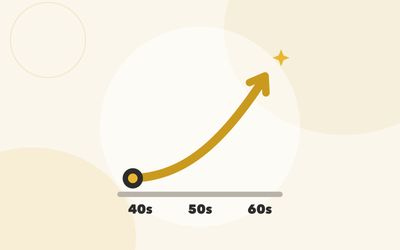
Despite headlines about a "50% improvement," Dr. Fishman's study actually showed no measurable gain in bone: the change was too small for a DEXA scan to reliably distinguish from no change at all. Keep your yoga for balance and mobility; it simply didn't rebuild bone, and a fixed pose routine has no way to. Reversing bone loss takes a load that keeps climbing - that's osteogenic loading.
You heard it from a friend, or a headline, or a hopeful corner of the internet: a doctor proved yoga reverses osteoporosis. And for a moment something in you exhaled - because if that's true, maybe you can skip the heavy lifting, the machines, the medication you've been dreading, and just roll out a mat for twelve minutes a day.
You're not naive for hoping that. The research is real, the doctor is real, and yoga really does more for your bones than walking ever will. So this isn't here to take your hope away. It's here to show you exactly how far that hope can carry you - and where it quietly runs out.
Because there's a villain in this story, and it isn't yoga - and it certainly isn't Dr. Fishman. It's believing a claim because it's worded to sound proven, when the data quietly says otherwise. "A study shows yoga reverses osteoporosis" sounds like settled science. But as you'll see, the study behind it is thin, and the bone change it measured is so small that a DEXA scan can't even tell it apart from its own margin of error. That's the trap: a sentence that is technically defensible yet, in the way that actually matters for your bones, false - comfortable enough to rest on for years while your skeleton, unconvinced, keeps slipping. It's how a lot of women find out, too late, that "doing something" wasn't the same as doing the thing that actually builds bone.
Here is the whole story in a single sentence - the study's own. The "50%" that everyone repeats reads, in full [1]:
"Mean rate of improvement in total hip BMD increased from baseline by 50% after a mean 23 ± 2 months of yoga, but wide variation in individual improvement caused the confidence intervals to overlap, thus precluding statistical significance."
The first half is the headline. The second half - "precluding statistical significance" - is the study itself noting the finding did not hold up. And the 50% was a change in the rate of bone change, not a 50% increase in bone. To his credit, Dr. Fishman put the caveat right there in the same sentence. The misdirection happens later, every time someone quotes the impressive first half and quietly drops the second. Read the sentence to its end and the headline dissolves. The rest of this article is just unpacking that one sentence.
The headline that gives everyone hope
Dr. Loren Fishman is a respected physiatrist (a physician specializing in physical medicine and rehabilitation), and his interest in yoga for bone is serious, not a gimmick. In 2016 he and his colleagues published a study with an irresistible title: "Twelve-Minute Daily Yoga Regimen Reverses Osteoporotic Bone Loss" [1].
The premise is genuinely clever. Certain yoga poses pit one muscle group against another and hold the body in loaded positions - which means the skeleton experiences real mechanical strain, the kind of signal bone responds to. Participants did a 12-pose sequence, and the researchers tracked their bone density with DXA scans over about two years. The reported finding: bone density went up in people who stuck with it.
Give this its full due. It loads bone more than a walk does. It's gentle, accessible, and nearly free. And yoga's balance and flexibility benefits are real and valuable - better balance means fewer falls, and since most fractures begin with a fall, that alone protects you. Dr. Fishman is right about something most people get wrong: yoga is not nothing for your bones.
So the honest question isn't "does it do anything?" It's "how much, for whom, and how long does it keep working?"
What the study actually found
This is where the study itself asks you to read past its own title - and it gives you everything you need to.
Start with the numbers. 741 people enrolled. 227 were compliant enough to count. And just 43 had complete before-and-after DXA data - the subset the strongest claims rest on [1]. And here's the honest headline: across those two years, there was no measurable gain in bone a scan could call real - nothing the data can confirm was rebuilt. On that, the numbers are firm. Whether the group held perfectly steady or kept slipping a little, the scans genuinely can't say - but a real increase in bone density is the one thing the data give no support to.
Why only "no measurable change," and not "improvement"? Because of a number every bone specialist knows but most headlines skip: the Least Significant Change (LSC). Every DEXA machine has one - the smallest difference between two scans that can be trusted as a real change rather than the machine's own measurement wobble. By the international standard, only a change that meets or exceeds the LSC counts as genuine; anything smaller sits inside the margin of error [2]. At the spine and hip that threshold is typically around 3 to 5%. Fishman's reported change worked out to roughly two to three percent across two years - at or below the LSC. In plain terms: on any individual woman's scan, that "improvement" can't be told apart from no change at all. The study surfaced a faint signal only by averaging the results across the 43 participants with complete before-and-after DXA data; for any one person actually being scanned, there was no change you could call real.
And even "maintenance" is the generous reading. Two things are worth being honest about. First, because the change sits inside the margin of error, the data can't separate a small gain from a flat line from a slow continued loss - to the scanner, all three are the same result, so "maintained" is the best case, not a measured fact. Second, the "they were declining before yoga" comparison rests on participants' own earlier scans - retrospective, often on different machines, with no controlled baseline - so even the starting trend is shaky. None of this means yoga did nothing. It means the most you can honestly claim is no change a DEXA could detect - which is a long way from rebuilding bone.
That's also where the eye-catching "50% improvement" comes from - the sentence we opened with. Remember how it ended: "precluding statistical significance." That 50% was a change in the rate of hip density, off a tiny base, and the paper's own clause rules the finding out as non-significant. It is not a 50% increase in bone density. The headline survives only by quoting the first half of that sentence and dropping the second.
Which points straight at that irresistible title. This is our interpretation, not the study's: a title like "Twelve-Minute Yoga Regimen: No Significant Change in Bone Density" would have tracked the findings far more closely than "Reverses Osteoporotic Bone Loss." Even the best-case reading - that committed practitioners held the line - would be worth something on a disease defined by relentless loss. But the data can't confirm even that, and they clearly rule out the one thing the headline sells, and the one thing a woman staring at a worrying DEXA is hoping for: bone actually rebuilt.
So the fair reading is this: in committed people, yoga was associated with no measurable change in bone over a couple of years - no detectable gain, and possibly a slow continued loss the scan couldn't rule out. That may still beat doing nothing, and it's all the data show. It is not the reversal the headline implies. That's not a knock on Dr. Fishman; it's simply what the numbers say.
Why yoga genuinely helps - and exactly where it stops
Here's the part that ties this article to every other one we've written about movement and bone.
Yoga helps because, for a while, it's a new and real demand on your skeleton - especially if you've been sedentary. Your bones feel poses they've never held, and they respond. That's the same reason walking can briefly build bone in a deconditioned person: almost any new stimulus produces some adaptation.
And then the same thing happens that happens with walking, with vibration plates, with any unchanging routine. Your body adapts to the poses. The sequence that challenged your skeleton in month one is, by month twelve, just your familiar Tuesday. Bone builds when it's loaded harder than it's used to - and a fixed routine, by definition, stops being harder than you're used to. We unpacked this in the adaptation principle and why progress plateaus: your body changes to match whatever you ask of it, and once it has, the osteogenic stimulus that same unchanged load provides is expected to diminish.
There's a sharper edge to this, too. Because your body keeps adapting, the same routine that held the line this year may not even manage that a few years from now - the stimulus that was once just enough to maintain becomes, to an adapted body, not quite enough. That's not a flaw in yoga. It's simply the boundary of what any fixed-stimulus practice can do.
Wondering if yoga alone is enough for your bones?
Book a free 15-minute Bone Health Call. We'll look at your DEXA, your current routine, and what it would take to actually move your numbers - no pressure, phone or Zoom.
Book Your Free Bone Health CallWhat progressive loading adds - and who each path is for
If yoga's limit is that it can't escalate, the fix has to be a stimulus that does - safely, and for years.
That's osteogenic loading. As we explain in the science of osteogenic loading, the goal is to push your skeleton above what it's already adapted to, then keep raising that load as you get stronger - and to do it in a controlled way that protects your joints and spine. On OsteoStrong's robotic Spectrum devices, you push against a device that doesn't move and produce force in multiples of your body weight from a coached position, in about 15 minutes a week, and the force you generate is measured every single visit - so you can actually see yourself exceeding your habitual load instead of hoping you are. It's the dial that yoga doesn't have.
And here's the difference in how each path proves itself. Dr. Fishman's evidence is one self-selected study with 43 fully-documented participants. Osteogenic loading's evidence is a real-world track record: the method rests on 152 peer-reviewed studies, it's been used by 65,000+ members worldwide, more than 100 Austin-area physicians refer their patients to our centers, and among members who follow the weekly protocol, 8 out of 10 see measurable DEXA gains on their next scan. To be clear about rigor: that last figure isn't from a published trial - it's our own members' follow-up DEXA results, real-world rather than lab-controlled, which is exactly the kind of repeated, ordinary-people proof a single study can't give. You can read some of those in our members' real DEXA stories. Fishman's study is one hopeful signal; OsteoStrong's track record is the same result showing up again and again, in ordinary people, over years.
So who's each path for?
- Keep yoga if you love it - for balance, mobility, calm, and as a genuine adjunct. If you're early, deconditioned, and just starting to move, it's a real first step, and it lowers your fall risk, which matters enormously. See fall prevention that actually works.
- Add progressive loading if your goal is to reverse established osteopenia or osteoporosis - to move your DEXA, not just hold the line. That's the job yoga isn't built for, and it's what women over 50 are actually accomplishing with a weekly osteogenic-loading protocol.
This isn't yoga or bone-building. It's yoga plus the one thing yoga can't do.
Yoga vs. progressive osteogenic loading, at a glance
| Fishman's yoga routine | Osteogenic loading | |
|---|---|---|
| What loads bone | Body-weight poses, held | Force you produce against an immovable device |
| Can the load escalate? | No - a pose asks a fixed amount | Yes - raised as you get stronger |
| Progress you can see | A DXA in ~2 years | A force number every visit |
| Evidence | One non-randomized, self-selected study [1] | 152 studies + real-world track record |
| Track record | 43 fully-documented participants | 65,000+ members; 8 in 10 see DEXA gains (member follow-ups, not a trial) |
| Best role | Balance, mobility, gentle adjunct | Designed for progressive osteogenic loading |
| Also great for | Fall prevention, flexibility, calm | Measurable, sustained density gains |
What's actually at stake while you decide
Here's what the comforting headline never mentions: the cost of waiting. Bone you don't load this year is bone you don't get back next year - the window doesn't reopen. And the sequence that ends independence rarely starts with a diagnosis. It starts with a fall, then a fracture, then a hospital stay, then the slow loss of doing things on your own terms.
So picture two years from now. In one version, you kept your yoga and added a load that climbed week over week - and your next scan finally moves the right direction, and you step off a curb or lift a grandchild without that flicker of fear. In the other, you rolled out the mat faithfully, certain you had it handled, and found out at your next DEXA that "doing something" hadn't been enough. Same effort, same good intentions - very different skeleton.
You get to choose which story your bones tell. Keep the yoga. Add the thing that escalates.
Find out what your bones actually need
You don't have to guess whether yoga alone is moving your numbers. The free 15-minute Bone Health Call is the first step: we look at your DEXA, your current routine, and what progressive loading could add - then measure your baseline at your first visit so you can watch it climb. No pressure, phone or Zoom.
Related reading:
- Does Walking Build Bone? Why It Works Until It Doesn't - the adaptation principle behind this whole article
- Onero vs. OsteoStrong: Why Strong Bones Need More Than a Heavy Barbell
- The Science of Osteogenic Loading, Explained
- What I Told a Room of Biohackers and Longevity Doctors About Bone Health
- Reversing Osteoporosis: What Women Over 50 Actually Accomplish
References
- Lu Y-H, Rosner B, Chang G, Fishman LM. Twelve-Minute Daily Yoga Regimen Reverses Osteoporotic Bone Loss. Topics in Geriatric Rehabilitation. 2016;32(2):81-87. doi:10.1097/TGR.0000000000000085
- International Society for Clinical Densitometry (ISCD). Precision Assessment and Least Significant Change. The LSC is calculated as 2.77 × the precision error and is the smallest change in BMD that can be considered statistically significant at 95% confidence; only changes meeting or exceeding the LSC should be interpreted as real when monitoring an individual over time. https://iscd.org/learn/resources/calculators/
This article is for general education and is not medical advice. We are not affiliated with Dr. Fishman or his yoga program, and we've represented his published findings - and their stated limitations - as faithfully as we can. Talk to your own doctor before starting, stopping, or changing any exercise program, especially if you have a diagnosis of osteopenia or osteoporosis.
Your simple plan from here
- Book your free Bone Health Call. 15 minutes, phone or Zoom, no pressure.
- Come in for a guided first session. A coach walks you through all four devices.
- Track your strength week after week. 15 minutes, once a week. The numbers rise.
Frequently asked questions
Is OsteoStrong safe if I already have osteoporosis?
We hear this one a lot, and the honest answer is that a new osteoporosis diagnosis is exactly why most of our members walked in. You stay in complete control the entire session - the devices don't move, you push against a fixed resistance, and a certified coach is beside you cueing every breath. More than 100 Austin-area physicians refer patients here, including women with severe DEXA results. The safest next step is simply to talk to us. Book your free 15-minute Bone Health Call and we'll walk through your DEXA together.
Can I really build bone density at my age?
Yes, and the question tells us you already suspected the answer. Bone is living tissue that responds to a specific mechanical signal at any age. Our members in their 70s, 80s, and 90s routinely see measurable DEXA improvements, and 8 out of 10 who follow the weekly protocol see bone density gains on follow-up scans. If your doctor has told you 'it's just age,' that's half the story. The best way to find out what's possible for your body is a free Bone Health Call.
What actually happens during a session?
Most women show up nervous and leave surprised at how simple it was. You arrive in street clothes, meet your coach, and walk through four supported devices that produce the exact force your bones need to rebuild. Total time: about 15 minutes. No cardio. No sweat. No locker room. You never change clothes. Most members come on their lunch break.
Do I really only need to come once a week?
Yes, and we know that sounds too easy to be real. When your body receives the osteogenic-loading signal, it keeps rebuilding for 7 to 10 days afterward. More frequent sessions don't produce more results - consistency, once a week, is what creates lasting change. This is the whole reason this method works for women over 50 who do not want a gym routine.
How is this different from going to the gym?
A regular gym trains muscles, which is wonderful but doesn't move the needle on bone. Research suggests bone only rebuilds when it receives roughly 4.2 times your body weight in force - a level you cannot safely produce with free weights, yoga, or Pilates. OsteoStrong's devices let your body generate that precise force safely, in four short efforts, in 15 minutes. Same room. Same coach. Every week.
What does it cost?
We know price is on your mind, and we respect that. We don't post pricing online because memberships vary by location and household (individual, couple, family). Your free 15-minute call covers pricing, location options, and any questions about your specific situation - no sales pressure, no long form to fill out in between.
Will my doctor approve?
Most do. Over 100 Austin-area physicians already refer patients to us, and we're glad to send educational materials to yours. We always recommend sharing your DEXA results with us so we can track your progress alongside your physician's plan. If it helps your decision, ask your doctor what she thinks of osteogenic loading - and then book your free call.
What if I've never exercised?
You are exactly who this was built for. Most of our members aren't athletes. You do not need to be fit, flexible, or experienced, and you will not be asked to do anything your body cannot do. A certified coach is beside you every session, adjusting everything to you. If you've been avoiding gyms for 30 years, this is the place you don't have to.
Do I have to sign a long contract?
No surprises here. We offer month-to-month and longer memberships, and the pros and cons of each are walked through on your free call. We'll never pressure you into a commitment that doesn't fit your situation.
How soon will I feel a difference?
Most members notice improvements in energy, balance, and posture within the first 4 to 6 weeks - long before any DEXA change. On DEXA, the typical pattern is a halt of bone loss in year one with measurable density gains showing up in year two. Bone remodels slowly. We plan the journey in years, not months, and your weekly force-output numbers give you something to watch in the meantime.
How does OsteoStrong help with osteoporosis?
Osteoporosis means your bones have lost enough mineral that a simple fall can become a fracture. OsteoStrong adds the one thing your body cannot get from medication alone: the mechanical signal that tells bone to rebuild. Four devices, 15 minutes a week, and a coach who has seen hundreds of women in your exact spot. The best first step is a free Bone Health Call where we look at your DEXA together.
Is OsteoStrong a replacement for my osteoporosis medication?
No - we're not here to replace your doctor or your prescriptions. We're here to give you a simple weekly routine that supports your bone health alongside your medical plan. Some members, after sustained DEXA gains, have worked with their physician to taper or discontinue medications. That decision is always between you and your doctor, never between you and us.
Is OsteoStrong right for postmenopausal women?
It's built for you. Postmenopausal women are our largest group of members, because menopause is when bone loss accelerates and estrogen protection drops. Osteogenic loading delivers the signal your body needs without the high-impact movement that menopausal joints often cannot tolerate. If that sounds like the season you're in, book your free call.
Does insurance cover OsteoStrong?
Usually not, and we'll give you the straight answer: OsteoStrong is a non-pharmaceutical wellness service, so most U.S. insurance plans don't cover it. Some members use HSA or FSA funds. Your free Bone Health Call covers pricing and payment options for your specific situation.
How is OsteoStrong different from physical therapy or the gym?
Physical therapy is medical rehabilitation and usually ends when you've recovered. A gym provides general exercise but rarely reaches the force threshold associated with bone rebuilding. OsteoStrong is a single-purpose service focused on triggering the osteogenic-loading signal. One coach, four devices, 15 minutes, once a week, indefinitely. Many of our members keep their PT or their gym and simply add OsteoStrong for bone health.
What happens if I don't do anything about bone loss?
This is the question we wish more women asked, and we'll give you a gentle but honest answer. Bone loss is quiet. It compounds year after year until a simple trip becomes a fracture. One in two women over 50 will break a bone because of osteoporosis in her lifetime. Forty percent of hip-fracture patients lose the ability to live independently, and nearly one in four dies within a year. Those are the stakes. The good news: the next step is small, it's free, and it's a 15-minute phone call. Book your free Bone Health Call - we'll meet you where you are.
I'm scared. What should I do first?
Of course you are. Bone loss is a quiet thing that suddenly becomes very loud at a doctor's appointment, and no one sat with you and walked through what comes next. Start with the smallest, safest step: book a free 15-minute Bone Health Call. It's a phone or Zoom conversation with someone who has helped hundreds of women in your exact situation. We'll read your DEXA with you, answer your questions, and help you decide whether to come in. You don't commit to anything. You just get a real person to talk to.
Does yoga build bone density?
Not in any way a scan can measure. Dr. Loren Fishman's research is the best evidence we have, and in his study the change in bone density over about two years was so small it fell inside a DEXA's own margin of error (its Least Significant Change). That means no detectable gain - nothing rebuilt. Whether participants held perfectly steady or kept slowly losing, the scan can't tell. Yoga clearly does more for bone than walking, and its balance benefits are real and valuable - but it did not measurably build bone, and because the body adapts to a fixed routine, there's no built-in way for it to start.
What did Dr. Fishman's yoga study actually find?
His 2016 study enrolled 741 people, of whom 227 were compliant and just 43 had complete before-and-after DXA data. In that group the measured change in bone density (about +0.001 g/cm² per month at the spine) was so small it sits at or below a DEXA's Least Significant Change - meaning no gain a scan could call real. The honest finding is 'no measurable change,' not reversal: at best the prior loss slowed, but the data can't confirm even that, and they rule out the rebuilding the title implies.
Did the yoga study's bone gains exceed a DEXA's Least Significant Change (LSC)?
For an individual, generally no - and this is the most important number most coverage skips. Every DEXA scanner has a Least Significant Change: the smallest difference between two scans that can be trusted as a real change rather than measurement error, typically around 3 to 5% at the spine and hip by the ISCD standard. Fishman's reported spine gain works out to roughly 2 to 3% over two years - at or below that threshold. The study reached statistical significance by averaging the results of the 43 participants with complete DXA data, not because any one person's scan crossed the LSC. So on your own follow-up DEXA, a change that small could not be reliably distinguished from the machine's noise.
Was Fishman's study a randomized controlled trial?
No, and the authors say so plainly. It was a non-randomized, non-controlled study of people who found it online and self-selected into yoga, with compliance self-reported on an electronic scorecard. The authors themselves list selection bias, the lack of randomization or blinding, and variable compliance data as limitations. That doesn't make it worthless - it makes it suggestive rather than definitive. It answers 'can yoga move bone?' with a cautious yes, not 'will yoga rebuild my bones?'
Can yoga reverse osteoporosis on its own?
For most people with established osteoporosis, not on its own. Yoga is wonderful for flexibility, strength, and especially balance - and better balance means fewer falls, which is genuinely important since most fractures start with a fall. But a fixed routine can't progressively increase the load on your bones, and progressive load is what reversing bone loss requires. Yoga is an excellent teammate. It isn't built to be the whole team.
Should I stop doing yoga then?
Absolutely not. Keep your yoga - it's one of the best things you can do for balance, mobility, and peace of mind, and Dr. Fishman is right that it loads bone more than most people assume. The point isn't to replace it. It's to add the one thing yoga can't do on its own: a load that keeps escalating safely over years, so your bones never fully adapt and stop responding.
How is osteogenic loading different from a yoga routine?
A yoga routine asks your body to hold a set of poses; the load is whatever those poses produce, and it doesn't grow. Osteogenic loading is designed to push your skeleton above what it's already used to - and to keep raising that load as you get stronger, with the force you produce measured every single session. One is a fixed stimulus your body adapts to. The other is a progressive stimulus built specifically so it doesn't stop working.