Yes, you can get osteoporosis in your 40s, and it usually has a reason: early or surgical menopause, long-term steroid use, thyroid or parathyroid problems, celiac disease or other malabsorption, a history of very low weight or missed periods, childhood medications, or cancer treatment. Before 50, physicians lean on the Z-score (your density compared to people your own age) rather than the T-score, and a low Z-score is a cue to find the cause. The plan is the same three moves at any age: treat the cause with your physician, supply the raw materials, and give bone a mechanical reason to build. Starting osteogenic loading in your 40s compounds, because every year of holding or gaining density is a year menopause cannot take from you. That is where OsteoStrong Austin and Georgetown fit.
Yes, osteoporosis in your 40s is real, and it is usually a clue
Most of the women who walk into our Austin and Georgetown centers are past menopause. The ones who arrive in their 40s tend to share a look: surprised, a little annoyed, and convinced they did something wrong.
They did not. Osteoporosis in your 40s is uncommon compared with the years after menopause, but it almost always points at something specific. Bone density peaks in early adulthood and holds relatively steady until estrogen drops. If yours is low well before that drop, either you never reached a high peak, or something has been pulling it down since. Either way, there is a thread to follow.
That matters because physicians are more cautious with the standard bone medications in premenopausal women, and the first move is usually a workup rather than a prescription. If you are still sorting out the two labels, read osteopenia vs. osteoporosis first.
What causes bone loss before 50?
Here are the drivers physicians look for when a DEXA comes back low in a woman under 50:
- Early or surgical menopause. Premature ovarian insufficiency, or removal of the ovaries, takes estrogen away years ahead of schedule, and bone feels it immediately.
- Glucocorticoids. Prednisone and its cousins, taken for asthma, autoimmune disease, or after a transplant, are the most common medication cause of bone loss.
- Thyroid and parathyroid. An overactive thyroid, or thyroid replacement dosed too high, speeds up bone turnover. Hyperparathyroidism pulls calcium out of bone.
- Malabsorption. Celiac disease, inflammatory bowel disease, and prior bariatric surgery can keep calcium, vitamin D, and protein from being absorbed no matter how well you eat.
- Low weight and missed periods. A history of anorexia, or years of athletic amenorrhea, means bone was underbuilt during the years it should have been banking density.
- Childhood and long-term medications. Some anti-seizure drugs, certain childhood treatments, and long courses of steroids can lower peak bone mass before adulthood starts.
- Cancer treatment. Aromatase inhibitors, chemotherapy that triggers early menopause, and radiation can each accelerate loss.
- Genetics and family history. A parent with a hip fracture is a FRAX input for a reason, which is why we wrote a separate guide on whether family members should get tested.
Smoking and heavy drinking add to any of the above. None of this is a verdict. It is a list of places to look.
Why the Z-score matters more than the T-score before 50
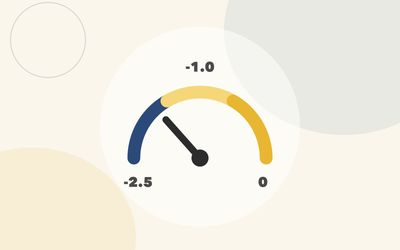
Your DEXA report shows two scores at each site. The T-score compares your density to a healthy young adult, and it is the number the WHO thresholds are built on: normal above -1.0, osteopenia from -1.0 to -2.5, osteoporosis at -2.5 and below. Those thresholds were designed for postmenopausal women.
The Z-score compares your density to people of your own age and sex. Before menopause, that is the number physicians lean on, because it answers the question that matters at 45: is this what a 45-year-old skeleton should look like? A low Z-score flags that something beyond ordinary aging is at work, and it usually triggers the workup above.
So if your report says osteopenia at 44, look at the Z-score and ask your physician what they think is driving it. The full walkthrough of the report is in what your DEXA T-score actually means, and our free bone health checklist lists the labs and questions worth bringing.
Should you get a baseline DEXA in your 40s?
USPSTF recommends a screening DEXA for all women at 65 and earlier for women with risk factors. A risk factor is precisely what puts a woman in her 40s on the scan table. If any of the causes above apply to you, or a parent broke a hip, or you have already had a low-trauma fracture, ask your physician for a baseline now.
Two reasons a baseline is worth pushing for. First, you cannot measure change without a starting point: a DEXA at 45 turns the scan at 55 from a snapshot into a trend. Second, follow-up scans are most useful on the same machine, so a baseline at an imaging center you can return to for years pays off later. Coverage before 65 depends on documented risk factors, so ask your physician's office to note the reason on the order and check your plan.
What to do about it: the plan
The plan in your 40s has the same three parts as the plan at 65, with one extra step at the front.
Step one: find and treat the cause with your physician
This is the step that makes early diagnosis a gift. Correcting a thyroid dose, treating celiac disease, addressing low estrogen, or reviewing a steroid regimen can slow or stop the loss at its source. Whether hormone therapy belongs in your plan is an individual decision; we cover the considerations in HRT for bone health. Every medication decision belongs to you and your physician.
Step two: supply the raw materials
Bone cannot build with an empty warehouse. The NIH Office of Dietary Supplements sets the vitamin D RDA at 600 IU through age 70, and many physicians target a 25-hydroxyvitamin D blood level of at least 30 ng/mL, so ask for the test. Calcium should come from food first; the RDA for women 51 and older is 1,200 mg per day, and your physician can confirm the target for your age. Protein is the material most women under-eat, and we explained why in how much protein you actually need to build bone.
Step three: give bone a reason to build
Materials are not a signal. Bone adds density in response to mechanical strain above a threshold, a principle described by Wolff's law and refined by Frost's mechanostat. The osteogenic loading literature associates that threshold with loads of roughly 4.2 times body weight (Deere et al., 2012). Walking, swimming, and most everyday activity sit well below it, which is why women who "do everything right" can still watch their scans drift down. Our guide to a four-pillar non-drug osteoporosis plan puts loading, nutrition, balance, and monitoring together.
Why starting loading in your 40s compounds
Bone adapts to load, but as bone gets stronger a fixed load produces less strain, so the stimulus has to keep rising for adaptation to continue. Osteogenic loading solves that by loading you in your strongest range of motion at near-maximal force and progressing in very small joint-angle increments, which a barbell cannot do because it is capped by the weakest point in the range of motion. The result is a stimulus that keeps climbing year after year.
Now add time. A woman who starts loading at 45 spends a decade building or holding density before the steepest estrogen-related loss arrives. Menopause then takes its percentage from a higher base, and she keeps loading through it. A woman who starts at 65 does the same work from a lower starting point. Both improve. The first one never has to dig out of a hole. Read the science of osteogenic loading for the mechanism in detail.
What this looks like at OsteoStrong
A session is about 15 minutes, once a week, on four devices, with a coach beside you the whole time. You press against the device in your strongest joint angle, the machine measures the force your skeleton produced, and that number becomes your scoreboard between DEXAs. No impact, street clothes. Our session protocols are reviewed on an ongoing basis with the physicians who refer to us, and more than 100 Austin-area physicians do. The how it works page walks through each device. Three members show what early causes look like in practice.

Zach: osteopenia in his 30s, from a childhood medication
Force output climbing week over week at three months
Zach is in his 30s, and his osteopenia traces back to a medication he took as a child. That is the early-onset pattern: a specific cause, caught early, with decades of remodeling ahead.
"My numbers are going up week over week and I'm definitely able to do stuff I wasn't able to do three months ago."
Verbatim from Zach's on-camera testimonial. Full case study.
Marjorie: 15 years of osteopenia, then a normal scan
DEXA normal at the spine and femoral neck after 18 months, following 15 years of osteopenia
Marjorie's turnaround came after 15 years of following the standard advice to the letter, with a load that never reached the threshold.
"I was doing barbell weightlifting, walking a lot, doing the things you're supposed to do for bone density. I went on hormone therapy. None of it was making it stop."
Verbatim from Marjorie's on-camera testimonial. Full case study.
Beverly: osteopenia after cancer treatment
Strength, balance, and grip improved; caught herself in several near-falls
Beverly is a cancer survivor with osteopenia who started in August 2024. Cancer treatment is on the list above, and her story shows the first things that move: strength and balance.
"My strength has increased, balance has increased. I've almost fallen several times and caught myself. My grip has improved too."
Verbatim from Beverly's on-camera testimonial. Full case study.
The bottom line
Osteoporosis in your 40s is real, and it is usually a clue rather than a mystery. Follow the clue with your physician, get the Z-score and the workup, and establish a baseline DEXA you can compare against for years. Then do what bone has always responded to: supply the materials and deliver a load above the threshold, week after week. You have more remodeling years ahead of you than almost anyone reading this page, and that is the best position to start from.
Want to know where osteogenic loading fits in your plan? Book a free Bone Health Roadmap Call, bring your DEXA, and we will walk through it with you.
Full case studies referenced in this article
- Zach: osteopenia in his 30s, force output climbing week over week
- Marjorie: normal DEXA after 15 years of osteopenia
- Beverly: cancer survivor, strength and balance up
Browse the full case studies hub or read the verification standard behind every number above.
This article is for general education and is not medical advice. Talk to your own doctor before starting, stopping, or changing any medication, supplement, or exercise program, especially if you have a diagnosis of osteopenia or osteoporosis.
Your simple plan from here
- Book your free Bone Health Call. 15 minutes, phone or Zoom, no pressure.
- Come in for a guided first session. A coach walks you through all four devices.
- Track your strength week after week. 15 minutes, once a week. The numbers rise.
Frequently asked questions
Can you get osteoporosis in your 40s?
Yes. Osteoporosis in your 40s is less common than after menopause, but it happens, and it almost always has an identifiable cause: early or surgical menopause, long-term steroid use, thyroid problems, celiac disease or other malabsorption, a history of very low body weight or missed periods, childhood medications, or cancer treatment. That is why physicians usually order a workup for secondary causes before deciding on treatment for a woman under 50.
What is a Z-score and why does it matter under 50?
A Z-score compares your bone density to other people of your own age and sex, while the T-score compares you to a healthy young adult. Before menopause, the Z-score is the number physicians lean on, and a low Z-score is a flag that something beyond ordinary aging is driving bone loss. A low Z-score in your 40s is a reason to look for a cause, not just a label.
Should I get a DEXA scan in my 40s?
USPSTF recommends routine screening at 65, earlier with risk factors, and a risk factor is exactly what puts a woman in her 40s on the scan table: a parent with a hip fracture, steroids, early menopause, celiac disease, thyroid disease, an eating disorder history, or a prior low-trauma fracture. If any of those apply, ask your physician for a baseline DEXA now. A baseline is the only way to know later whether your plan is working.
What causes osteoporosis in premenopausal women?
The most common drivers are conditions or medications that either block estrogen or interfere with how bone is built and maintained: premature ovarian insufficiency, oophorectomy, glucocorticoids like prednisone, an overactive thyroid or excess thyroid replacement, hyperparathyroidism, celiac disease, inflammatory bowel disease, anorexia or prolonged amenorrhea, some anti-seizure medications, aromatase inhibitors, and chemotherapy. Genetics set your peak bone mass, so family history matters too.
Can bone loss in your 40s be reversed?
Often, yes, especially when the underlying cause is treated and mechanical loading is added. Bone responds to load above a threshold at any age, and in your 40s you have the advantage of starting from a higher base with more remodeling years ahead of you. Among OsteoStrong members who follow the weekly protocol and complete a follow-up DEXA, 8 out of 10 see measurable improvement, with consistency and starting point the biggest factors. See the results page for examples.
Is OsteoStrong safe for someone in their 40s with osteopenia?
Yes. Osteogenic loading is self-directed and impact-free: you push against a device in your strongest range of motion with a coach beside you, in street clothes, for about 15 minutes once a week. There is nothing dropped, thrown, or jumped. Members range from their 30s to their 80s, and the protocol is scaled to your force output, not to a fixed weight. Bring your DEXA and any diagnosis to the free Roadmap call and we will walk through it.