Osteoporosis at 65 is usually discovered on a woman's first screening DEXA, because 65 is the age USPSTF recommends every woman get one and Medicare covers a screening scan every 24 months. When to start treatment depends on three numbers: a T-score of -2.5 or below at any site means osteoporosis and typically opens the treatment conversation right away; osteopenia (-1.0 to -2.5) shifts the decision to your FRAX score, where a 10-year major fracture risk of 20 percent or hip fracture risk of 3 percent is the U.S. threshold; and a prior fragility fracture puts you in the treatment conversation regardless. Whether medication is part of the plan belongs to you and your physician. The non-drug side of the plan, including osteogenic loading at OsteoStrong Austin and Georgetown, can start the same week as the diagnosis.
Why do so many women get their first DEXA at 65?
If you are reading this at 65 with a fresh diagnosis, you are in very good company. USPSTF recommends a screening DEXA for all women at 65, and Medicare begins covering a screening scan every 24 months for eligible people at the same age. For a large share of women, that scan is the first time anyone has measured their bone density.
Which means the number on the report is not really news about this year. It is news about the last fifteen. Bone loss accelerates in the years around menopause and continues quietly afterward, and a first scan at 65 is catching up on all of it at once. That is worth knowing, because the right reaction is not "how did this happen so fast?" It is "what is the trend from here?"
If your question is whether starting a bone program at this age is worth it, we answered that in starting OsteoStrong at 60, 70, or 80. This article is about the decision itself: what your first result means, and when treatment should begin.
What your first DEXA result means at 65
Your report lists a T-score for each site scanned, usually the lumbar spine, the total hip, and the femoral neck. The WHO thresholds are:
- Normal: above -1.0
- Osteopenia: -1.0 to -2.5
- Osteoporosis: -2.5 and below
Two rules of thumb make the report easier to read. First, the lowest site rules: if your spine is -1.8 and your femoral neck is -2.6, your diagnosis is osteoporosis. Second, the femoral neck deserves extra attention, because it is the input that feeds your FRAX score and the site whose fracture changes lives fastest. Our guide to what your DEXA T-score actually means walks through the whole page.
One more number to ask for: FRAX. It combines your femoral neck T-score with age, weight, fracture history, parental hip fracture, smoking, steroids, and a few other factors into a 10-year fracture probability. At 65, FRAX is often the number that tips the treatment decision, and we explained how it works and how it moves in lowering your FRAX fracture risk.
When should you start treatment for osteoporosis at 65?
Here is the decision tree most physicians use, condensed. "Treatment" here means the full plan, and whether it includes a prescription is a decision for you and your physician.
| Your first result at 65 | What it usually means | When the treatment conversation starts |
|---|---|---|
| T-score -2.5 or below at any site | Osteoporosis | Now. Medication is commonly discussed, and the non-drug plan starts immediately. |
| Prior fragility fracture (wrist, spine, hip from a fall at standing height) | Clinical osteoporosis regardless of T-score | Now. A first fracture is the strongest predictor of the next. |
| Osteopenia with FRAX at or above 20 percent major or 3 percent hip | High-risk osteopenia | Now. FRAX crosses the BHOF treatment threshold. |
| Osteopenia with FRAX below those thresholds | Lower-risk osteopenia | An active plan now, a follow-up DEXA in 12 to 24 months, and medication revisited if the trend worsens. |
| Normal | Baseline established | Keep the baseline and rescan on the screening schedule. |
Two things are true in every row. A physician workup for secondary causes (thyroid, parathyroid, vitamin D, kidney function, celiac disease, medications) belongs at the start, because treating a cause changes the plan. And the non-drug layer belongs in every row, including the last one.
If your physician has recommended medication and you are weighing whether to start immediately, our guide on starting osteoporosis medication right after diagnosis covers that specific decision in detail.
What "treatment" actually includes at 65
A complete plan at 65 has four parts, and the prescription is only one of them.
- Medication, if your physician recommends it. Bisphosphonates like alendronate are usually the first option and are inexpensive as generics. Prolia is an every-six-months injection that must never be stopped without a physician's exit plan, because rebound bone loss is well documented. Anabolics like Forteo, Tymlos, and Evenity are reserved for higher-risk cases and run for a fixed course. The plain-English medications guide covers each class.
- Mechanical loading. Medication works on bone chemistry. Bone also needs a mechanical reason to build, and that signal comes only from load above a threshold the osteogenic loading literature places at roughly 4.2 times body weight (Deere et al., 2012). Walking does not reach it.
- Raw materials. The NIH Office of Dietary Supplements sets calcium at 1,200 mg per day for women 51 and older, food first, and vitamin D at 600 IU to age 70 and 800 IU after. Protein is the material most women at 65 under-eat.
- Balance and fall prevention. About 1 in 3 adults over 65 falls each year, according to the CDC, and most fractures start with a fall. Bone density lowers the damage; balance lowers the odds. Our fall prevention and balance training program treats them together.
For a full comparison of local options, including which Austin specialists handle what, see osteoporosis treatment options in Austin.
Why "now" beats "let's watch it"
"Let's keep an eye on it" is a comfortable sentence to hear at 65. It is worth understanding what it costs.
Bone does not hold still while it is being watched. The follow-up scan is 12 to 24 months away, and without a change in inputs, the trend on that scan will be the same trend that produced this one. Two years of watching is two years of loss, compounded by the fall risk that rises in the same window.
There is a better version of watching. Start the non-drug plan the same week as the diagnosis, and let the next scan measure what changed rather than what continued. Bone remodels in cycles measured in months, so a change that starts now has time to show up by the follow-up. Frost's mechanostat, the model of how bone responds to strain, has no age cutoff: bone loaded above threshold adapts.
Starting now also means the first improvements arrive early. Strength and balance move within weeks, and force output on the loading devices climbs week over week. Those numbers tell you the plan is working long before the DEXA can, and they are why members walk into their follow-up scan expecting good news.
What this looks like at OsteoStrong
A session is about 15 minutes, once a week, on four devices, with a coach beside you the whole time. You press against each device in your strongest range of motion, the machine measures the force your skeleton produced, and that force output is recorded every session. No impact, no weights overhead, street clothes. Our session protocols are reviewed on an ongoing basis with the physicians who refer to us, and more than 100 Austin-area physicians do. The how it works page shows each device.
Among members who follow the weekly protocol and complete a follow-up DEXA, 8 out of 10 see measurable improvement. Consistency and starting point are the two biggest factors. Member DEXAs are performed by independent imaging providers, not by OsteoStrong, and we encourage everyone to rescan on schedule.
Two Austin members in their 60s show what a first diagnosis and a first follow-up can look like.
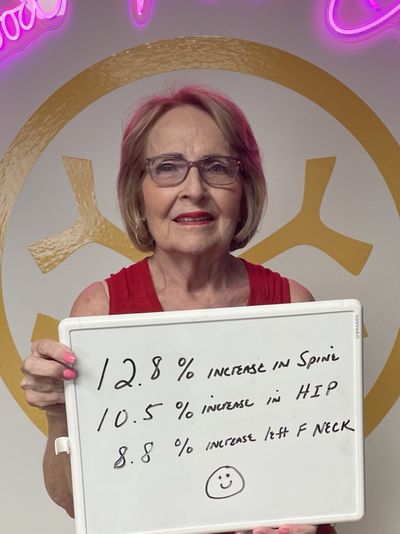
Nicole: her spine is no longer osteoporotic
Spine +12.8%, hip +10.5%, femoral neck +8.8% in 15 months
Nicole, in her 60s, started with an osteoporosis diagnosis and a decision to make. Fifteen months later her follow-up scan reclassified her spine.
"To my surprise, I found out that my spine no longer was osteoporotic. I improved my bone density by 12.8%, and my hip had improved by 10.5%, and the femoral neck had improved by 8.8%."
Verbatim from Nicole's on-camera testimonial. Full case study.
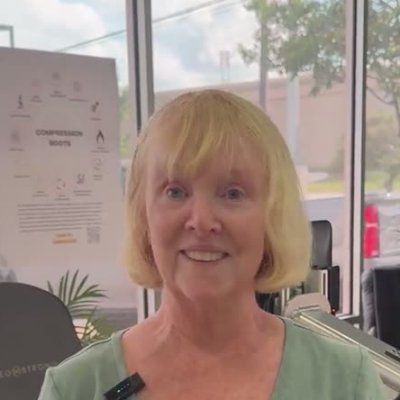
Bonnie: the first scan that ever came back better
Every site improved on her follow-up DEXA after years of decline, femoral neck +8.7%
Bonnie, in her 60s, had years of scans that each came back worse than the last. That is what "watching it" looks like on paper. Three years of weekly sessions changed the direction.
"Every time I've had it, it's always gotten worse. I couldn't believe it. Everything improved."
Verbatim from Bonnie's on-camera testimonial. Full case study.
Questions to bring to the appointment
Turn the follow-up visit into a plan by asking:
- What is my T-score at each site, and which site is lowest?
- What is my FRAX score, and is it above the treatment threshold?
- Have we checked for secondary causes (thyroid, parathyroid, vitamin D, kidney function)?
- If you are recommending medication, what should it do to my numbers, and by when?
- When is my follow-up DEXA, and will it be on the same machine?
- I am adding weekly osteogenic loading. Does that change anything in your plan?
Our free top 10 questions guide has the printable version.
The bottom line
A first DEXA at 65 is the most common way osteoporosis gets found, and the treatment decision rests on three numbers: T-score, FRAX, and fracture history. If any of them crosses the line, the treatment conversation starts now, and whether it includes medication is yours and your physician's call. Whatever that call is, the non-drug plan does not need to wait: loading, protein, vitamin D, and balance can start this week, so the follow-up scan measures a change instead of a continuation.
Want to know where osteogenic loading fits in your plan? Book a free Bone Health Roadmap Call, bring your DEXA, and we will walk through it with you.
Full case studies referenced in this article
- Nicole: spine no longer osteoporotic, +12.8% spine, +10.5% hip, +8.8% femoral neck
- Bonnie: every site improved after years of decline, femoral neck +8.7%
Browse the full case studies hub or read the verification standard behind every number above.
This article is for general education and is not medical advice. Talk to your own doctor before starting, stopping, or changing any medication, supplement, or exercise program, especially if you have a diagnosis of osteopenia or osteoporosis.
Your simple plan from here
- Book your free Bone Health Call. 15 minutes, phone or Zoom, no pressure.
- Come in for a guided first session. A coach walks you through all four devices.
- Track your strength week after week. 15 minutes, once a week. The numbers rise.
Frequently asked questions
Is osteoporosis at 65 common?
Yes. The Bone Health and Osteoporosis Foundation estimates that about 1 in 2 women over 50 will break a bone because of osteoporosis, and 65 is the age at which USPSTF recommends every woman get a screening DEXA. For many women that first scan is the first time anyone has measured their bone density, which is why so many diagnoses cluster at this age. The diagnosis is common; so is doing something effective about it.
Does Medicare cover a bone density scan at 65?
Medicare covers a screening DEXA every 24 months for eligible people, and it can cover a scan sooner when a physician documents medical necessity, such as monitoring an osteoporosis medication. Ask your physician's office to confirm the coverage reason on the order and check your specific plan, since Medicare Advantage plans can add their own referral rules. If you are paying out of pocket, several Austin imaging centers offer DEXA directly.
What T-score means I need treatment at 65?
A T-score of -2.5 or below at the spine, hip, or femoral neck is osteoporosis by WHO definition, and at 65 that usually opens a treatment discussion right away. A T-score between -1.0 and -2.5 is osteopenia, and the decision then leans on your FRAX score: BHOF guidance treats a 10-year major fracture risk of 20 percent or a hip fracture risk of 3 percent as thresholds. A prior fragility fracture moves you into the treatment conversation regardless of T-score.
Should I start osteoporosis medication right away at 65?
That decision belongs to you and your physician, and the answer depends on your T-score, FRAX, fracture history, and any secondary causes found in your labs. Some situations call for medication now; others are reasonable to revisit after a workup. Either way, the non-drug side of the plan (loading, protein, vitamin D, balance) can start on day one. Our guide on osteoporosis medications explains each class.
Is it too late to build bone at 65?
No. Bone responds to mechanical load above a threshold at every age, because the cells that build bone never stop listening for strain. Among OsteoStrong members who follow the weekly protocol and complete a follow-up DEXA, 8 out of 10 see measurable improvement, and many of them started in their 60s and 70s. Consistency and starting point are the two biggest factors, and 65 is a strong starting point.
What if my first scan at 65 shows osteopenia, not osteoporosis?
Osteopenia at 65 is an early warning worth acting on, not a reason to relax. Ask for your FRAX score, because osteopenia with a high FRAX is treated differently than osteopenia with a low one, and ask when the follow-up scan will be. Then build the active plan: weekly loading, adequate protein and vitamin D, and balance work. The goal is that the next scan at 67 shows the trend reversed, not simply slowed.