Whether you should start osteoporosis medication right after diagnosis depends on what is driving the diagnosis. Start promptly, with your physician, if you have had a fragility fracture, your T-score is well below -2.5, your FRAX 10-year risk is 20 percent or more for a major fracture or 3 percent or more for hip fracture, or a secondary cause like long-term steroids is accelerating loss. If your numbers sit near the threshold and you have never fractured, it is reasonable to spend the first 30 days getting labs, a FRAX calculation, and answers before deciding. Bone remodels in months, so a few weeks of deciding well costs nothing; a year of passive waiting does. Either way, add the mechanical loading signal from day one. That is where OsteoStrong fits, alongside whatever you and your physician decide.
The first 30 days are for deciding well, not deciding fast
You are sitting with a new word, a T-score, and a prescription you may or may not have filled. The question in your head is simple: do I start this now?
The answer is a timing question, and timing questions have a shape. Some situations call for a prompt start. Some deserve a second look measured in weeks. None deserve the thing that actually happens most often, which is the prescription sitting in a drawer for a year while nothing else changes.
This article is about that first month. For the broader map, read the day after your osteoporosis diagnosis. For what each drug actually does, read the osteoporosis medications guide. Here we stay on one decision: start now, or look closer first.
When starting osteoporosis medication right away is clearly warranted
Physicians lean toward a prompt start, and usually with good reason, in four situations.
1. You have already had a fragility fracture. A break from a fall from standing height or less, including a vertebral compression fracture you may not have felt, is the strongest predictor of the next one. The next fracture does not wait for a remodeling cycle, so physicians treat protection as urgent.
2. Your T-score is well below -2.5. The WHO defines osteoporosis at -2.5 and below. The further a site sits below that line, the more exposed you are and the longer any plan needs to bring it back. A -2.6 and a -3.4 are both osteoporosis on paper. They are not the same conversation.
3. Your FRAX is over the treatment threshold. FRAX combines your femoral neck T-score with age, prior fracture, parental hip fracture, smoking, steroids, and a few other inputs. The U.S. thresholds from the Bone Health & Osteoporosis Foundation are a 20% ten-year major osteoporotic fracture risk or a 3% hip fracture risk.
4. A secondary cause is driving the loss. Long-term prednisone, an overactive thyroid or parathyroid, celiac disease, and certain cancer treatments can pull bone down faster than any non-drug plan can rebuild it. The cause needs treating, and the bone often needs protection in the meantime.
If one of these describes you, the useful questions are not whether to start but which medication, for how long, and with what exit plan. One note if Prolia (denosumab) is the recommendation: it must never be stopped without a physician's follow-on plan, because rebound bone loss and vertebral fractures are well documented when it is simply dropped. Ask about the long-term plan before the first injection.
When is it reasonable to ask for a second look?
Plenty of women get a prescription on the strength of one number, with no fracture history and no FRAX in the chart. If that is you, a second look is reasonable, and most physicians welcome the questions.
- Labs for secondary causes. A 25-hydroxyvitamin D level, calcium, kidney function, thyroid and parathyroid hormone, and, depending on your history, a celiac screen. If your vitamin D is low, that is worth knowing before anything else is decided, because many physicians target a blood level of at least 30 ng/mL.
- A FRAX calculation. If nobody has run it, ask. It is the number most likely to change the recommendation in either direction. Understanding your DEXA T-score explains how the two relate.
- The scan itself. Positioning, arthritis in the lumbar spine, and prior surgery can all skew a DEXA. If one site reads far worse than the others, or the result surprised your physician, ask whether the scan quality is solid.
- Osteopenia with a low FRAX. A T-score of -1.8 at one site, no fracture, FRAX well under the thresholds: this is where many physicians reasonably say build the non-drug plan and re-scan in 12 to 24 months.
The second look should take weeks, not seasons. Book the labs, get the FRAX, and put the follow-up appointment on the calendar before you leave.
What happens if you wait?
Bone remodels in cycles measured in months. A DEXA cannot even register a change until it exceeds the scanner's least significant change, typically 3 to 5 percent, which is why follow-up scans are spaced 12 to 24 months apart. Against that clock, three weeks of gathering information is nothing.
A year is not nothing. Density that was drifting down keeps drifting down, and the deciding you did not do gets done for you by the next scan. That is the trap: waiting feels cautious, and passive waiting is the least cautious option on the table.
| Your situation | What physicians usually lean toward | What you can add this week |
|---|---|---|
| Prior fragility fracture | Start promptly | Loading, protein, vitamin D, balance work |
| T-score well below -2.5 | Start promptly | Same, plus a scan date to beat |
| FRAX at or above 20% / 3% | Start promptly | Same |
| T-score near -2.5, no fracture, FRAX unknown | Labs and FRAX first, then decide | Same, starting now |
| Osteopenia, low FRAX | Non-drug plan, re-scan in 12 to 24 months | Same, with a follow-up DEXA booked |
Every row has the same third column. That is the point.
Questions to bring to the appointment
- What is driving your recommendation: my T-score, my FRAX, a fracture, or something in my history?
- What is my FRAX score, and what would it be if my femoral neck T-score improved?
- Which labs have we checked for secondary causes, and which have we not?
- What is this medication expected to do to my numbers, and by when?
- How long would I be on it, and what is the exit plan?
- If I take a few weeks to get labs and think, what changes?
- I want to add a mechanical loading program now. Does that change your plan?
The free top 10 questions guide is a printable version you can take with you.
Add the loading signal from day one, either way
Here is what does not depend on the medication decision.
Every osteoporosis medication works on bone chemistry, slowing the cells that remove bone or stimulating the cells that build it. None of them supplies the input your skeleton was built to respond to, which is mechanical load. Wolff's law and Frost's mechanostat describe it: bone adapts when strain crosses a threshold, and the osteogenic loading literature cites loads above roughly 4.2 times body weight, after Deere and colleagues. Walking does not get there. Neither do most weight-room exercises, which are capped by the weakest point in your range of motion.
At OsteoStrong the session is about 15 minutes once a week: four devices, a coach beside you, street clothes, no impact. Each device positions you in your strongest range of motion so you can produce that level of force safely, and your force output is measured every session, so you have a number moving in the right direction weeks before any scan can show it. Among members who follow the weekly protocol and complete a follow-up DEXA, 8 out of 10 see measurable improvement, with consistency and starting point the two factors that matter most. Our session protocols are reviewed on an ongoing basis with the physicians who refer to us, and more than 100 Austin-area physicians do, to both our Austin and Georgetown centers. How OsteoStrong fits alongside osteoporosis treatment in Austin has the fuller picture.
Two members who started with a medication conversation in front of them:
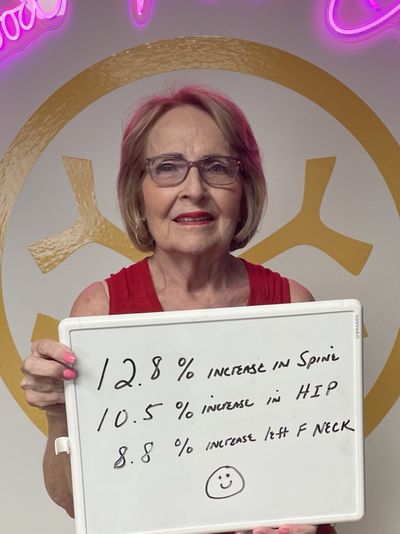
Nicole: her spine is no longer osteoporotic
Spine +12.8%, hip +10.5%, femoral neck +8.8% in 15 months
Nicole came to our Austin center with a fresh osteoporosis diagnosis and a decision to make. She added weekly loading right away and set a follow-up scan as her benchmark.
"To my surprise, I found out that my spine no longer was osteoporotic. I improved my bone density by 12.8%, and my hip had improved by 10.5%, and the femoral neck had improved by 8.8%."
Verbatim from Nicole's on-camera testimonial. Full case study.
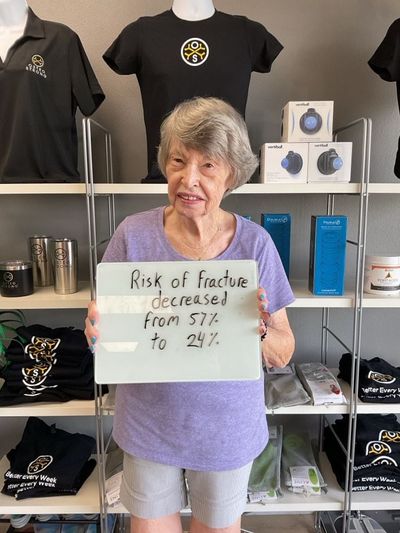
Ruth: FRAX fracture risk from 57% to 24%
10-year fracture risk cut by more than half
Ruth's starting FRAX of 57% sat far above the 20% threshold, squarely in the range where medication is a strong consideration. She added osteogenic loading alongside her physician's plan, and her femoral neck gain pulled the whole calculator down.
"My risk of fracture dropped from 57% to 24%."
Member-initialed DEXA and FRAX summary at OsteoStrong Austin. Full case study.
Neither story tells you what to do about a prescription. Both show what the third column of that table looks like when it starts on day one.
The bottom line
Should you start osteoporosis medication right after diagnosis? If you have fractured, your T-score is well below -2.5, your FRAX is over the threshold, or a secondary cause is at work, the answer from most physicians is yes, and the good questions are about which drug and what the exit plan is. If your numbers are borderline and you have never fractured, a second look measured in weeks is reasonable and most doctors will help you take it. What is never reasonable is a year of passive waiting. Whatever you and your physician decide, the loading signal, the protein, the vitamin D, and the balance work belong in the plan from the first week.
Want help sorting out which column you are in? Book a free Bone Health Roadmap Call, bring your DEXA and your prescription, and we will walk through it with you.
Full case studies referenced in this article
- Nicole: spine no longer osteoporotic, +12.8% spine, +10.5% hip
- Ruth H.: FRAX 10-year fracture risk from 57% to 24%
Browse the full case studies hub or read the verification standard behind every number above.
This article is for general education and is not medical advice. Talk to your own doctor before starting, stopping, or changing any medication, supplement, or exercise program, especially if you have a diagnosis of osteopenia or osteoporosis.
Your simple plan from here
- Book your free Bone Health Call. 15 minutes, phone or Zoom, no pressure.
- Come in for a guided first session. A coach walks you through all four devices.
- Track your strength week after week. 15 minutes, once a week. The numbers rise.
Frequently asked questions
Should I start osteoporosis medication right after diagnosis?
It depends on what drove the diagnosis. If you have already had a fragility fracture, your T-score is well below -2.5, or your FRAX shows a 10-year major fracture risk of 20 percent or more or hip fracture risk of 3 percent or more, physicians usually recommend starting promptly. If your numbers are close to the threshold and you have never fractured, it is reasonable to ask for labs, a FRAX calculation, and a short window to decide. Either way, the decision belongs to you and your physician.
Is it safe to wait a few weeks before starting osteoporosis medication?
Bone remodels in cycles measured in months, so a few weeks spent getting labs, a FRAX score, and your questions answered does not change your trajectory. What does change it is passive waiting: a year of doing nothing while density keeps drifting. The exception is a recent fragility fracture, where physicians treat the next fracture as an urgent risk and usually want to start sooner. Ask your doctor how much time you have to decide well.
What tests should I ask for before starting osteoporosis medication?
Common ones are 25-hydroxyvitamin D, calcium, kidney function, thyroid and parathyroid hormone, and, depending on your history, a celiac screen or other tests for secondary causes of bone loss. Physicians also calculate FRAX from your femoral neck T-score and clinical factors. If your first DEXA was unusual, they may check scan quality or repeat it. These are questions for your physician; they are not a reason to delay indefinitely.
Can I do OsteoStrong while I decide about medication?
Yes, and many members start the same week they are diagnosed. Osteogenic loading delivers the mechanical signal bone adapts to, which no medication supplies, and it works alongside any prescription you and your physician choose later. More than 100 Austin-area physicians refer patients to OsteoStrong, including patients who are on medication and patients who are still deciding.
What if my doctor prescribed Prolia right away?
Prolia (denosumab) is a reasonable first choice in several situations, including when bisphosphonates are not tolerated or kidney function is a concern. The one thing every Prolia patient must know before the first injection: it can never be stopped without a physician's exit plan, because rebound bone loss and multiple vertebral fractures are documented when it is dropped without follow-on therapy. Ask your physician about the long-term plan before you start, not after.
Does starting medication mean I do not need a non-drug plan?
No. Medications work on bone chemistry, slowing removal or stimulating formation. They do not deliver mechanical load, build muscle, or train balance, and most fractures begin with a fall. A complete plan pairs whatever your physician prescribes with loading, protein, vitamin D, and balance work. The four-pillar non-drug plan lays out the pieces that belong in every plan, medication or not.