How long you need to take osteoporosis medication depends on the class. Oral and IV bisphosphonates are commonly reassessed after 3 to 5 years, and many women then take a supervised drug holiday because the drug stays bound in bone. Prolia has no holiday: it continues every 6 months until your physician transitions you to a follow-on medication, because stopping without a plan causes rapid rebound bone loss. The bone builders run a fixed course (Forteo and Tymlos about 2 years, Evenity 12 monthly doses), always followed by an antiresorptive to protect the gains. Hormone therapy has no fixed end date and protects bone only while you take it. Whatever the duration, the goal is a plan that keeps building bone after the prescription ends, which is where osteogenic loading at OsteoStrong fits.
How long do you take osteoporosis medication? It depends on the bottle
You were handed a prescription and a start date. Nobody mentioned an end date. So you are left wondering whether this is a two-year project or the rest of your life, and whether "the rest of your life" is even what your doctor intended.
It is a fair question, and the answer is different for every class of osteoporosis medication. For the tour of what each drug does, read our plain-English guide to osteoporosis medications. This article covers one thing only: duration. How long each class is typically taken, why, what happens when it stops, and what "done" should look like.
Two ground rules. First, nothing here is a recommendation to start, stop, or change a prescription. That decision belongs to you and your physician. Second, "how long do you take it" and "how long is your bone plan" are two different questions with two different answers, and the second one is the one that protects you.
How long do you take bisphosphonates?
Alendronate (Fosamax), risedronate (Actonel), ibandronate (Boniva), and the yearly infusion zoledronic acid (Reclast) share one unusual property: they bind into bone and keep working for a while after you stop. That is why bisphosphonates are the one class with a built-in pause.
Many physicians reassess after 3 to 5 years. The reassessment looks at your fracture history, your current T-score, your FRAX score, and how you have tolerated the drug. Two things drive the timing:
- Diminishing returns. Most of a bisphosphonate's density gain shows up in the first few years. After that, the curve flattens.
- Rare long-term risks. Osteonecrosis of the jaw and atypical femoral fracture are uncommon, but their risk rises with years of use. A pause lowers the exposure.
If your risk is now lower, your physician may suggest a drug holiday: a planned, supervised break with a scheduled re-scan, often after a year or two, to decide whether to resume. If your risk is still high (a prior hip or spine fracture, a very low T-score), your physician may keep you on it longer or move you to something else. Either way, "holiday" is the right word. It has a start date, a check-in date, and a physician watching it. It is not the same as quietly running out of refills. We go deeper on this family in Fosamax and other bisphosphonates: are they worth the risk?
Prolia: why there is no drug holiday
Denosumab (Prolia) is the exception that every patient on it needs to understand. It is an injection every 6 months, and unlike bisphosphonates, it does not stay in bone. When it wears off, the cells that remove bone come back fast, and rapid rebound bone loss with multiple vertebral fractures has been documented in women who stopped without a follow-on medication.
So the honest answer to "how long do you take Prolia" is: until you and your physician have a transition plan, and then you follow it. That plan is usually a bisphosphonate, started on a schedule timed to when the next Prolia dose would have been due. It might be after several years, or it might be longer. What it is never is a lapse.
Three practical rules if you are on Prolia:
- Put the next injection on the calendar before you leave the office. A late dose is not a small thing.
- Do not let a move, an insurance change, or a scheduling problem become an unplanned stop. Call your prescriber the week you see a gap coming.
- Prolia is never stopped without a physician's exit plan. If a different provider suggests otherwise, ask them to coordinate with your prescriber first.
Forteo, Tymlos, and Evenity: a fixed course, then a follow-on
The bone builders are the only medications with a hard stop written into the plan. Teriparatide (Forteo) and abaloparatide (Tymlos) are daily self-injections for a course of about 2 years. Romosozumab (Evenity) is 12 monthly injections. They stimulate the cells that build bone, and they are usually reserved for higher-risk situations: a very low T-score, a fracture on other therapy, or a high FRAX.
Here is the part that surprises people. When the course ends, the new bone is not locked in on its own. Physicians almost always follow an anabolic with an antiresorptive (a bisphosphonate or Prolia) to protect the gains. So the real timeline for an anabolic is "about 2 years of building, then a chapter of protecting," and that second chapter has its own duration rules, described above.
How long can you stay on HRT for bone?
Hormone therapy is FDA-approved for prevention of postmenopausal osteoporosis, and it protects bone for as long as you take it. When it stops, bone loss resumes at roughly the postmenopausal pace. That is the whole duration story in one sentence, and it is why the question of how long to stay on HRT is one of the most individual decisions in bone health.
Older guidance pushed for the shortest possible course. The current view is more nuanced: benefit and risk depend on your age, how many years since menopause, and your breast cancer and clot history, and there is no single stop date that fits everyone. Some women continue for years with regular review; others transition to another approach. We cover the candidates, the history, and the trade-offs in is HRT right for me? For duration, the only rule is that the decision is revisited on a schedule with your physician, not left on autopilot.
What "done" should mean
Here is the trap. A woman finishes 5 years of alendronate, her physician says "let's take a break," and she hears "you're cured." She stops thinking about her bones. Nothing else in her life changes. Two years later the re-scan shows the drift has resumed.
A medication ending is not the plan ending. Osteoporosis is managed for life, and the medication was one chapter. What should never stop:
- A mechanical loading signal. Bone adapts to strain above a threshold (Wolff's law), and as bone gets stronger a fixed load produces less strain, so the stimulus has to keep rising. That is the one input no prescription provides.
- Protein and the raw materials. Calcium, food first, 1,200 mg per day for women 51 and older; vitamin D at the level your physician targets.
- Balance and reaction time. Most fractures start with a fall, and a medication does nothing for fall risk.
- A scheduled re-scan. Follow-up DEXAs are usually 12 to 24 months apart. Put the next one on the calendar the day a medication pauses.
This is the four-pillar non-drug plan that sits underneath every prescription and outlasts all of them. If you want the local version, including how it pairs with your physician's plan, start with our page on drug-free osteoporosis treatment in Austin.
What this looks like at OsteoStrong
A typical bisphosphonate course is 3 to 5 years. That is also the timescale where a non-drug program shows what it does, and it is why we like to show what a fifth year looks like rather than a first.
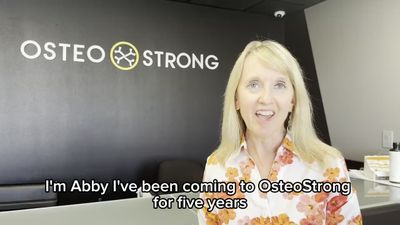
Abby: five years in, and her spine gains kept rising
Spine +4% at her first follow-up DEXA, +11% at her most recent
Abby has been a member of our Austin center for five years. Her first follow-up DEXA showed a 4% spine gain, the point where many people would coast. She kept showing up weekly, and her most recent scan showed the gain had nearly tripled. There was no drop-off after year three, because the loading signal kept rising with her.
"Two years ago I had a 4% increase in my spine, and a couple months ago I had an 11% increase in my spine, so I'm thrilled."
Verbatim from Abby's on-camera testimonial. Full case study.
The mechanism is why the curve does not flatten. Osteogenic loading at our Austin and Georgetown centers loads you in your strongest range of motion at near-maximal force, and the coach beside you progresses that position in very small joint-angle increments, so the strain your bone experiences keeps climbing year after year. A session is about 15 minutes once a week, on four devices, in street clothes, with no impact. Force output is measured every session, so you can see the number move long before your next DEXA, which is how members know their bone training is working.
Among members who follow the weekly protocol and complete a follow-up DEXA, 8 out of 10 see measurable improvement, with consistency and starting point as the biggest factors. Many of them are on one of the medications above while they do it, and more than 100 Austin-area physicians refer patients to us for exactly that reason: the loading runs through every chapter of the medication plan, including the pauses. Some members, after sustained DEXA gains, have revisited their medication with their physician. That conversation belongs to the two of them, with real scan data on the table. What OsteoStrong does is make sure the bone-building signal never has an end date.
The bottom line
How long you take osteoporosis medication depends on the bottle: 3 to 5 years and a supervised holiday for bisphosphonates, an exit plan and never a lapse for Prolia, a fixed course and a follow-on for the bone builders, and an individual, regularly reviewed decision for HRT. Every one of those timelines is a decision for you and your physician. The plan underneath the prescription is the part that should never end, and it is the part you can start this week.
Want to know where osteogenic loading fits in your plan, before or after the prescription ends? Book a free Bone Health Roadmap Call, bring your DEXA and your medication list, and we will walk through it with you.
Full case studies referenced in this article
Browse the full case studies hub or read the verification standard behind every number above.
This article is for general education and is not medical advice. Talk to your own doctor before starting, stopping, or changing any medication, supplement, or exercise program, especially if you have a diagnosis of osteopenia or osteoporosis.
Your simple plan from here
- Book your free Bone Health Call. 15 minutes, phone or Zoom, no pressure.
- Come in for a guided first session. A coach walks you through all four devices.
- Track your strength week after week. 15 minutes, once a week. The numbers rise.
Frequently asked questions
How long do you take osteoporosis medication?
It depends on the class. Oral and IV bisphosphonates are commonly reassessed after 3 to 5 years, and many women then take a supervised drug holiday. Prolia continues every 6 months until your physician transitions you to a follow-on medication. Forteo and Tymlos run about 2 years and Evenity 12 monthly doses, each followed by an antiresorptive. Hormone therapy has no fixed end date. Every duration decision belongs to you and your physician.
What is a bisphosphonate drug holiday?
A drug holiday is a planned, physician-supervised pause after several years of bisphosphonate use. Because the drug binds into bone and keeps working for a while after you stop, physicians can often pause it to lower the long-term risk of rare side effects without losing protection right away. Your physician decides whether you qualify based on your fracture history, T-score, and FRAX, and sets a date to re-scan and reassess.
Can you stop Prolia after a few years?
Not without a plan. Denosumab (Prolia) does not stay in bone after the injections stop, and rapid rebound bone loss with multiple vertebral fractures has been documented when it ends without a follow-on medication. There is no drug holiday for Prolia. If you and your physician decide it is time to move on, the standard approach is a transition to another medication, usually a bisphosphonate, timed before the next dose would have been due.
How long do you take Forteo or Tymlos?
Teriparatide (Forteo) and abaloparatide (Tymlos) are prescribed for a course of about 2 years. They stimulate the cells that build new bone, and when the course ends that new bone needs protecting, so physicians almost always follow with an antiresorptive such as a bisphosphonate or Prolia. Romosozumab (Evenity) follows the same pattern over 12 monthly doses. The follow-on step is part of the plan from day one.
Do you have to take osteoporosis medication for life?
Usually not in one unbroken stretch, but osteoporosis itself is managed for life. Bisphosphonates are commonly paused after 3 to 5 years. Anabolics are a fixed course. Prolia continues until a transition is planned. What should never end is the plan around the prescription: mechanical loading, protein, vitamin D, balance work, and follow-up DEXA scans. That is the part that keeps bone after a medication stops.
What happens to your bones after you stop osteoporosis medication?
It depends on the drug. After a bisphosphonate, protection fades gradually because the drug stays bound in bone. After Prolia without a follow-on, bone turnover rebounds quickly and loss can be rapid. After an anabolic without a follow-on, some of the new bone is lost. After hormone therapy, bone loss resumes at roughly the postmenopausal pace. In every case, a non-drug plan that keeps the bone-building signal going matters more once the prescription ends.