Osteoporosis treatment options are usually presented as a choice between medication and exercise and diet, but they work on three different pathways. Medication changes bone chemistry: it slows the cells that remove bone or stimulates the cells that build it. Exercise only builds bone when it loads the skeleton above roughly 4.2 times body weight, a threshold walking and ordinary workouts do not reach. Diet supplies calcium, vitamin D, and protein, the raw materials, but cannot build bone without a loading signal. The strongest plan uses all three: a physician-directed medication decision, a loading stimulus that reaches the threshold, and the nutrition to use it, which is where osteogenic loading at OsteoStrong fits.
The either/or question, and why it is the wrong shape
You came home from the appointment with two competing voices. One says "start the medication." The other says "you can fix this with weights and calcium." Framing osteoporosis treatment options as medication versus exercise and diet feels natural, because that is how they were presented to you. It is also the wrong shape for the question.
Bone is built by three inputs that do not substitute for each other: a chemical environment that favors building over removal, a mechanical signal that tells bone where strength is needed, and the raw materials to do the construction. Medication works on the first. Loading works on the second. Diet works on the third. Pull any one out and the others get less effective.
If you want every approach ranked column by column, our post comparing osteoporosis treatments does that. If you already know you want the non-drug side built out, our four-pillar plan for osteoporosis treatment without medication is the practical version. This article explains why the three pathways are different, so you stop treating them as rivals.
What medication does: chemistry
Your skeleton is a construction site with two crews. Osteoclasts remove old bone; osteoblasts lay down new bone. After menopause, falling estrogen lets the removal crew outwork the builders, and density drifts down year after year.
Every osteoporosis medication adjusts that balance chemically:
- Antiresorptives (alendronate, risedronate, zoledronic acid, denosumab, raloxifene) slow the removal crew. Density holds or rises modestly as remodeling spaces fill in.
- Anabolics (teriparatide, abaloparatide, romosozumab) stimulate the building crew for a fixed course of about one to two years, then hand off to an antiresorptive.
- Hormone therapy restores some of the estrogen signal that kept removal in check, for the right candidate.
These are powerful tools. In clinical trials they reduce fracture rates, and for a woman with a prior fragility fracture, a T-score well below -2.5, or a FRAX score above the U.S. thresholds (20% for major osteoporotic fracture, 3% for hip), a physician's recommendation to start one is usually a sound one. Whether you take it is your decision with that physician. One rule applies no matter what: Prolia must never be stopped without a physician exit plan, because rebound bone loss is well documented.
What medication does not do is tell your skeleton where to put the bone. Chemistry has no address. That instruction comes from load.
What exercise does: the mechanical signal
Bone is living tissue that responds to strain. Wolff's law describes it: bone adapts to the forces placed on it. Frost's mechanostat refines it: bone adapts only when strain crosses a threshold, and as bone gets stronger, the same load produces less strain, so the stimulus has to keep rising or adaptation stops.
The research puts that threshold at roughly 4.2 times body weight (Deere et al., 2012, measuring hip bone in adolescents, a figure the osteogenic loading literature has adopted). That number is the whole story of why most exercise does not build bone.
Why walking and ordinary exercise rarely reach the threshold
Walking loads your skeleton at about one to one and a half times body weight per step. Swimming and cycling load it less. Light dumbbells, resistance bands, yoga, and Pilates build muscle, posture, and balance, all of which matter, but the strain they put on the femoral neck and spine sits well under the line. Your bones adapted to those loads years ago, which is why a woman who walks four miles a day can still watch her DEXA slide. We wrote about that pattern in does walking build bone.
Heavy barbell training can cross the line, and for people who can safely learn the lifts and tolerate the load, it is a legitimate path. Its limit is built into the tool: a barbell is capped by the weakest point in the range of motion, so the load you can move through a full squat is far less than the load your hips could handle at their strongest angle.
How osteogenic loading reaches it safely
Osteogenic loading solves that by positioning you in your strongest range of motion and having you produce force against a device rather than lifting a weight. Nothing to drop, no impact, and the load can be progressed in very small joint-angle increments so the strain keeps crossing the threshold week after week. Hunte et al., writing in the Journal of Osteoporosis, measured 14.9% hip and 16.6% spine density gains over about 30 months in postmenopausal women using this approach.
What diet does: raw materials
You cannot build a wall without bricks, and you cannot build bone without calcium, phosphorus, protein, vitamin D to absorb the calcium, and magnesium and vitamin K to help place it. The NIH Office of Dietary Supplements sets the calcium target at 1,200 mg per day for women 51 and older, food first, and vitamin D at 600 IU to age 70 and 800 IU after, with a tolerable upper limit of 4,000 IU. Many physicians target a 25-hydroxyvitamin D blood level of at least 30 ng/mL. Protein deserves more attention than it gets; our post on how much protein you need to build bone covers it.
Can diet alone treat osteoporosis?
No, and the reason is the same one that limits walking. A pile of bricks on a job site does not become a wall until someone decides where it goes. Calcium and vitamin D prevent the losses that come from deficiency, and they make loading work better, but without a strain signal the body has no reason to lay new bone down. That is why calcium supplements alone have such an unimpressive record for building density, and why the raw-material pathway is the third leg of the plan rather than the plan itself.
Three pathways at a glance
| Pathway | What it changes | What it cannot do | Where it fits |
|---|---|---|---|
| Medication | Bone chemistry: slows removal or stimulates building | Cannot tell bone where to grow; cannot train balance | Physician-directed, based on T-score, FRAX, and fracture history |
| Loading (osteogenic) | The mechanical signal that triggers adaptation above roughly 4.2 times body weight | Cannot alter chemistry; cannot replace a prescription your physician judges necessary | Weekly, alongside any medication or none |
| Ordinary exercise | Muscle, balance, heart, mood | Cannot reach the bone-building threshold | Daily life, fall prevention |
| Diet and supplements | Raw materials for construction | Cannot build bone without a loading signal | Every day, food first |
What this looks like at OsteoStrong
At our Austin and Georgetown centers, the loading pathway takes about 15 minutes once a week. You work through four devices in street clothes with a coach beside you the whole time, producing force from your strongest position while the device measures your output. That number climbs week over week, which is how you know the signal is landing long before your next DEXA. Our session protocols are reviewed on an ongoing basis with the physicians who refer to us, and more than 100 Austin-area physicians do. Their patients keep taking what they were prescribed, and they keep eating well. We are the mechanical leg of the plan, not a replacement for the other two.
Among members who follow the weekly protocol and complete a follow-up DEXA, performed by independent imaging providers rather than by us, 8 out of 10 see measurable improvement. Consistency and starting point are the biggest factors. Nicole is one of them.
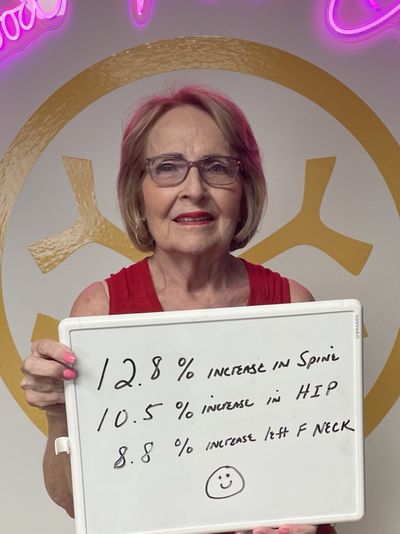
Nicole: her spine is no longer osteoporotic
Spine +12.8%, hip +10.5%, femoral neck +8.8% in 15 months
Nicole came in with an osteoporosis diagnosis and a medication conversation already on the table with her physician. She wanted a way to measure whether anything she did was working, so she added the loading pathway and asked for a follow-up DEXA at 15 months.
"To my surprise, I found out that my spine no longer was osteoporotic. I improved my bone density by 12.8%, and my hip had improved by 10.5%, and the femoral neck had improved by 8.8%."
Verbatim from Nicole's on-camera testimonial. Full case study.
How to combine osteoporosis treatment options
Think of it as three decisions, each with its own owner:
- The chemistry decision belongs to you and your physician. Bring your DEXA, your FRAX, and your fracture history, and ask what any proposed medication is expected to do to your T-score and by when, so your next scan has a benchmark.
- The signal decision is yours to start this week. Pick a loading method that reaches the threshold safely for your body, and be consistent, because bone remodels over months and follow-up DEXAs are usually 12 to 24 months apart.
- The materials decision is daily. Protein at each meal, calcium from food, vitamin D checked and corrected, alcohol moderate.
Add balance training and you have covered the fall as well as the bone; roughly 1 in 3 adults over 65 falls each year, according to the CDC, and no medication changes that number. Our page on drug-free osteoporosis treatment in Austin shows how the pieces sit together.
The bottom line
Medication versus exercise and diet is a false choice, because the three work on different pathways: chemistry, signal, and materials. Medication can slow removal or stimulate building but cannot tell bone where to grow. Exercise builds bone only when the load crosses roughly 4.2 times body weight, which walking and ordinary workouts do not. Diet supplies what construction needs but cannot start it. Decide the medication question with your physician, then make sure the other two legs are never blank.
Want to know where osteogenic loading fits in your plan? Book a free Bone Health Roadmap Call, bring your DEXA, and we will walk through it with you.
Full case studies referenced in this article
Browse the full case studies hub or read the verification standard behind every number above.
This article is for general education and is not medical advice. Talk to your own doctor before starting, stopping, or changing any medication, supplement, or exercise program, especially if you have a diagnosis of osteopenia or osteoporosis.
Your simple plan from here
- Book your free Bone Health Call. 15 minutes, phone or Zoom, no pressure.
- Come in for a guided first session. A coach walks you through all four devices.
- Track your strength week after week. 15 minutes, once a week. The numbers rise.
Frequently asked questions
Which osteoporosis treatment options work best: medication or exercise?
They are not competing osteoporosis treatment options; they act on different pathways. Medication changes bone chemistry, slowing the cells that remove bone or stimulating the cells that build it. Loading delivers the mechanical strain that tells bone where strength is needed, and only loads near roughly 4.2 times body weight reach that threshold. Physicians in Austin routinely pair the two. Whether you need medication at all is a decision for you and your physician based on your T-score, FRAX, and fracture history.
Can you treat osteoporosis with diet and exercise alone?
Diet and ordinary exercise alone rarely build bone, because food supplies raw materials without a signal to use them and walking or light weights load bone well below the threshold it responds to. A non-drug plan can work when it includes loading that reaches that threshold, adequate protein, vitamin D and calcium, and balance training, and when your fracture risk is low enough that your physician agrees to monitor rather than prescribe. That call belongs to you and your physician.
Does walking help osteoporosis?
Walking is excellent for your heart, mood, and general fitness, and it helps maintain bone rather than build it. Each step loads the skeleton at roughly one to one and a half times body weight, far below the load associated with new bone formation. Keep walking for the reasons that matter, and add a loading stimulus that actually reaches the threshold. Our post on whether walking builds bone explains the adaptation trap.
What exercise builds bone the most?
The exercise that produces the highest safe strain on bone. Heavy supervised barbell training can do it for people who can tolerate the load and learn the technique. Osteogenic loading reaches multiples of body weight in a coached position with no impact, in about 15 minutes a week, which is why it suits women over 50 with an existing diagnosis. Among OsteoStrong members who follow the weekly protocol and complete a follow-up DEXA, 8 out of 10 see measurable improvement.
What should I eat for osteoporosis?
Protein at every meal, calcium from food toward the NIH target of 1,200 mg per day for women 51 and older, and enough vitamin D (600 IU to age 70, 800 IU after, with an upper limit of 4,000 IU) to keep your blood level where your physician wants it. Dairy, leafy greens, canned fish with bones, beans, and fortified foods cover most of it. Food supplies the materials; a loading signal decides whether they become bone.
Do I still need medication if I do osteogenic loading?
That depends on your fracture risk, and the answer comes from your physician, not from us. Osteogenic loading works alongside every osteoporosis medication because it delivers a mechanical signal rather than a chemical one; more than 100 Austin-area physicians refer patients to OsteoStrong while those patients stay on their prescriptions. If you take Prolia, never let it lapse without a physician exit plan, because rebound bone loss is well documented.