To help a family member choose the right osteoporosis treatment, start by asking what role she wants you to play, then learn enough to be useful: how to read her DEXA (T-scores by site, FRAX percentage), which questions to bring to the appointment, and what each treatment option does and does not do. The medication decision belongs to her and her physician; your leverage is in making sure it is informed, in handling logistics like rides and fall-proofing, and in making sure the non-drug side of the plan (loading, protein, vitamin D, balance) actually starts. At OsteoStrong Austin and Georgetown, family members are welcome at the Roadmap call and in the room during sessions.
The phone call after the appointment
It rarely comes as a clear report. It comes as "the doctor says my bones are thin" or "she wants me to start some injection," followed by a change of subject. You hang up with more questions than she had answers, and a familiar tension: you want to help, and you do not want to become the adult child who takes over.
This guide is for you, the daughter, son, or spouse trying to help a family member choose the right osteoporosis treatment. If you are the one with the diagnosis, our day-after roadmap is written for you. If the diagnosis has made you wonder about your own bones, should family members get tested answers that.
How do you help a family member choose osteoporosis treatment without taking over?
Before you research anything, ask one question: "How do you want me to help with this?"
Some parents want a researcher who reads everything and summarizes. Some want a second set of ears at the appointment. Some want a driver and nothing else. Some want to think out loud with someone who will not panic. Asking first turns you from an intruder into an invited guest, and it sets the tone for every decision that follows: hers, with your help.
One more thing to settle early. Osteoporosis is a diagnosis, not a decline in competence. A T-score says nothing about judgment. Treat her as the decision-maker she is.
How to read a parent's DEXA report
Ask her for the DEXA report (she is entitled to it) and look for three things.
T-scores by site. The report lists the lumbar spine, total hip, and femoral neck. The World Health Organization thresholds are: above -1.0 normal, -1.0 to -2.5 osteopenia, -2.5 and below osteoporosis. The lowest site drives the diagnosis, which is why a normal spine and an osteoporotic hip still reads as osteoporosis.
FRAX. Many reports include a 10-year fracture probability. In U.S. practice, treatment is generally considered at 20% for major osteoporotic fracture or 3% for hip fracture (Bone Health & Osteoporosis Foundation guidance). FRAX also counts a parental hip fracture, so if her mother broke a hip, make sure the physician knows.
Fracture history and height. A prior fracture from a fall at standing height changes the picture more than any single T-score. So does height loss, which can signal unnoticed vertebral compression.
Our post on understanding your DEXA T-score explains the numbers in more depth, and the free DEXA report guide walks through a sample report line by line.
What questions should you ask at her appointment?
Physicians work inside short appointments. A written list makes the visit better for everyone. The essentials:
- Which site is driving the diagnosis, and what is her FRAX?
- Should we check labs for secondary causes (vitamin D, thyroid, parathyroid, celiac, kidney function)?
- If medication is recommended: what is it expected to do to her numbers, by when, and what is the plan for how long she takes it?
- Which side effects would you want a call about immediately?
- How will we measure whether it is working, and when is the next DEXA?
- Does adding a mechanical loading program change your plan?
- Which of her current medications raise fall risk (dizziness, drowsiness, blood pressure drops)?
Our full checklist of questions to ask your doctor about osteoporosis treatment groups these by theme and is built to print and bring. So is the Top 10 Questions guide.
Weighing medication with her, not for her
This is where well-meaning family members most often overstep, in either direction: pushing a parent onto a drug she is afraid of, or talking her out of one her physician had good reason to recommend. Neither is your call. The decision belongs to her and her physician; your job is to make sure she understands the trade-offs.
What the options do:
- Antiresorptives (bisphosphonates such as alendronate; denosumab, sold as Prolia) slow the removal of old bone. Generic alendronate is inexpensive; Prolia is a brand-name biologic whose list price runs into the thousands per year before insurance, so check her plan. Bisphosphonates are often reassessed after 3 to 5 years. Prolia is given every six months and must never simply stop: rebound bone loss and multiple vertebral fractures are documented when it is discontinued without follow-on therapy, so any exit needs a physician's plan.
- Anabolics (Forteo, Tymlos, Evenity) build new bone over a defined course, usually reserved for higher-risk cases, and are followed by an antiresorptive.
- Hormone therapy is FDA-approved for prevention of postmenopausal osteoporosis; its benefit-risk is individual.
- Osteogenic loading delivers the mechanical signal none of the above provide. Bone adapts to load above roughly 4.2 times body weight, a threshold walking and ordinary exercise do not reach. It works alongside any of the medications, on a different pathway.
For the plain-English version of each class, read our guide to osteoporosis medications. For every option compared side by side, including the local specialists who treat osteoporosis, see osteoporosis treatment options in Austin.
Phrases that keep you on the right side of the line
- "Would it help if I read up on this and gave you a one-page summary?"
- "Can I come to the appointment and take notes so you can just listen?"
- "What did the doctor say this medication is supposed to do to your numbers?"
- "Whatever you decide about the prescription, can we get the other half of the plan going now?"
And a few to avoid: "You have to take it." "Don't take that, I read about it." "Let me handle this." The first two substitute your judgment for her physician's; the third substitutes it for hers.
Fall-proofing, rides, and the logistics nobody plans for
Family members are uniquely good at the practical side, which is where fractures are actually prevented. Most fractures start with a fall, and the CDC reports about 1 in 3 adults over 65 falls each year.
The house. Night-lights from bed to bathroom. Loose rugs and cords gone. Grab bars in the shower and by the toilet. Rails on both sides of the stairs. Grip-soled shoes instead of slippers. Everyday items moved out of overhead cupboards. Our fall prevention and balance training in Austin page covers the training side.
The rides. A weekly plan only works if she can get there. If she no longer drives in traffic, put the session on your calendar too, or set up a rotation with siblings. Jane, an Austin member, drives an hour and a half each way from Temple every week; most families can solve a 20-minute ride.
The calendar. Oral bisphosphonates have strict weekly rules. Prolia has a six-month appointment that must not slip. DEXA follow-ups run every 12 to 24 months. A shared calendar with alerts is one of the most valuable things you can set up.
What this looks like at OsteoStrong
Sessions are about 15 minutes once a week: four devices, a coach beside her the whole time, street clothes, no impact. Force output is measured every session, so you both see the trend long before the next scan. Family members are welcome to sit in. Among members who follow the weekly protocol and complete a follow-up DEXA, 8 out of 10 see measurable improvement; consistency and starting point are the two biggest factors. More than 100 Austin-area physicians refer patients to OsteoStrong, and our session protocols are reviewed on an ongoing basis with them.
Two Austin families show what it looks like.

Claudia and her spouse: recovering from a heart transplant, together
Stronger and more capable about a year after her transplant, in her own words and her spouse's
Claudia received a heart transplant in 2024. Prednisone, one of her anti-rejection medications, is known to cost bone, so she came to OsteoStrong to rebuild what the medication was taking. About a year in, she describes herself as stronger and more capable than before the transplant.
Her spouse recorded a separate testimonial from the caregiver's side: the transplant came with a lot of very strong medication that weakens bone, and watching her come in week after week, get stronger, and take on more has been remarkable, the kind of thing worth recommending to anyone recovering from something serious.
Paraphrased from Claudia's on-camera testimonial and her spouse's caregiver testimonial.
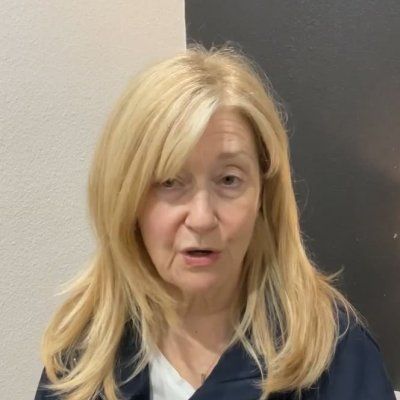
Virginia: from a wheelchair to standing straight
Four years in a wheelchair with a T-score of -4; now walking unassisted and standing straight
If the family member you are helping is in her 70s or 80s and someone has said it is too late, share Virginia's story. Her baseline was about as low as a DEXA reads.
"Two years ago I had a negative four DEXA. I was in a wheelchair for four years. Today I'm standing up straight."
Verbatim from Virginia's on-camera testimonial. Full case study.
For the later-in-life decision, read is it too late to treat osteoporosis at 75.
Do not forget your own bones
If the person you are helping is your parent, her diagnosis is information about you. Bone density is substantially inherited, and her hip fracture, if she has had one, is an input to your own FRAX. Ask your own physician about a baseline, and consider starting the same plan you are building for her. Some of the most consistent members at our Austin and Georgetown centers come in as mother-daughter pairs, and the daughter often books first.
The bottom line
Helping a family member choose osteoporosis treatment is less about picking the treatment and more about making sure the choice is informed, the logistics work, and the non-drug half of the plan starts now. Read the DEXA, bring the questions, respect that the prescription decision is hers and her physician's, fall-proof the house, and handle the calendar. Then take care of your own bones too.
Want to walk through her DEXA together? Book a free Bone Health Roadmap Call, bring her report and your questions, and we will go through it with both of you.
Full case studies referenced in this article
- Virginia: DEXA T-score -4, four years in a wheelchair, now walking unassisted
- Claudia and her spouse: video testimonials only, on the results page
Browse the full case studies hub or read the verification standard behind every story above.
This article is for general education and is not medical advice. Talk to your own doctor before starting, stopping, or changing any medication, supplement, or exercise program, especially if you have a diagnosis of osteopenia or osteoporosis.
Your simple plan from here
- Book your free Bone Health Call. 15 minutes, phone or Zoom, no pressure.
- Come in for a guided first session. A coach walks you through all four devices.
- Track your strength week after week. 15 minutes, once a week. The numbers rise.
Frequently asked questions
How can I help a family member choose osteoporosis treatment without taking over?
Ask what role she wants you to play before you play it: researcher, note-taker at the appointment, driver, or simply someone to think out loud with. Bring information, not conclusions. Frame options as questions for her physician rather than verdicts. The decision about medication belongs to her and her doctor; your job is to make sure it is an informed one and that the non-drug side of the plan (loading, protein, vitamin D, balance, fall-proofing) actually happens.
How do I read my mother's DEXA report?
Look for the T-score at each site: spine, total hip, and femoral neck. A T-score above -1.0 is normal, -1.0 to -2.5 is osteopenia, and -2.5 or below is osteoporosis (WHO). The lowest site usually drives the diagnosis and the treatment recommendation. Then look for a FRAX percentage: a 10-year major fracture risk of 20% or a hip fracture risk of 3% is where U.S. guidance says treatment is generally considered. Our free DEXA report guide walks through a sample report line by line.
Should my parent take osteoporosis medication or try exercise first?
That is a decision for your parent and her physician, and the answer depends on her T-score, FRAX, fracture history, and other conditions. Medication and mechanical loading work on different pathways: drugs on bone chemistry, loading on the signal that tells bone to adapt. Many physicians recommend both. What you can do is make sure the question is asked directly, and that whichever way it goes, the non-drug plan starts now rather than later.
What questions should I ask at my parent's osteoporosis appointment?
Which site is driving the diagnosis? What is her FRAX score? Are there secondary causes worth checking with labs? If medication is recommended, what is it expected to do to her numbers, by when, and what is the exit plan? What side effects warrant an immediate call? How will we measure whether it is working? And does adding a mechanical loading program change the plan? Bring the DEXA report and a notebook.
How do I fall-proof my parent's home?
Start with lighting (night-lights from bed to bathroom), floors (remove loose rugs and cords), bathrooms (grab bars, non-slip mat), stairs (rails on both sides), and shoes (grip soles instead of socks or slippers on hard floors). Move everyday items out of overhead cupboards. Ask her physician to review medications that cause dizziness. Then work on the person, not only the house: leg strength, reaction time, and balance are trainable at any age.
Should caregivers get their own bone density tested?
Yes, especially if the person you are caring for is your parent. Bone density is substantially inherited, and a parent's hip fracture is a direct input to your own FRAX score. The USPSTF recommends DEXA screening for all women at 65 and earlier with risk factors, which family history is. Ask your own physician about a baseline, and start the same non-drug plan you are helping your parent build. Read our post on family history and testing.